
New genuine turbo
AED 5,300 to 9,500Compare the correct part number, supplier, availability and written coverage. A new part does not remove the need to diagnose why the original turbo failed.
Losing power, blue or black smoke, a whistle that grows louder or limp mode on a loaded van? We test boost pressure and the turbo itself before replacing anything, then fit a new, rebuilt or tested used turbo using the specified installation procedure and addressing the confirmed cause of failure.
Caddy turbo replacement guide AED 2,800–9,500 fitted. Indicative Dubai budget. New, rebuilt and used options priced side by side on one written quote.
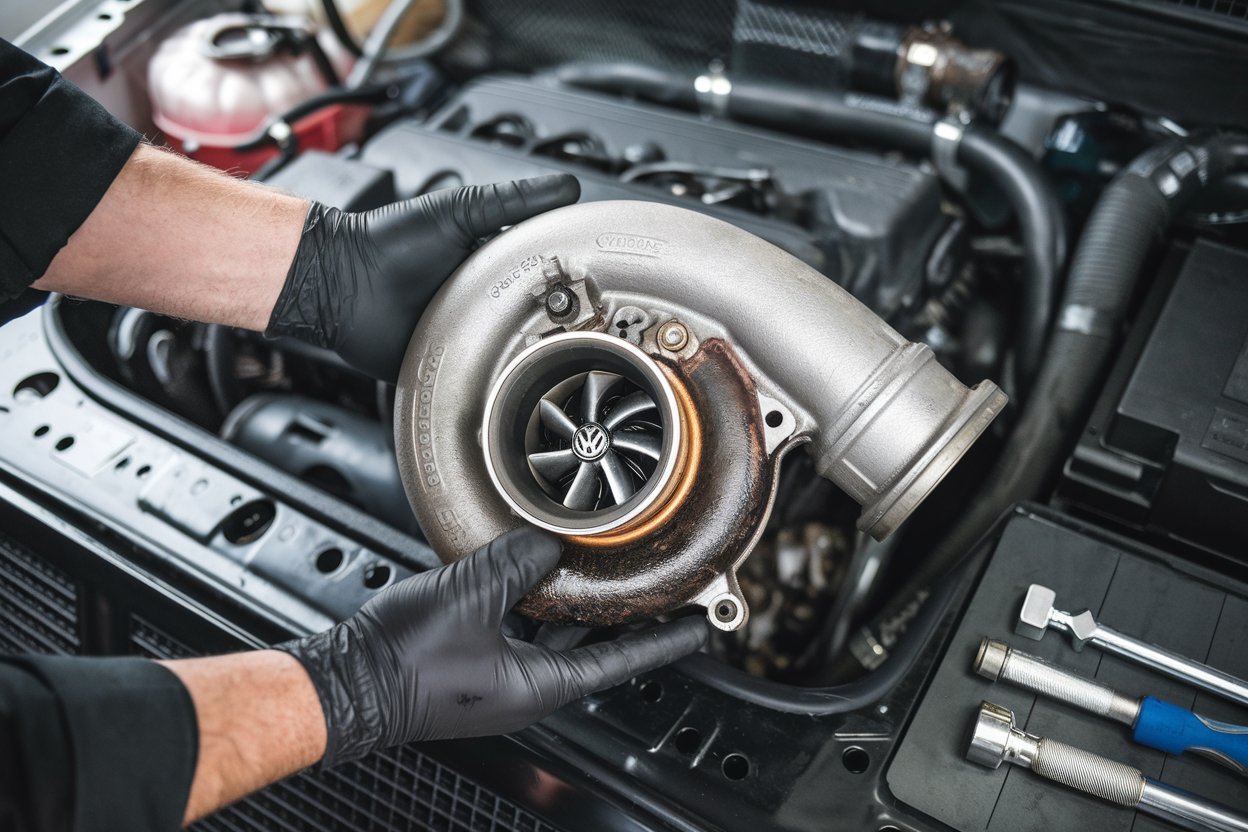
A VW Caddy turbo replacement in Dubai costs about AED 2,800 to 9,500 fitted, depending on whether you choose a used, rebuilt or new genuine turbo. Volkswagen Repair Dubai in Al Quoz 4 uses boost data, intake/control checks and a suitable mechanical inspection to establish the fault first, because boost leaks and control faults often mimic a failed turbo.
Compare used, rebuilt and new turbo fitted totals. Each guide already includes an AED 800–1,500 fitting allowance; do not add that labour again. The correct turbo, access and any related repairs determine the written quote.
Compare the correct part number, supplier, availability and written coverage. A new part does not remove the need to diagnose why the original turbo failed.
Ask for the documented rebuild scope, balancing and actuator checks, supplier coverage and exchange/core conditions. Do not assume every rebuilt unit contains a new cartridge.
Availability and supplier terms are confirmed for the actual unit. Compare compatibility, documented condition checks and provenance; a used unit is not assumed to have a known remaining life or guaranteed mileage.
These are fitted guides, not fixed offers; do not add the fitting allowance again. The quote confirms gaskets, oil-feed/return parts, oil and filter, priming, testing and VAT treatment. Initial diagnosis, actuator work, necessary contamination cleaning, exhaust/DPF damage or engine repairs are separate unless included. Unsafe oil or debris contamination must be resolved before restarting. No extra work proceeds without approval.
A boost complaint does not prove the turbo needs replacing. Intake leaks, control faults, fuel or exhaust restrictions can look similar; these checks help separate them.
| What you notice | Findings that need investigation | Common look alike we rule out |
|---|---|---|
| Power loss or limp mode | Compare specified/actual boost with air supply, control operation and exhaust checks; low boost alone is not proof | Split intercooler hose, boost pipe clamp, stuck vanes or a faulty control solenoid |
| Whistle or siren noise | Inspect for wheel contact, damage and abnormal noise using the turbo-specific procedure | Small boost leak at a hose joint or a cracked intake pipe |
| Blue or grey smoke | Assess oil quantity, consumption, drain and breather condition; a light oil film alone does not prove seal failure | Worn valve stem seals, PCV fault or overfilled engine oil |
| Black smoke on a TDI | Turbo not delivering enough air for the fuel injected | Leaking injector, dirty mass air flow sensor or EGR fault |
| Oil use between services | Investigate abnormal oil accumulation with supply, return, breather and engine-condition checks | External oil leaks or worn piston rings |
Diagnosis can include specified/actual boost data, a controlled intake-leak test and actuator/control checks. A mechanical inspection follows the turbo-specific limits: some radial movement in an unpressurised journal bearing can be normal. Severe smoke, abnormal noise or oil loss rules out a loaded road test until assessed. Wider service options are covered on our Volkswagen turbo replacement page.
TDI diesel and TSI petrol versions are turbocharged. The 1.6 MPI petrol has no turbo. Confirm the fitted engine before investigating a boost fault or ordering a replacement unit.
Found across different Caddy years and markets. The turbo and its control arrangement depend on the actual engine and part revision.
Check boost behaviour and the relevant vacuum, actuator or vane operation. An external control fault can resemble turbo failure.
TSI versions use a turbo, but the turbo number and control system must match the engine. A generation badge alone is not enough to select the part.
Assess intake leaks and boost control. A boost-related fault code does not establish mechanical turbo damage.
If this Caddy loses power, start with the engine complaint. Ignition, fuel delivery or throttle faults need a different assessment.
Explore Caddy problems and symptoms or tell us what the van is doing.
Tell us the year and symptoms if known. We can identify the fitted engine at inspection. Engine and turbo numbers help confirm compatibility before parts are ordered.
Confirm the fault, assess its cause and agree the repair scope. Parts availability, contamination or related damage can extend the work.
Assess fault codes, boost data, intake leaks and control operation. Mechanical checks follow the limits for the fitted turbo; no single reading proves failure.
Oil level, oil feed pipe, breather and intake condition checked so the new turbo is protected.
Use required new gaskets, seals and fixings. Inspect the oil feed and return; renew lines where the installation procedure requires it or their condition is unsuitable.
Fresh oil and filter, oil primed before first start, oil soaked pipes cleaned.
Check lubrication, leaks and control operation before a safe test drive. Recheck the original complaint and boost behaviour under suitable conditions.
Oil supply, contamination, boost control and operating conditions all matter. Dubai heat or high mileage alone does not explain a failure. The cause needs assessing so the same fault does not damage the replacement.
Low oil, unsuitable oil or restrictions in the feed or return need investigation. Lubrication problems can damage the turbo’s bearings.
Oil level and condition, feed and return lines, and the specified oil and filter.
High operating temperatures and unsuitable lubrication can contribute to deposits and damage. Cooling arrangements vary by engine.
Service history and engine-specific lubrication, cooling and installation requirements.
A split hose or control fault can cause poor boost and power loss. These faults may be repairable without changing the complete turbo.
Intake pipework, hose joints, requested versus actual boost, and the fitted control system.
Where variable vanes are fitted, deposits can interfere with their movement and contribute to overboost or underboost complaints.
Actuator travel and vane operation where applicable. A long drive is not a repair for a stuck mechanism.
Stop safely and call for advice on assistance. Continuing with severe oil loss or mechanical damage can harm the engine.
Straight answers to what Caddy owners and fleet managers ask us.
Fitted guides are AED 2,800–5,500 for a used unit, AED 3,300–7,000 rebuilt and AED 5,300–9,500 new genuine. The fitting allowance is already counted. The written quote confirms seals, oil-feed parts, oil/filter, testing and VAT; diagnosis, contamination cleaning and related repairs are separate unless included.
TDI versions, including 1.6, 1.9 and 2.0 examples, and TSI petrol engines are turbocharged. The 1.6 MPI petrol fitted to many UAE Caddys has no turbo, so a power loss on that engine points to other faults such as ignition, fuel or the throttle body.
A hose, control-solenoid, vacuum or actuator fault may be repairable without replacing the turbo. A sticking vane mechanism may require specialist assessment. Boost and mechanical checks establish whether external repair, a documented rebuild or replacement is appropriate; symptoms alone are insufficient.
Possible causes include inadequate or contaminated oil, restricted feed/return lines, foreign-object damage, overspeed and control faults. Deposits can affect variable vanes where fitted. Establish and address the actual cause before installation; hot weather or high mileage alone does not prove turbo failure.
Stop if there is heavy smoke, a loud metallic whine or the oil warning comes on. A turbo that is shedding oil or blades can damage the engine. Limp mode with no other symptoms still needs prompt diagnosis.
A straightforward installation may fit within a working day once the correct parts are available. Diagnosis, supplier lead time, seized fixings, contamination or related damage can extend it. We confirm the plan after assessment rather than promise stock or same-day completion.
Follow the turbo supplier and engine-specific installation requirements for seals, feed and return lines. A line may require renewal even when a blockage is not obvious. Oil supply, drainage, specified oil/filter replacement and priming must be addressed before starting.
Send the year, engine and what the van is doing. We discuss the appropriate checks, then provide a written quote after assessment. Model and engine details are helpful if known.