
Hoses and clamps
Rubber hoses harden and crack, and quick connect joints lose their seal. Usually the cheapest fix.
Low coolant warning, a sweet smell, pink crust around the engine or a temperature gauge that climbs in traffic? We pressure test your Passat cooling system at our Al Quoz 4 workshop, find the exact leak and fix only what is leaking, before it turns into an overheated engine.
Repair guides for the listed external leaks run from AED 300 to 2,000. Hoses and thermostats sit at the low end, water pumps at the top. Internal engine repair is a separate, higher-cost job that requires diagnosis.
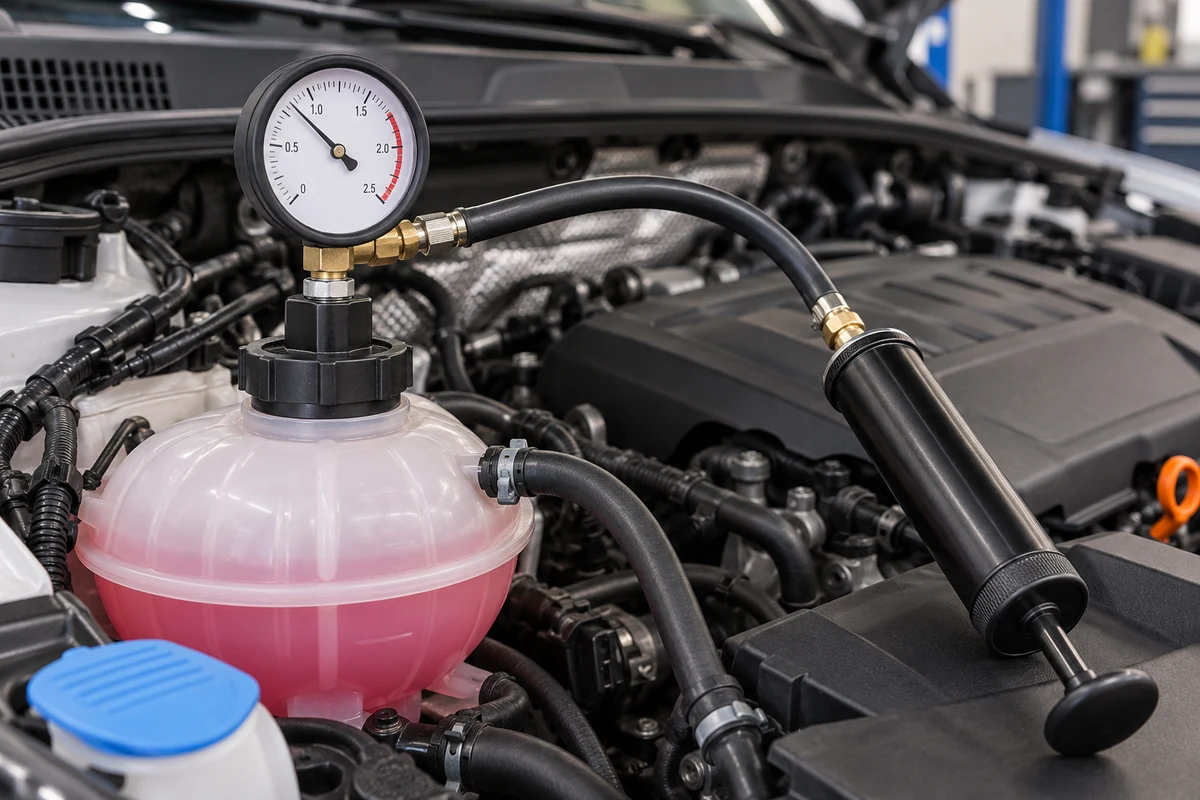
A Passat coolant leak means the cooling system is losing coolant, usually from a hose, the water pump, the thermostat housing or the radiator. Listed external repair guides are AED 300 to 2,000; internal engine work is separate. We pressure test the system to find the exact leak, fix only that part and refill with VW approved coolant.
Indicative guides for different repairs. The complete quote identifies the affected component, parts route, access and fitting, coolant specification and refill, bleeding, final checks, VAT and any diagnostic charge. Combined pump/housing work can differ from a thermostat-only repair.
| Repair | Guide price |
|---|---|
| Coolant hose replacement | AED 300 to 800 |
| Thermostat replacement | AED 300 to 900 |
| Expansion tank replacement | AED 400 to 1,000 |
| Radiator repair or replacement | AED 500 to 1,500 |
| Water pump replacement | AED 800 to 2,000 |
| Head gasket repair | AED 3,000 to 6,000 |
Ask for the complete fitted total. Any separately listed labour must be identified before approval and must not be added again when already included in the agreed repair.
Tell us whether there is an overheating warning and how quickly coolant drops. These optional details help us plan the checks.
What you notice tells us a lot about where the coolant is going and how urgent it is.
| What you notice | Possible sources | Urgency |
|---|---|---|
| Temperature gauge rising or overheating warning | Low coolant from any leak, failed water pump or thermostat | Stop driving |
| White smoke and coolant use with no visible leak | Internal leak, head gasket or EGR cooler on diesels | Stop driving |
| Low coolant light every few days | Water pump seal, thermostat housing or a hose joint | Assess promptly |
| Sweet smell after driving | Coolant dripping on a hot part, often the housing or a hose | Assess promptly |
| Pink or orange puddle under the front | Radiator, lower hose or water pump | Assess promptly |
| Weak heater or a damp passenger footwell | Low coolant or a leaking heater core | Assess promptly |
Never open the coolant cap on a hot engine. If the gauge is in the red, pull over, switch off and call us on 056 464 6081.
These components are useful inspection points. The exact engine and observed leak path determine the checks; coolant can travel away from its source before dripping.
Rubber hoses harden and crack, and quick connect joints lose their seal. Usually the cheapest fix.
Pump seals, housing joints and thermostat assemblies can leak. Their layout and serviceability differ by engine.
Plastic end tanks crack and road debris damages the core. A leaking radiator also cools less in summer.
Cracked tanks and tired caps let coolant escape as steam, often with no puddle at all. A cap is a cheap part to rule out first.
A damp passenger footwell, a misty windscreen or a sweet smell inside the cabin point to the heater core behind the dashboard.
Suspect an internal fault when the evidence supports it. Exhaust vapour, contaminated oil or bubbles alone do not prove a head gasket failure; combine appropriate combustion-gas, pressure and mechanical tests.
Where your Passat leaks depends a lot on its engine. Fitments vary by market and year, so we confirm your engine code from the VIN.
| Passat | Common engines | Components to inspect for this engine |
|---|---|---|
| B6, 2006 to 2010 | 2.0 FSI and TSI, 3.6 VR6 | Thermostat housing, water pump, coolant pipes at the back of the engine, expansion tank |
| B7, 2011 to 2015 | 1.8 TSI, 2.0 TSI, 2.0 TDI on some markets | Water pump and thermostat housing module, hose joints, EGR cooler on diesels |
| US built Passat, 2012 to 2019 | 2.5 five cylinder, 1.8 TSI, 3.6 VR6 | Coolant flange on the 2.5, water pump on the 1.8 TSI, radiator end tanks |
| B8, 2015 onwards | 1.4 TSI, 2.0 TSI | Water pump and thermostat housing on the 2.0 TSI, coolant pipes and hose clips |
Engines depending on market and year. The Passat CC has its own guide on our VW CC page.
Locate the source before choosing parts. The written quote explains the confirmed repair and any additional damage found.
Test at the specified pressure and inspect for leakage. Temperature-dependent or intermittent leaks may need further checks; compatible dye can help where appropriate.
We inspect hoses, the pump, housing, radiator and tank, and run a combustion gas test if coolant is disappearing internally.
Leaking parts replaced with genuine or OEM supplier parts, new seals and clamps, and the correct VW coolant specification.
The system is refilled and bled so no air is trapped, then pressure tested again and run up to temperature.
Straight answers before you book in.
The external repair guides run from AED 300 to 2,000: hoses AED 300–800 and a pump AED 800–2,000. Internal engine or head-gasket work is a separate AED 3,000–6,000 guide only when testing supports it. Confirm fitting, coolant, diagnosis and VAT on the complete quote.
Do not assume a topped-up level or normal gauge makes continued travel safe. Stop safely for an overheating warning, steam or rising temperature, switch off and call. Never open the cap while hot. Arrange assessment for recurrent coolant loss; recovery may be needed.
Coolant can escape as steam from a tired cap or tank, drip onto hot parts and evaporate, or leak internally through the heater core or head gasket. Pressure testing and inspection guide diagnosis; internal-loss concerns may need combustion-gas or mechanical tests. One negative test does not rule out every intermittent leak.
There is no failure-rate ranking established here. TSI pump/housing assemblies, 2.5 coolant flanges, hoses, tanks and radiators are relevant checks depending on the engine. A generation or badge alone does not identify the source.
We do not recommend them. They can block the radiator and heater core and only delay the repair. Replacing the leaking part is the lasting fix.
Use the VW coolant specification approved for the actual vehicle and current service information. Colour alone is not a compatibility guide. Assess what is already in the system and use the prescribed filling and bleeding procedure; flushing is done when the condition or repair requires it.
Tell us the warning and rate of coolant loss. The year and a safely taken photo help if available. We explain whether recovery is advisable and quote the confirmed repair before approval.