Tiguan losing coolant, leaving a puddle or showing a coolant warning? We trace the source before replacing parts. Hose and pipe repairs start from AED 300, with diagnosis from AED 150; the complete quote depends on the fault. For overheating, steam or a red coolant warning, stop safely, switch off and keep the hot coolant cap closed.
Repairs fromAED 300
Tiguan hose and pipe leak repairs from AED 300; diagnosis from AED 150. Indicative Dubai guide. We quote the repair, required coolant and any additional work after tracing the source.
Possible sources include the pump or thermostat housing, hoses, tank, cap, radiator and heater circuit. Volkswagen Repair Dubai in Al Quoz 4 uses appropriate pressure, visual and further tests to locate the source. Diagnosis is estimated at AED 150–300; the listed external repairs range from AED 300–2,400, while heater-core and internal-engine work are quoted separately.
1Warning signs
Signs your Tiguan has a coolant leak
Coolant can escape outside the engine, into the cabin or inside the engine itself.
Book a leak test
1
Tank level dropping below the minimum mark when checked cold.
2
Pink spots on the floor under the front of the car after parking.
3
Dried crust on hoses, pipes or the housing in the engine bay.
4
Sweet smell around the bonnet after a drive.
5
Repeated coolant warning needs prompt assessment. Follow the message; stop safely for a red warning or rising temperature.
Stop and call us
Puddle that keeps growing or coolant pouring out while the engine runs.
Temperature rising or a red coolant warning on the dashboard.
White sweet exhaust smoke a sign coolant may be burning inside the engine.
A sweet smell inside the car with no puddle outside often means the heater core. See our Tiguan heater core page for cabin side symptoms.
2How it works
Finding a Tiguan coolant leak properly
A pressure reading shows how the system behaves. Inspection and further tests establish where coolant is escaping and which repair is needed.
01Assess the pressure loss
Apply the specified test pressure to the cold system and monitor the gauge. Check the test connection and temperature effects alongside the vehicle inspection; a pressure drop alone does not locate the fault.
02Follow the external evidence
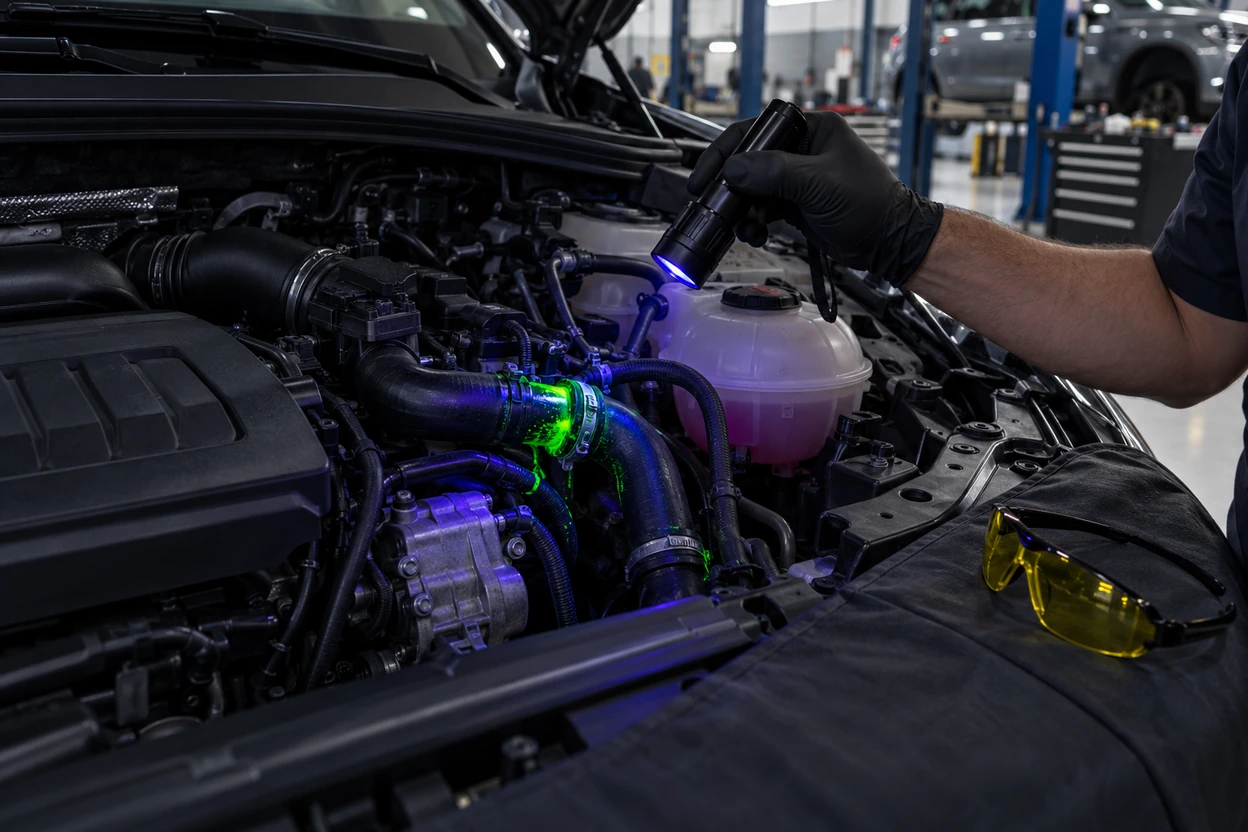
Inspect the pump and thermostat housings, pipes, connectors, expansion tank, cap and radiator end tanks. Heater-core leakage can also reach the passenger footwell. Compatible approved dye may help trace a suitable slow leak.
03Investigate hidden or internal loss
If no external source is found, select tests for the fitted engine and symptoms. These may include the oil cooler, EGR cooler, cylinder head or gasket. A pressure drop or positive combustion-gas test alone does not identify the failed component.
Testing follows the vehicle’s condition. Warm testing or a road assessment is carried out only when coolant level, temperature and vehicle condition make it safe.
3Why it happens
Where Tiguan coolant leaks start
We inspect the relevant components rather than replacing the part most often associated with the model.
Pump and thermostat housing
Inspect the fitted housing, seals and pump area for confirmed leakage or damage.
Hoses, pipes and connectors
Rubber hoses harden and plastic pipes crack, especially near the turbo and the back of the engine.
Expansion tank and cap
The tank can crack along its seams and a weak cap lets coolant escape as vapour.
Radiator
Plastic end tanks crack and sand damages the fins and cores at the front.
Heater core
Leaks inside the dashboard show up as a sweet smell and a wet passenger footwell.
Internal leak
Coolant may enter a cylinder or another fluid circuit through different failed components. Fluid mixing or persistent exhaust vapour needs further diagnosis.
4By generation
Common Tiguan leak points by generation
Engine and cooling-system layouts vary. The table shows inspection areas, not a confirmed fault or a failure-rate ranking.
Generation
Engine
Areas to inspect
What we check first
Tiguan Mk1 5N2008 to 2016
2.0 TSI EA888
Thermostat housing, water pump seal, aged hoses, radiator tanks
Housing area, lower hoses and the radiator
Tiguan Mk2 AD12016 to 2024
2.0 TSI EA888 Gen 3
Pump and thermostat housing, plastic pipes at the rear, expansion tank
Housing under the intake and the turbo coolant pipes
Tiguan Mk2 base trims2016 to 2020
1.4 TSI
Pump module at the end of the head, hoses
Pump module seals and hose clips
Tiguan Allspace and RMk2 variants
2.0 TSI
Engine cooling components and any fitted auxiliary-cooling lines
Check any additional radiators actually fitted
We explain the findings and show or photograph an accessible confirmed leak before repair. Concealed or intermittent sources may need further testing or agreed access.
5How we fix it
How we trace and fix a Tiguan coolant leak
The findings guide the work. Extra tests are selected when needed, before the confirmed source is repaired and the system rechecked.
01
Pressure-test the cold system
Apply the specified pressure and assess any loss with the test connections, temperature and inspection findings.
02
Inspect and trace the source
Look around accessible joints and components. Use compatible approved UV dye where appropriate to follow a slow leak.
03
Check the tank and cap
Inspect the expansion tank and test the cap’s opening pressure separately.
04
Investigate internal loss when indicated
Select further tests for the symptoms, including combustion-gas or oil-cooler checks where needed.
05
Repair, refill and recheck
Fix the confirmed source, refill with the required VW coolant, bleed using the correct procedure and pressure-test again.
6Your options
Which leak test does your Tiguan need?
We pick the test based on how fast you lose coolant and where.
Fast or visible leak
Pressure test
Helps locate leaks that appear under the specified test conditions
Inspect for visible leakage and assess any pressure loss
Performed with the appropriate cold-system procedure
Test scope and further investigation explained in the quote
Slow or hidden leak
Compatible UV dye trace
May reveal traces from small or concealed leaks
May help trace an intermittent leak when safe testing is possible
Additional warm testing only when safe
Cabin symptoms may need heater-circuit inspection and access
No outside leak
Combustion gas test
Checks for exhaust gas in the coolant
Can support combustion-gas leakage; the failed component still needs identifying
Quick test at the tank
Only used with other evidence
7Price factors
What changes the cost of a coolant leak repair
The tests, access and confirmed failed parts determine the bill. Compare the complete repair scope rather than the price of a single component.
01Leak location
An accessible hose clip and a housing beneath the intake require different amounts of access and labour.
02Engine and cooling layout
Generation alone does not set the price. The fitted engine, cooling arrangement and exact source determine the work.
03One leak or several
An older system may leak in more than one place. Each confirmed source changes the parts and repair scope.
04Part choice
Genuine Volkswagen and suitable OEM-supplier options are identified and priced in the written quote.
05Refill and associated work
The quote states whether a top-up or drain/refill is needed, with the correct coolant and bleeding procedure. Contamination treatment is separate when required.
8Price guide
How much does a Tiguan coolant leak repair cost?
Diagnosis is estimated at AED 150–300. The external repairs listed below range from AED 300–2,400; this does not cap the price of heater-core, internal-engine, multiple-leak or contamination repairs.
Listed repairs fromAED 300
Coolant leak diagnosisPressure and visual checks; compatible dye or cap test as appropriate
AED 150 to 300
Hose or pipe replacementPart, coolant top up and bleed
AED 300 to 800
Expansion tank and capTank, cap and coolant
AED 350 to 750
Radiator replacementRadiator, coolant and bleed
AED 1,100 to 2,200
Pump and thermostat housingMk2 2.0 TSI, see water pump page
AED 1,400 to 2,400
Indicative Dubai guides, not fixed tariffs. Heater core and head gasket repairs are quoted on their own pages.
Estimates vary with the fitted parts and work required. Your written quote lists parts, labour, diagnostic charges, VAT treatment and any extra repairs. Ask about the applicable parts and labour warranty terms before approving work.
These help us find the leak faster. When the car arrives, we check the level again ourselves and inspect the same spots under a lamp.
Mark the level
Compare the level only when fully cold and follow the handbook. Do not delay assessment of continued loss, a warning or overheating to complete a monitoring period. Never open the hot cap.
Cardboard test
Put clean cardboard under the engine overnight and see where drops land.
Look for crust
With the engine cold, look for pink or white crust on hoses and the housing.
Check inside
Look for wet carpet or a recurring film on the windscreen. Water ingress and AC condensate can also wet the footwell, so the fluid source needs checking.
Check the oil cap
Report unusual fluid mixing or oil-level changes. Oil-cap residue alone can be condensation and does not prove head-gasket failure.
01Why is my Tiguan losing coolant with no puddle?
A leak may evaporate on hot parts, collect behind covers, enter the cabin or pass into another circuit or the engine. Recent filling and bleeding can also affect the observed level. Persistent loss needs investigation; no puddle does not identify the failed component.
02Where do Tiguan coolant leaks usually come from?
We inspect the relevant pump and thermostat housing, hoses, connectors, tank, cap, radiator and heater circuit. The actual source depends on engine and condition. Internal faults need separate tests rather than being assumed from a model pattern.
03How much is a coolant leak test in Dubai?
Diagnosis is estimated at AED 150–300 for the listed checks. Pressure and visual checks are selected first, with a cap test or compatible approved dye where appropriate. Additional investigation is explained before proceeding; confirm VAT and the total in your quote.
04Is it safe to drive with a small coolant leak?
Do not assume a small leak provides a safe driving period. Stop safely for active coolant loss, overheating, steam or a red warning, switch off and seek assistance. Keep the hot coolant cap closed. A normal gauge or repeated top-ups does not guarantee safe driving.
05Can I use stop leak?
Stop-leak products can restrict narrow cooling passages and complicate later repair. They are not a substitute for finding the source. Tell us if one has already been added so the inspection and cleaning plan can account for it.
06What colour is Tiguan coolant?
Select coolant by the VW approval and mixing requirements for the exact engine and cooling circuit, not by colour alone. We check the specification and concentration; imported, newer and hybrid cars may have different requirements.
07Can a bad expansion tank cap cause coolant loss?
Yes, a damaged cap, seal or tank can lose coolant or fail to regulate pressure. The cap is tested against its specification; a weak cap does not explain every leak and is not replaced simply because coolant is disappearing.
08Does a coolant leak mean the head gasket has gone?
Not automatically. External leaks and other internal components can cause loss. Combustion-gas testing, fluid checks and cylinder tests may help, but a positive result can also involve head or block damage. The diagnosis determines whether dismantling is justified.
09How long does it take to find a coolant leak?
A straightforward visible leak may be located within an hour. Intermittent leakage, concealed parts, compatible dye tracing or internal tests can take longer. Any warm or road testing is done only when vehicle condition makes it safe.
10Can a coolant leak damage the engine?
Yes. Loss can lead to overheating, while some internal leaks can contaminate oil or enter a cylinder. Do not continue running an overheating engine. Stop safely and arrange assistance for serious symptoms.
11Do you show me the leak?
We show or photograph an accessible confirmed leak and explain the findings before repair. Some concealed or intermittent faults need further testing or agreed dismantling before their source can be demonstrated.
Tell us about the coolant loss or warning and we will explain the next step and guide price. For active loss, overheating or a red warning, stop safely and call to discuss recovery.