
Sweet smell in the cabin
Strongest when the fan is on and the climate control is warm or set to defrost.
Sweet smell, misting glass, weak cabin heat or a wet footwell in your Tiguan? We locate leaks and check heater operation before recommending a flush, pipe-joint repair or heater-core replacement. A suitable flush is estimated at AED 450–800 and core replacement at AED 1,800–3,500. Call to arrange a check.
Tiguan heater core flush from AED 450, replacement from AED 1,800. Indicative Dubai guide. The final price depends on how much dashboard trim has to come out on your Tiguan.
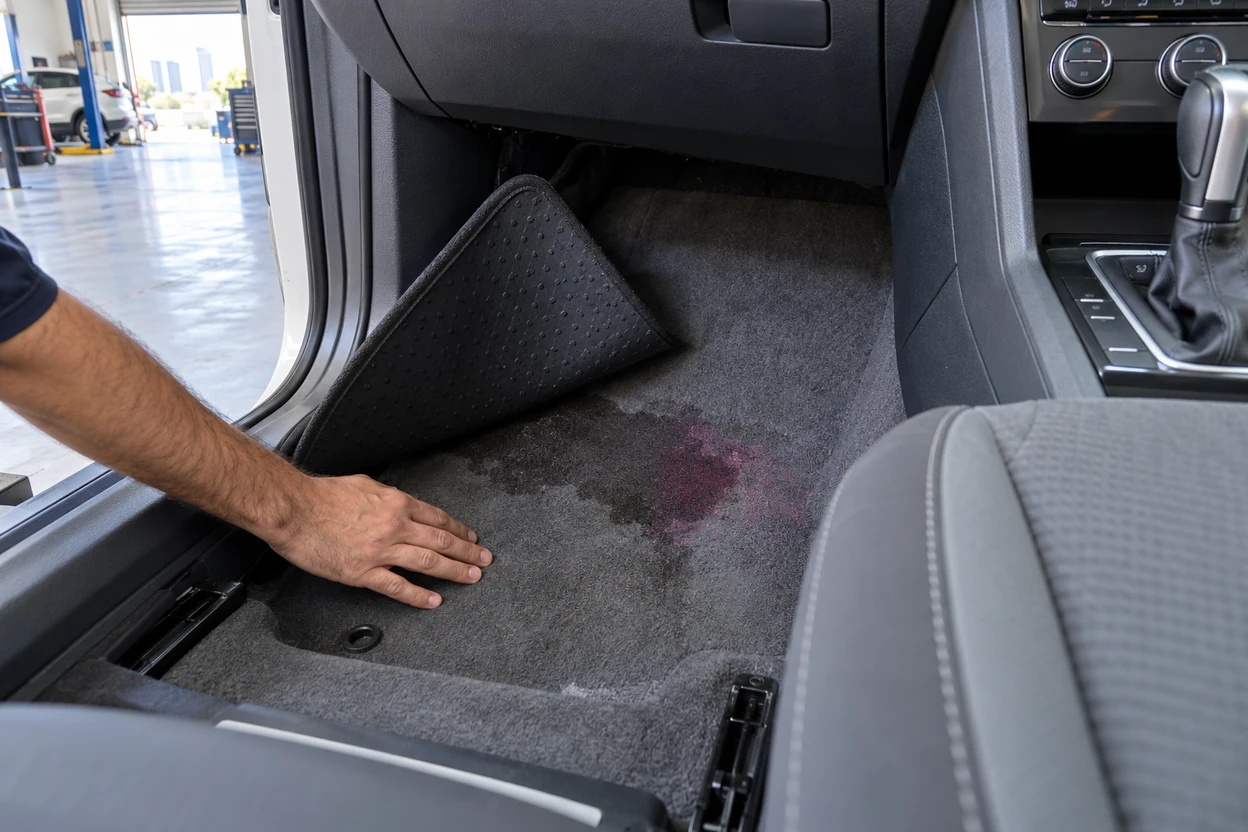
A heater core may leak coolant or become restricted, but wet carpet and uneven heat are not proof. Volkswagen Repair Dubai in Al Quoz 4 distinguishes leakage, restricted coolant flow and air-flap faults before quoting. Estimated prices are AED 450–800 for a suitable flush and AED 1,800–3,500 for listed Mk1/Mk2 replacement work. A flush does not seal a leak.
Use these symptoms to describe the fault, then confirm it with inspection. Stop safely if visibility is impaired or the engine overheats.
Strongest when the fan is on and the climate control is warm or set to defrost.
A misty smear on the inside of the windscreen that comes back after you wipe it.
The tank keeps going down but there is no puddle under the car.
Uneven heat may involve core restriction, air in the system, an actuator or a temperature-control fault.
Wet carpet may be coolant, rainwater or AC condensate. Identify the fluid and leak route before choosing the repair.
Steam on the windscreen that blocks your view is a safety risk on the road.
Enough coolant has been lost for the engine to start running hot.
If you also see coolant outside the car, the heater core may not be the only leak. Our Tiguan coolant leak guide explains how we trace every leak point.
You may rarely turn up the heat, but a heater-core leak or blockage can still affect your Tiguan. Cabin heating, demisting and coolant loss each need the right checks.
Engine coolant passes through the heater core, and the blower moves air across its fins to provide cabin heat when requested.
The heater is not always adding heat to the AC air. Reheating depends on the climate setting, air-flap position and your Tiguan’s fitted system. Selecting 22°C does not mean the heater is working continuously.
The core supports cabin warmth and demisting when the climate system requests heat. Weak or uneven heating can also come from low coolant, air in the system or an air-flap fault.
A sweet smell, recurring film on the glass or coolant loss can point to the core or its pipe joints. We inspect the connections and surrounding housing before recommending replacement.
Deposits can restrict the core’s narrow passages. A controlled flush may help a sound but restricted core, after checking coolant flow and flap operation. A flush does not seal a leak.
Check coolant condition, leakage, circulation and control operation before attributing a fault to age or heat.
Degraded or contaminated coolant can affect corrosion protection and contribute to deposits. Follow the applicable coolant requirements rather than assuming a universal replacement interval.
Use coolant meeting the specified VW approval and mixing requirements. Brand name or colour alone does not establish compatibility; unsuitable mixtures or contamination may create deposits.
Test the cap and cooling system where indicated. A cap can lose pressure or fail to regulate correctly; do not assume every cap fault raises pressure.
Daily short trips in Dubai traffic heat and cool the core again and again, which fatigues the joints.
Sealant poured into the tank can clog the core tubes and leave the heater weak on one side.
The core design is similar across Tiguans, but access and labour change between generations.
We confirm the access route on your exact car before quoting, because the heater-box version, steering position, drivetrain and access procedure can change the labour time.
Locate any leak and assess coolant flow and air control before choosing a repair.
Pressure-test using the applicable procedure and locate any loss. A drop with no visible external leak does not prove the heater core is at fault.
We check the heater box drain, the carpet and the core pipes so we know it is the core and not a hose.
Consider controlled flushing only for a sound but restricted core. Use suitable pressure and compatible products; uncontrolled high-pressure flushing can damage it. Repair a confirmed leaking joint or replace a leaking core as appropriate.
The new core goes in with new seals, then we refill with VW coolant and bleed using the model-specific procedure, then verify circulation and stable levels.
We dry the carpet, refit trim, run the climate control through every mode and recheck the level the next day if needed.
Volkswagen Repair Dubai, independent workshop in Al Quoz 4. Updated 20 October 2026. About our workshop.
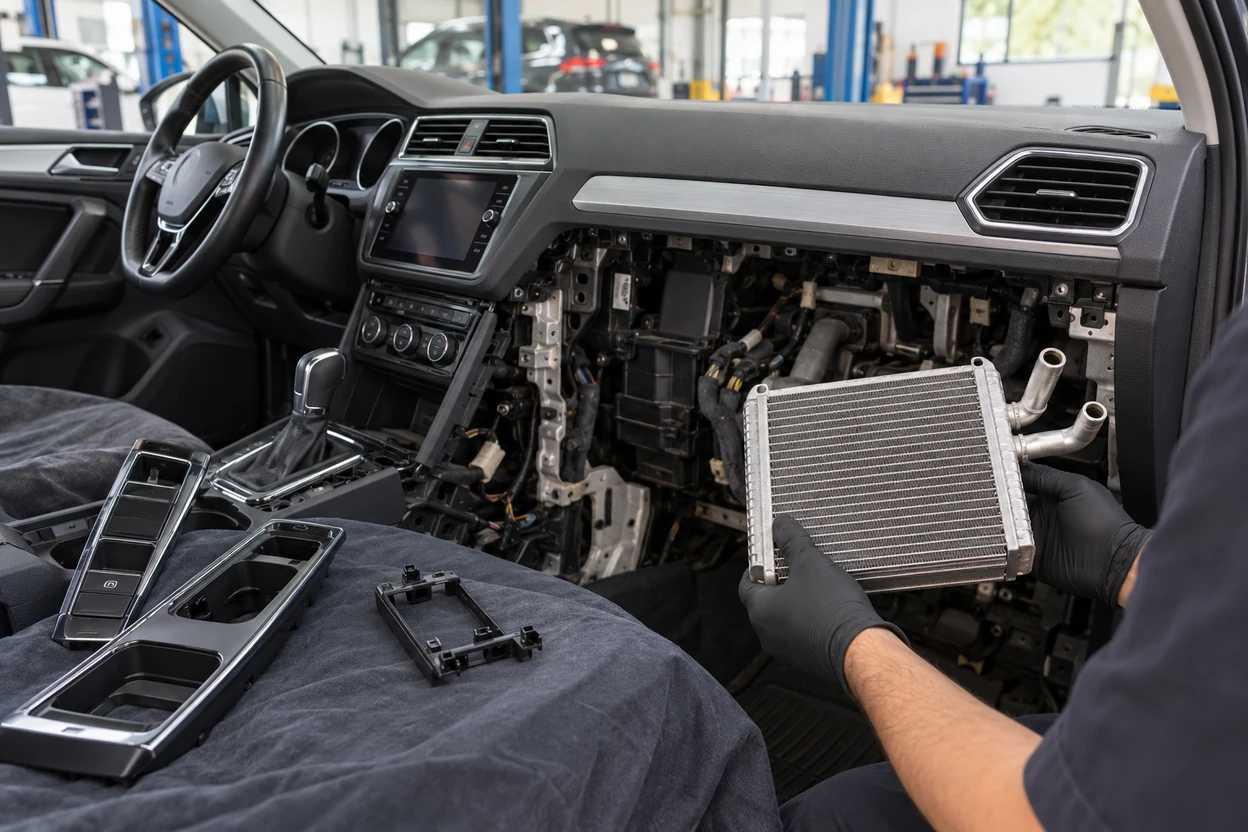
The right choice depends on whether the core is blocked, leaking or both.
These are the main things that move a Tiguan heater core repair quote up or down.
Plan around AED 450 to 800 for a flush and AED 1,800 to 3,500 for a replacement, including coolant.
Indicative Dubai guides, not fixed tariffs. Your written quote shows the part brand and labour before we start.
Confirm the diagnostic charge, VAT treatment and total payable in your written quote. Ask for the applicable parts and labour warranty terms, including exclusions, before authorising work. Additional repairs require approval.
These take a few minutes and help us quote faster.
Look for wet carpet near the center console and tell us which area is affected. Coolant, rainwater and AC condensate need different repairs.
Wipe the inside glass with a clean cloth. A recurring film with coolant loss needs investigation, but glass contamination can have other causes. Do not drive with obscured vision.
Look at the expansion tank level only when cold, following the handbook. Keep the hot cap closed; do not delay assessment of ongoing loss or a warning light.
A hidden external leak, evaporating leak or internal engine fault is also possible. No puddle does not establish a heater-core leak.
A sweet smell, recurring glass film or a damp footwell with coolant loss can suggest leakage. Confirm the fluid and inspect the core and pipe joints. AC condensate or rainwater can also wet the carpet; a pressure drop alone is not proof.
The heater supports cabin heat and demisting when required, even in a warm climate. Its use varies with settings and conditions. A leaking core or joint still needs repair even if you rarely select warm air.
Do not rely on repeated top-ups. Stop safely and arrange recovery if coolant is leaking, the engine overheats or windscreen visibility is impaired. Seek assessment before driving with unexplained coolant loss; a normal gauge does not guarantee safety.
Not always. Some heater boxes allow side access after local trim removal; others need more dismantling. We identify the fitted unit and steering position, then explain the work and time before you approve it.
An indicative guide is about one day for some Mk1 jobs and one to two days for some Mk2 jobs. Access, parts, drying and electrical damage can extend the time. Confirm the actual schedule after inspection.
No. Flushing can sometimes improve a confirmed restriction in a structurally sound core. A leaking pipe joint needs an appropriate seal or pipe repair; a leaking core normally requires replacement.
A coolant-like smell needs prompt investigation. Avoid prolonged exposure and keep children and animals away from spilled coolant. Ventilation is not a repair; stop if visibility is affected or coolant is being lost.
Stop-leak products do not restore damaged joints or core structure and can restrict narrow passages. Tell the workshop if any have been used before deciding on flushing or replacement.
Humidity, air-control faults and glass contamination can cause misting. A sweet smell or persistent film combined with coolant loss raises suspicion of a heater-system leak, but inspection is needed.
Yes. Loss through a core or pipe joint can reduce coolant and lead to overheating. A red coolant warning, rising temperature or steam calls for stopping safely and switching off. Keep the hot coolant cap closed.
We use coolant meeting the correct VW specification and concentration for the car, then follow its filling and bleeding procedure. We select by specification rather than colour, including for imported and hybrid variants.
Yes, we inspect affected carpet, insulation and accessible connectors. We explain any drying or electrical work separately before starting; moisture may extend beyond the visible patch.
Tell us about the smell, wet area or heating problem and we will help arrange a check. The model year is useful if known; you do not need to identify the failed part before contacting us.