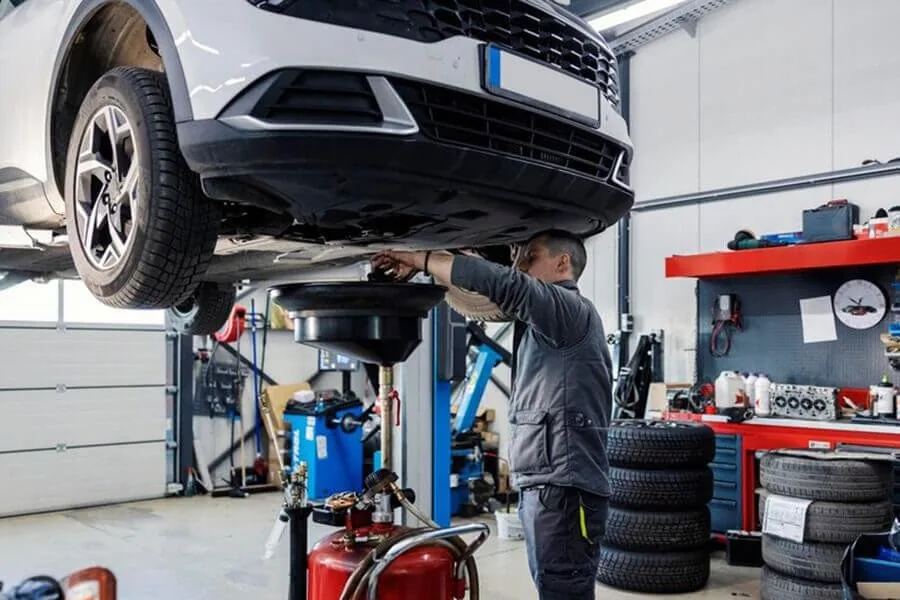
Volkswagen spare parts come in three grades, genuine Volkswagen, OEM parts made by the same suppliers that build them for the factory, and aftermarket. At our Al Quoz 4 workshop we match each part to your VIN, explain the difference, price both where available and list every part on your written quote.
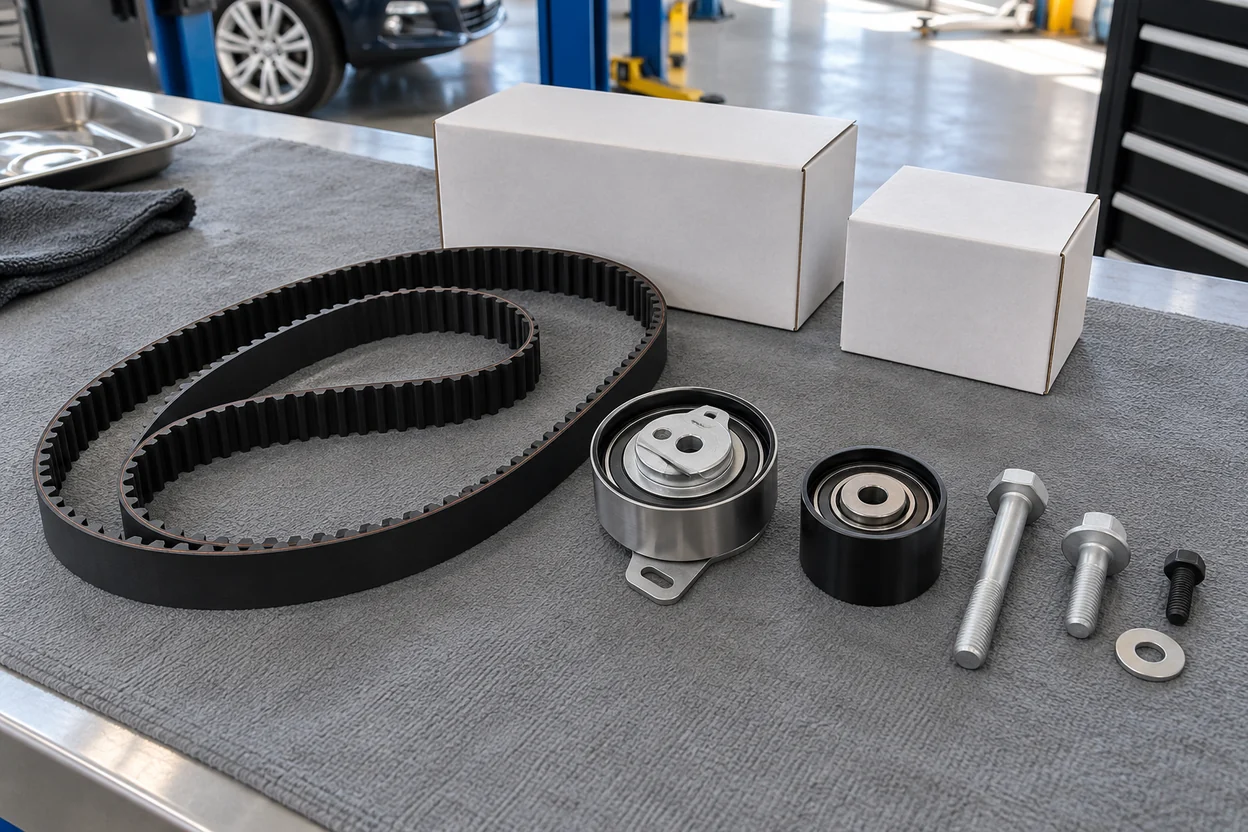
A new timing kit checked against the old parts before it goes on the engine.
Choose with confidence
Key takeaways
Compare the part, its fit and the complete job.
01
Genuine parts come in Volkswagen packaging and carry the VW part number.
02
OEM parts come from the factory suppliers, usually in the maker box.
03
Aftermarket parts are made to fit, not to the VW drawing, and quality varies.
04
The VIN, not the model name, decides which part number your car needs.
05
Mechatronic units, sensors and control modules are usually worth buying genuine.
06
Filters, brake pads and many suspension parts are sensible in quality OEM.
07
A price far below the usual range is the first sign of a fake part.
08
Your quote names each part, its grade and its price before work starts.
Compare the options
What is the difference between genuine, OEM and aftermarket VW parts?
Owners in Dubai hear the words genuine, original, OEM, OES and aftermarket used as if they meant the same thing. They do not. The grade tells you who made the part, who checked it and whose name is on the box. Knowing the difference is the simplest way to compare two quotes that look alike on paper but use very different parts.
01
Genuine Volkswagen
A genuine part is supplied through the Volkswagen parts network in Volkswagen or Volkswagen Group packaging, with the VW part number on the label. It is made to the factory drawing and checked to the factory standard, and it is the same part a dealer would fit.
Who makes it
A supplier contracted by Volkswagen, sold under the VW brand
Useful for
Electronics, safety systems and parts that must be coded
What to weigh up
Usually the highest price of the three grades
02
OEM or OES
OEM means original equipment manufacturer, and OES means original equipment supplier. Either way it is a part made by a company that supplies the same component to the Volkswagen production line, sold in its own box. It is often the same part without the VW logo.
Who makes it
The factory supplier, under its own brand
Useful for
Service items, brakes, suspension and many engine parts
What to weigh up
Fit and quality match genuine when the maker and number are right
03
Aftermarket
An aftermarket part is made by a company that does not supply Volkswagen. It is designed to fit and work in place of the original, but it is not made to the VW drawing. Some aftermarket brands are very good, and some are made only to a price.
Who makes it
An independent maker with its own design
Useful for
Older cars, wear items and parts no longer made by VW
What to weigh up
Quality ranges widely, so the brand matters as much as the price
Used, reconditioned and salvage parts are a fourth route that some owners ask about. They are a separate conversation, because their condition and history matter more than their grade, and we only discuss them case by case.
Match before you order
How do VW part numbers and VIN matching work?
Every Volkswagen part has a part number of nine characters written in three groups, often followed by a suffix letter. The number is not random. Once you know how it is built, you can tell a lot about the part from the label alone, and you can see why two parts that look identical may not fit the same car.
Example part number
5C6Vehicle or engine821Main and sub group105Part and sideAIndex letter
The complete number matters, including the suffix.
01
First group, the application
The first three characters show the vehicle or engine family the part was first made for. For example, 1K0 points to the fifth generation Golf and Jetta platform, and 5C6 to the sixth generation Jetta sedan. The letter O is never used, so 1J0 is read as one J zero.
02
Second group, the system
The first digit of the middle group is the main group, such as 1 for the engine, 4 for front suspension and steering and 9 for electrical parts. The next two digits are the sub group, the area inside that system, such as the cylinder head or the fuel system.
03
Third group, the part
The last three digits identify the part itself. On body parts the final digit often shows the side, with odd numbers for the left side and even numbers for the right. A front wing ending in 105 and its partner ending in 106 are a mirrored pair.
04
Suffix, the version
A letter after the number shows a change in design, material or maker. Sometimes the new letter supersedes the old one after an update. Sometimes it is a different part for a different car, so a newer letter is not always a straight swap.
Compatibility comes first
Which VW parts should you buy genuine?
For some parts the genuine version is the safer choice, because the part has to talk to the rest of the car, carry the right software or protect people in a crash. A cheaper copy that almost works can cost more than the part itself in repeat labour. These are the parts where we usually recommend genuine Volkswagen.
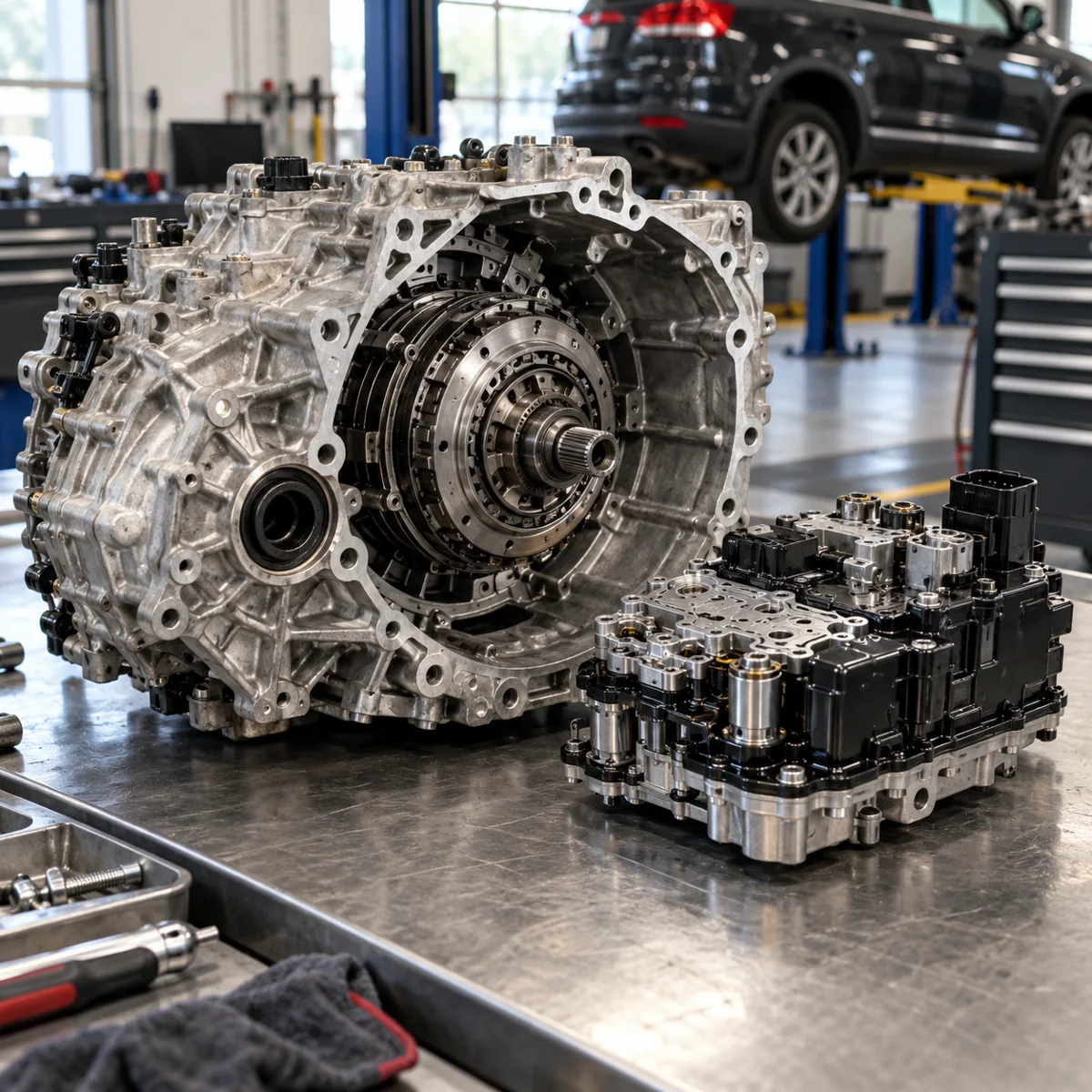
A DSG mechatronic unit is one part where we usually recommend genuine.
Confirm the complete job
Ask whether the part requires coding, adaptation or calibration, and have those steps included in the quote.
DSG mechatronic units and gearbox electronics
The mechatronic unit is the brain and hydraulic control of the DSG gearbox. It must match the gearbox code and be coded and adapted to the car with VW specific diagnostic software, so we usually recommend a genuine unit. Our mechatronic replacement page explains the job.
Control modules and the engine ECU
Engine, ABS, airbag and comfort control units carry software for a specific car. A wrong or copied module can bring warning lights, limp mode or features that stop working, which is why we usually fit genuine.
Engine and gearbox sensors
Crankshaft, camshaft, pressure and speed sensors feed the control units the data they run on. A poor sensor can give readings that are slightly wrong, which is harder to find than one that has failed outright.
Airbag and seat belt parts
Airbags, seat belt pretensioners and their sensors are safety parts. For these systems we recommend genuine parts, matched to the VIN.
Parts that need coding
Lights, keys, parking sensors and some comfort parts must be coded to the car after fitting. Genuine parts follow the factory coding path, which keeps the job predictable.
Spend where it matters
Where are OEM or quality aftermarket VW parts a sensible choice?
Not every part needs a Volkswagen logo on the box. For many service and wear parts, the OEM supplier part is the same part that went on the car at the factory, and a known aftermarket brand can be a fair choice on an older car. The table shows where we often price an OEM option next to genuine, and what we check before we fit it.
Your quote shows both options where both are available, so the choice is always yours. The part number and maker are checked against your VIN either way.
Part
Sensible choice
What we check first
Oil, air and cabin filters
Genuine or OEM supplier
The filter matches the engine code, and the oil filter comes with the right O rings for the housing.
Brake pads
OEM or a known brand
Pad size for your brake system, a wear sensor where fitted and a friction rating suited to Dubai heat and traffic.
Brake discs
OEM or a known brand
The disc diameter and thickness for your car, since one model can use more than one brake size.
Shock absorbers and struts
OEM supplier
The damper suits the suspension type, such as sport or standard, and the car ride height code from the build data.
Control arms, bushes and links
OEM or quality aftermarket
Bush type and joint size, plus new bolts or nuts where VW calls for single use fixings.
Belts, pulleys and tensioners
OEM supplier kit
The complete kit for the engine code, so new and old parts are not mixed on a timing or drive belt job.
Spark plugs and ignition coils
Genuine or OEM supplier
Plug type and gap for the engine, since the wrong heat range can cause misfires.
Bulbs, wipers and small trim
OEM or quality aftermarket
Fit and finish, and whether a light needs coding after it goes in.
Send us the car details and tell us what needs replacing. Where both are available, your written quote shows the genuine part and the OEM part next to each other, so you can choose.
Counterfeit parts copy the look and packaging of genuine and OEM brands, and they are often good enough that the box alone will not tell you. Brake pads, brake discs, spark plugs and filters are among the parts most often copied. These are the warning signs we look for before any part goes on a car.
Price too good to be true
A branded part sold well below its usual price by a seller you do not know is the most common sign.
No traceable seller
A genuine supplier can trace a part and replace it in a recall. A fake has no such chain behind it.
Generic fit claims
Fakes are often sold as fitting many models, rather than matched to a part number and VIN.
Weak print and labels
Blurred logos, spelling mistakes, missing batch codes or a part number in the wrong format.
Light or rough finish
A part that feels lighter than the old one, with rough casting, poor welds or loose rubber.
No quality documents
Real makers supply proof of original equipment quality. Fakes rarely come with any paperwork.
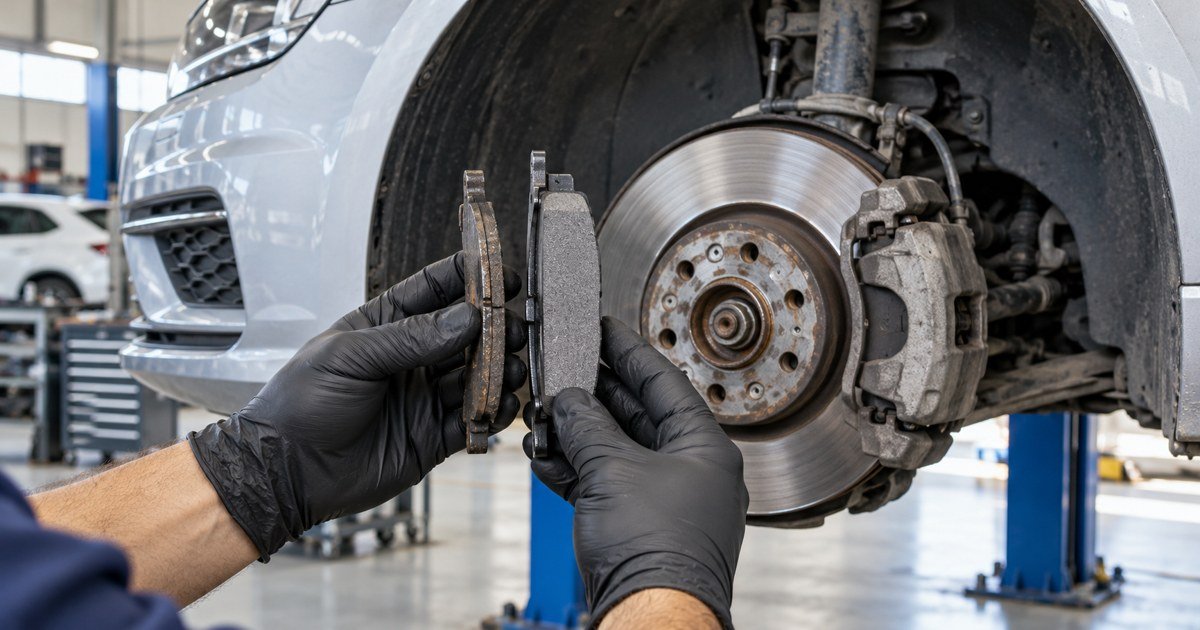
Comparing the new part with the old one is a quick first check for weight, size and finish.
A cheap part is not always a fake, but it can still be the wrong quality for your car. If a part was bought online and you think it is not genuine, contact the seller or the platform it came from, and ask us to compare it with the part number for your VIN before it is fitted.
Choose how to buy
Is it better to have parts fitted or buy them over the counter?
Some owners buy a part first and then look for a workshop to fit it. Others ask the workshop to supply and fit the part as one job. Both routes can work, but they put the responsibility for choosing the right part in different places. We are a repair workshop, so the parts we deal with are the ones we fit as part of a repair.
The decision
Who handles each step?
One job, one quote
Workshop supply and fit
You choose the part
Bought over the counter
Part matching
Workshop supply and fit
The workshop checks the VIN, part number and suffix before ordering.
Bought over the counter
Confirm the part number, suffix and compatibility with the seller before buying.
Quote and choice
Workshop supply and fit
The written quote names the part grade, maker, price and fitting work.
Bought over the counter
Compare the part price with the separate fitting and setup costs.
Coding and setup
Workshop supply and fit
Parts that require it are coded and adapted after fitting.
Bought over the counter
Buying the part alone does not include any coding or adaptation it may need.
Testing the repair
Workshop supply and fit
The original fault is checked again after the part is fitted.
Bought over the counter
Agree who will diagnose the fault and test the completed repair.
Aftercare
Workshop supply and fit
Ask for the parts and labour terms on your quote. Removed parts are returned on request.
Bought over the counter
Confirm the seller’s returns and parts-warranty terms, and the fitter’s labour terms.
Already bought a part?
Tell us before you book. Send a photo of the label and the part number so we can check it against your VIN and discuss suitability.
The part is only as good as the diagnosis behind it. Replacing parts until a fault goes away is the most expensive way to repair a Volkswagen, so every parts job at our workshop follows the same order.
Diagnose the fault first
We read the fault memory with VW specific diagnostic software, look at live data and test the suspect part, so the part we quote is the part that has actually failed.
Look up the part by VIN
The VIN gives us the build data for your car. From it we confirm the part number, the suffix and any update that has replaced the original part.
Price genuine and OEM where available
We explain the difference between the grades for that part and price both where both exist. For parts where we usually recommend genuine, we explain why.
Send a written quote
Each part is listed on the quote with its grade and price, next to the labour. Nothing is ordered or fitted until you approve it, and any extra work is only done after your approval.
Fit, code and adapt
The part is fitted to the factory procedure. Where a new part needs it, VW specific diagnostic software codes it to the car and runs the adaptation, such as a gearbox, throttle or sensor learn.
Test and hand back
The fault memory is cleared, the car is tested again and the old parts are returned to you on request, so you can see what was replaced.
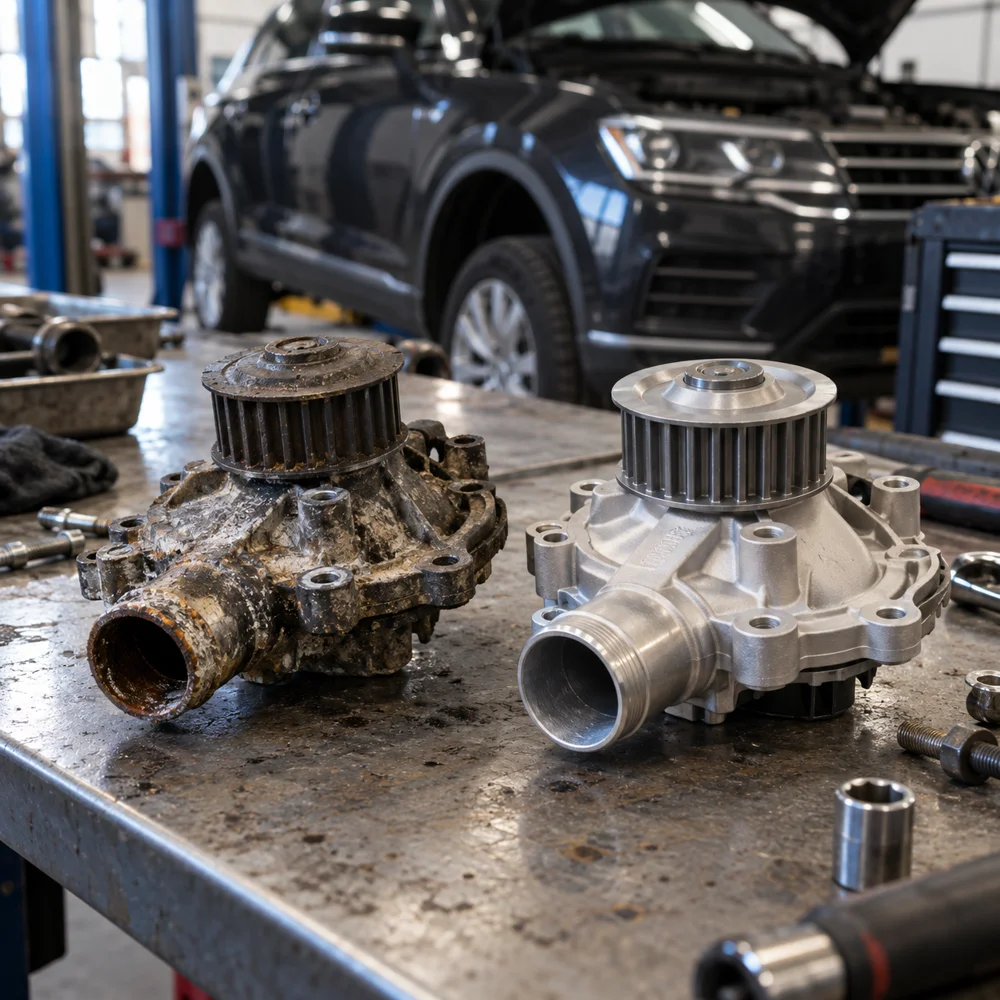
Old and new parts side by side. Old parts are returned on request.
After the job
What happens to your old parts and the parts warranty?
Two questions come up at almost every handover. Here is what we tell owners, in plain words.
Can I have my old parts back?
Yes. Old parts are returned on request. Ask when you approve the quote, and we keep the removed parts aside for you so you can see the wear or damage for yourself.
What warranty comes with the part?
Parts warranty depends on the part and its maker, so it is not the same for every job. Ask us for the terms on your quote, and we will show them next to the part before you approve the work.
Will an OEM part affect my car?
An OEM part made to the right number by the factory supplier fits and works like the original. If your car is still under a manufacturer warranty, check its terms before you choose a part grade.
Parts by system
Which VW repairs involve these parts?
Most parts questions start with a fault or a service. Pick the system below to read how we diagnose it and which parts are usually involved.
Yes. At our Al Quoz 4 workshop we fit genuine Volkswagen parts or OEM parts from the same suppliers that make them for the factory. We explain the difference for your part, price both where both are available and list each part with its grade and price on your written quote, so you choose before any work starts.
What is the difference between genuine and OEM VW parts?
A genuine part comes in Volkswagen packaging with the VW part number and is sold through the Volkswagen parts network. An OEM or OES part is made by a company that supplies the same component to the Volkswagen factory, sold in its own box. When the maker and the part number are right, the OEM part is often the same part without the VW logo.
Are aftermarket parts safe for a Volkswagen?
Some are, and some are not. Aftermarket parts are made to fit in place of the original, not to the VW drawing, so quality depends on the brand. A known brand can be a fair choice for wear items on an older car. For safety systems, sensors and electronics we usually recommend genuine, because a part that almost works can cause faults that are hard to find.
Why do you need my VIN to quote a part?
The model name covers many engines, gearboxes, brake sizes and equipment levels, so it is not enough to pick a part. The 17 character VIN returns the build data for your exact car, including the engine and gearbox codes. From it we confirm the correct part number and suffix, which avoids ordering a part that looks right but does not fit.
How do I read a Volkswagen part number?
A VW part number has nine characters in three groups, often with a suffix letter. The first group shows the vehicle or engine family, the middle group shows the system and area, such as engine or brakes, and the last group identifies the part. A suffix letter marks a version, and a newer letter does not always replace the older one.
Should a DSG mechatronic unit be genuine?
We usually recommend a genuine mechatronic unit. It controls the clutches and gear changes of the DSG gearbox, it must match the gearbox code and it has to be coded and adapted to the car with VW specific diagnostic software. We test the gearbox first, because some DSG faults come from sensors, wiring or fluid rather than the mechatronic unit itself.
Can OEM brake pads and filters be used on my VW?
Yes. Filters, brake pads and many suspension parts are a sensible choice in OEM form, made by the supplier that builds them for the factory. We first confirm the right size from your VIN, because one model can use more than one brake size or filter type, and the quote shows the genuine and OEM options where both are available.
How can I tell if a VW part is fake?
Warning signs include a price far below the usual range, a seller you cannot trace, claims that one part fits many models, blurred print or spelling mistakes on the label, a part that feels lighter or rougher than the old one and no quality paperwork. Brake pads, discs, spark plugs and filters are among the parts most often copied.
Do I get my old parts back?
Yes, old parts are returned on request. Ask when you approve your quote and we keep the removed parts aside for you. Seeing the old part next to the new one is a simple way to understand what failed, and it gives you a clear record of the work done on your Volkswagen alongside the invoice.
What warranty do VW spare parts come with?
Parts warranty depends on the part and its maker, so it is not the same for every job or every grade of part. Ask us for the terms on your quote, and we show them next to the part before you approve the work. If your car still has a manufacturer warranty, check its terms before choosing a part grade.
Al Quoz 4, Dubai
Get the right part fitted to your VW
Volkswagen Repair Dubai is an independent VW workshop, open Monday to Saturday, 9am to 7pm. Send your model, year and VIN with the fault or the part you need, and we confirm the part number, the grade and the price in writing before any work.
How this page was written. Prepared by the Volkswagen Repair Dubai workshop team in Al Quoz 4 and reviewed in October 2026. It describes how we choose, quote and fit parts at our own workshop. Part number structure and counterfeit warning signs come from the sources below. No prices are shown, because each part is priced from your VIN on a written quote.