In this guide
If your VW shows a red coolant warning, steam or a temperature gauge rising into the hot range, stop as soon as it is safe and switch the engine off. Do not keep driving to test whether it cools down. Keep clear of steam and never open a hot coolant cap. Low coolant, a leak, fan failure or a circulation fault can cause overheating; the symptom alone does not identify the failed part.
Volkswagen Repair Dubai · Al Quoz 4 · Updated October 2026
Key takeaways
- A red coolant warning or steam means stop safely and switch off. Driving on can warp the cylinder head.
- Never open the coolant cap on a hot engine. The system is under pressure and can spray scalding coolant.
- Overheating only in traffic usually points to the radiator fan, a blocked radiator or low coolant.
- Topping up hides the cause. Coolant that keeps dropping is leaking somewhere, inside or outside the engine.
- Use the VW coolant specification listed for the actual engine. Colour alone does not establish compatibility.
- A pressure test and fan check find most causes before any expensive part is replaced.
What should you do when your VW overheats?
-
Stop safely
Move out of traffic as soon as it is safe. A red coolant warning means stop; using the heater or switching off the AC is not permission to continue driving.
-
Switch the engine off
Follow the dashboard instruction. Do not leave an overheating engine idling while you investigate.
-
Keep clear of steam
Keep passengers away from traffic and hot coolant. If steam is escaping, keep away from the bonnet until it has stopped.
-
Leave the cap closed
Cooling depends on the engine and conditions. A fixed waiting time does not prove that the system is cold or depressurised.
-
Arrange help
Report the warning, coolant loss and location. Follow your model handbook and professional advice before restarting; arrange recovery if the fault or safe restart conditions are uncertain.
The pressurised system can release scalding liquid. Checking or adding coolant is only considered after the engine has cooled safely, using the vehicle handbook.
What do the VW temperature warnings mean?
Volkswagen dashboards use one coolant symbol for several problems. The colour, and what the gauge shows, tell you how urgent it is.
Needle above normal
On most VWs the needle sits in the middle once warm. If it climbs above its usual position in traffic, turn off the AC and plan a check.
Coolant level message
A red coolant warning requires stopping and switching off even with a normal-looking gauge. Check the exact message and handbook; a dropping coolant level needs investigation.
Red coolant warning
Red means the coolant is too hot, the level is too low or the system has a fault. Stop safely and switch off.
The handbook for your car shows the exact symbols and messages for your model. Volkswagen also explains them in its warning and indicator lights guide.
Why does a VW engine overheat?
Overheating means the cooling system cannot remove heat as fast as the engine makes it. These are the causes we find most often, matched to the clues owners notice.
| Cause | Typical clue | What is checked |
|---|---|---|
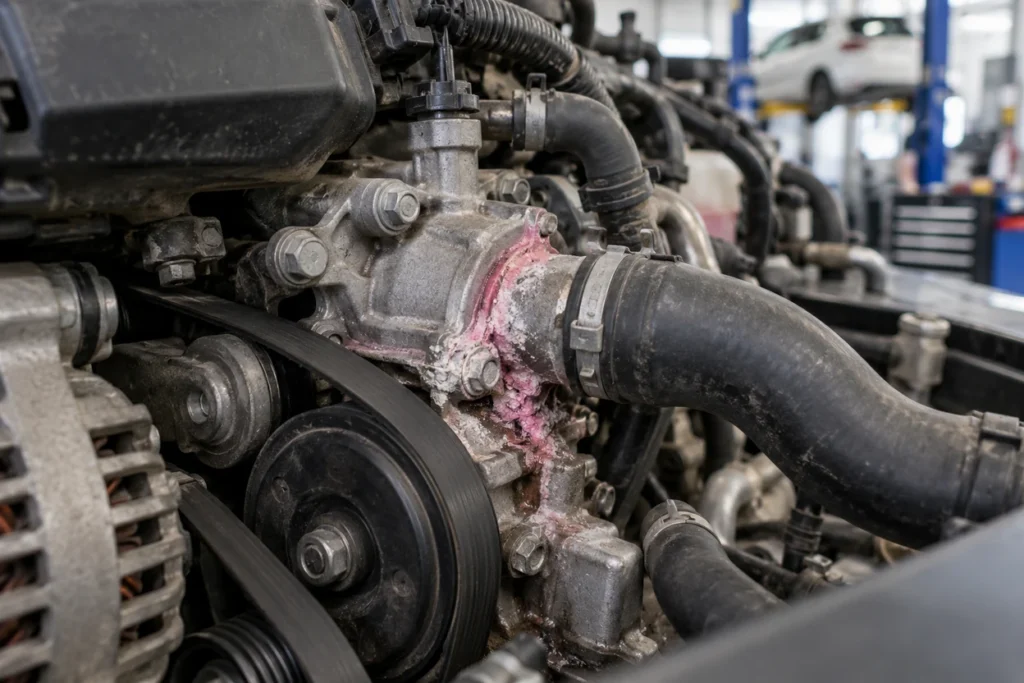
| Low coolant or leak | Level keeps dropping, sweet smell, pink crust | Pressure test, hoses, joints, radiator, pump |
| Radiator fan fault | Hot only in traffic or at idle | Fan operation, fan control, fuses and wiring |
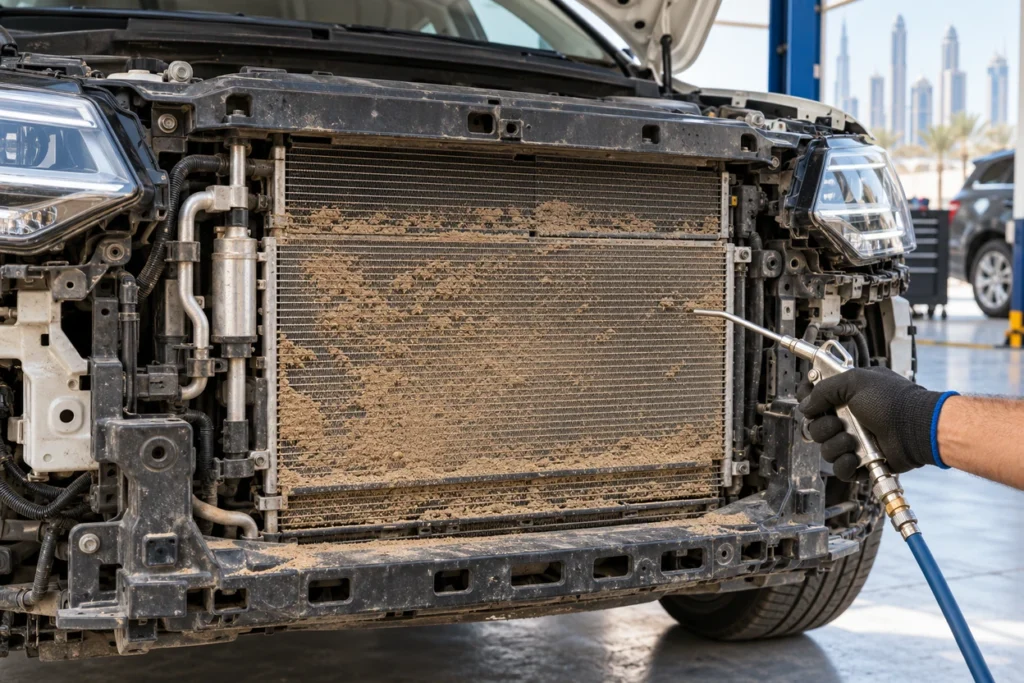
| Blocked radiator | Hot in traffic, worse in summer | Sand and debris in the fins, internal blockage |
| Thermostat stuck shut | Rises quickly, top hose stays cool | Thermostat opening and temperature readings |
| Water pump fault | Overheats at speed and idle, leak near pump | Pump flow, seal leak, drive belt or gear |
| Head gasket problem | White smoke, bubbles in the tank, coolant loss | Combustion gas test, compression test |
Air trapped after a repair can also cause overheating, which is why VW cooling systems are bled to the procedure for each engine after any coolant work.
Why do VWs overheat more in Dubai traffic?
At highway speed, air is forced through the radiator by the movement of the car. In slow traffic that airflow stops and the radiator fan has to do all the work. Dubai summer adds very hot air, sun on the bonnet and a busy AC condenser sitting in front of the radiator.
- Sand in the fins builds up between the condenser and radiator and blocks airflow.
- A weak fan may run but not move enough air at idle.
- Low coolant leaves less margin when the engine is working hard.
- AC load adds heat in front of the radiator just when cooling is hardest.
If your VW runs normally on the highway but the needle climbs in traffic, the fan and the radiator are the first things to check.
Temperature rising in traffic? Tell us your model and when the needle climbs, and we will tell you what to check first.
What should you check before Dubai summer?
Check the coolant level when cold, investigate any repeated loss and have weak airflow or temperature warnings assessed before a long journey. A healthy system should manage normal use; hot weather does not make repeated overheating acceptable.
| Record at the visit | Why it helps |
|---|---|
| Model, engine, mileage and previous cooling work | Identifies the correct specification and bleeding procedure. |
| When temperature rises, and the actual warning | Separates an idle or traffic pattern from a problem that also occurs at speed. |
| Pressure-test result and leak location | Supports a targeted repair instead of repeated top-ups. |
| Fan response and live temperature readings | Checks airflow and temperature control rather than assuming the pump failed. |
For cooling that fails only inside the cabin, see VW AC not cooling in Dubai heat. For slow cranking after hot parking, see battery life and heat.
Which coolant does your VW need?
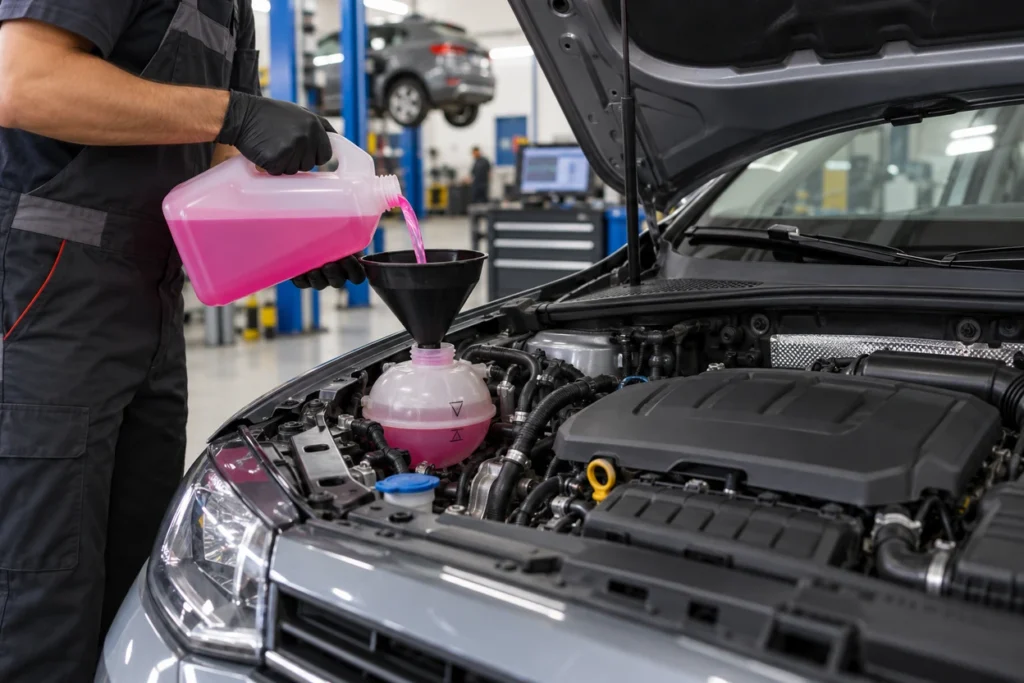
Volkswagen coolant is identified by a G number and a VW specification code. Using the wrong type can reduce corrosion protection, and some older types react badly when mixed.
- G12evo
- G12evo is identified by VW specification TL 774 L. Confirm the approved specification and any replacement guidance for your engine before choosing it.
- G13
- Specification TL 774 J, used before G12evo. It is fully compatible with G12 plus plus.
- Older G11 and G12
- These early types should not be mixed with each other, as they can react and clog small passages.
- Mixing and topping up
- Use the specified premix or the approved concentrate and dilution for the application. Follow the vehicle guidance on mixing; coolant colour alone is insufficient.
Check the specification in your owner manual and the product approval. If overheating or coolant loss occurs, stop and obtain advice before topping up or restarting. Coolant service is covered on our coolant flush service page.
Can you drive an overheating VW to the workshop?
It depends on what the car is showing. Use this as a guide, and when in doubt, arrange recovery rather than risk the engine.
Red means do not drive
A red coolant warning, a needle at the top, steam or a boiling sound means the engine should not be driven further.
A falling gauge is not clearance
A lower reading after switching the AC off does not establish that the fault is resolved. Stop safely and get advice before continuing.
Arrange recovery
Repeated overheating, heavy coolant loss, white smoke or a rough running engine need recovery to avoid further damage.
Do not keep topping up
Adding water every few kilometres to keep going can crack the cylinder head and turn a hose job into an engine repair.
Our roadside assistance service can recover the car to our Al Quoz 4 workshop if it cannot be driven safely.
How urgent is each overheating sign?
Not every sign carries the same risk. Read the scale from left to right, from signs you can book in for to signs that mean stop now.
Book a leak check. Note how much you add and how often.
Stop safely if the temperature is rising; get advice before continuing.
Follow the warning instruction. A red warning means stop safely and switch off, even when the gauge looks normal.
Stop safely, switch off and get advice before restarting.
Stop and switch off. Arrange recovery rather than driving on.
How is VW overheating diagnosed?
Heat alone does not tell you which part has failed. A proper diagnosis works through the cooling system in order.
- 1Read the data
Coolant temperature readings, fan requests and stored cooling faults with VW diagnostics.
- 2Pressure test
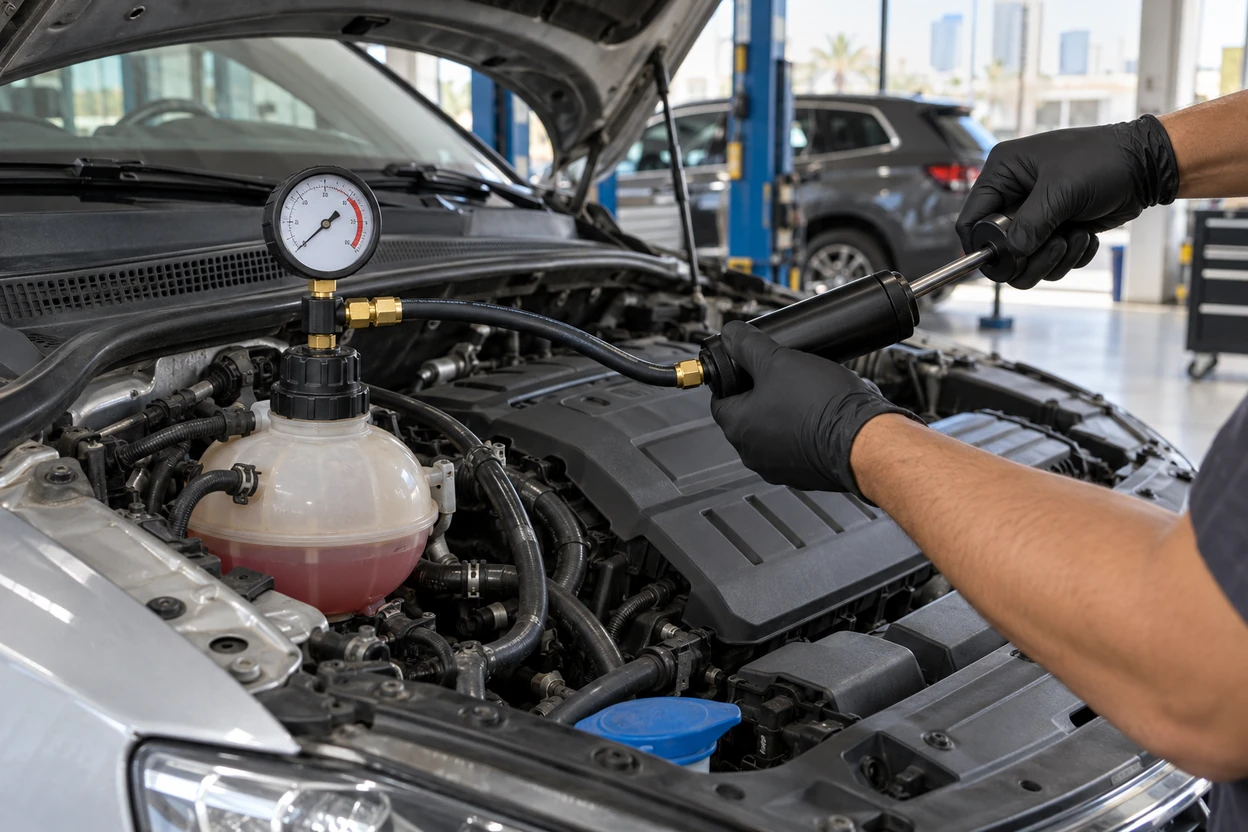
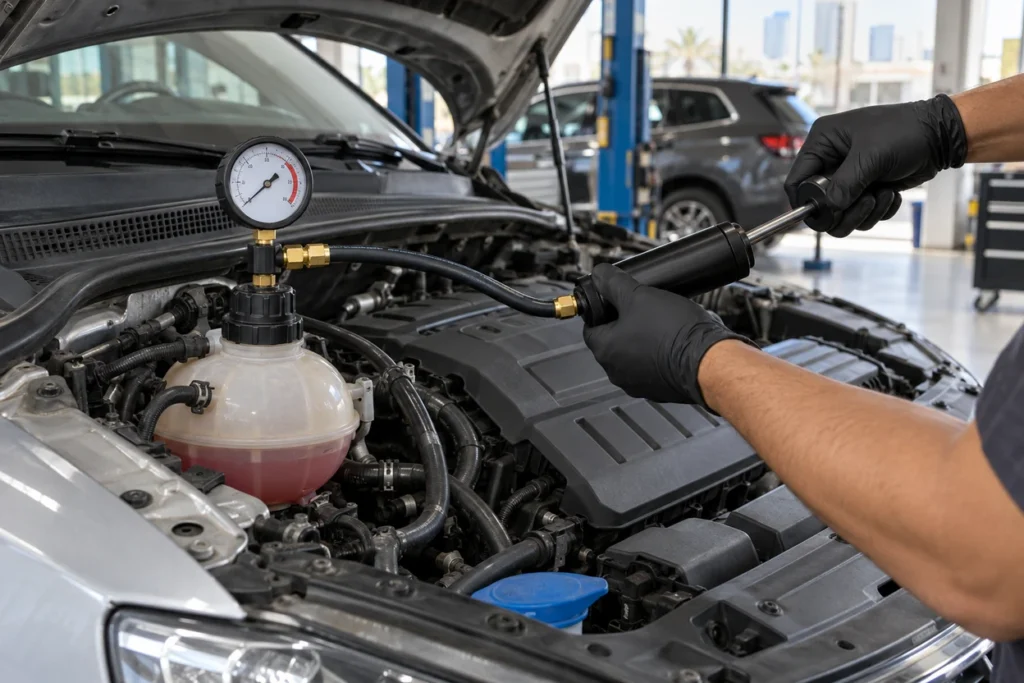
A cold pressure test of the system and the cap to find leaks.
- 3Fans and flow
Check both fan speeds, the thermostat opening and pump circulation.
- 4Engine checks
A combustion gas or compression test if a head gasket fault is suspected.
What damage can overheating cause?
A single short overheat often causes no lasting harm. Repeated or severe overheating can damage expensive parts, which is why stopping early matters.
Head gasket
The gasket between head and block can fail, letting coolant into the cylinders or oil.
Cylinder head
Aluminium heads can warp or crack when driven hot, needing machining or replacement.
Plastic parts
Hot coolant softens plastic housings and tanks, which then crack and leak.
Engine oil
Very high temperatures thin and break down oil, increasing wear on bearings and turbo.
How much does it cost to fix VW overheating in Dubai?
The cost depends on which part has failed. These guide ranges come from our cooling service pages. They are alternatives, not one bill added together.
| Repair | Guide range | Typical cause |
|---|---|---|
| Hose or seal leak repair | AED 300 to 800 | Leaking hose, joint or seal |
| Thermostat or housing | AED 700 to 1,500 plus | Thermostat stuck or housing leak |
| Water pump and thermostat | AED 1,200 to 2,800 | Pump leak or poor circulation |
| Radiator replacement | AED 1,200 to 3,500 | Leaking or blocked radiator |
Indicative ranges. Engine type, access and any damage from overheating change the quote. Head gasket and engine work are quoted after testing. Details are on our coolant leak repair page, thermostat replacement page, water pump repair page and radiator repair page.
Stop the overheating before it damages the engine
Our Al Quoz 4 workshop reads the cooling data, pressure tests the system and checks the fans, thermostat and pump, then explains the repair with a written quote before work.
Overheating mistakes we see in Dubai
Boiling coolant can spray out and cause serious burns.
A few more kilometres can warp the cylinder head.
Water lowers the boiling point and corrosion protection.
Mixing incompatible coolants can reduce protection or form sludge.
Sealers can block narrow passages in the radiator and heater.
A new thermostat will not fix a failed fan or a leak.
Key cooling system terms explained
These are the parts and terms a technician will mention when explaining an overheating fault.
- Expansion tank
- The plastic coolant reservoir with minimum and maximum marks. Check the level only when cold.
- Thermostat
- A valve that opens as the engine warms, letting coolant flow to the radiator.
- Water pump
- The pump that circulates coolant through the engine, radiator and heater.
- Radiator fan
- The electric fan behind the radiator that moves air when the car is slow or stopped.
- Pressure test
- A test that pressurises the cold system to find leaks and check the cap.
- Bleeding
- Removing trapped air after coolant work, following the procedure for each engine.
What we check first on an overheating VW
Every overheating VW in our Al Quoz 4 workshop goes through the same order, from the quickest checks to the most involved.
Cold checks first
The engine is tested cold before anything is replaced.
-
We check the coolant level and condition with the engine cold, and look for dried crust, wet hoses and oil in the coolant.
-
We read the stored cooling faults and live coolant temperature with VW diagnostics.
-
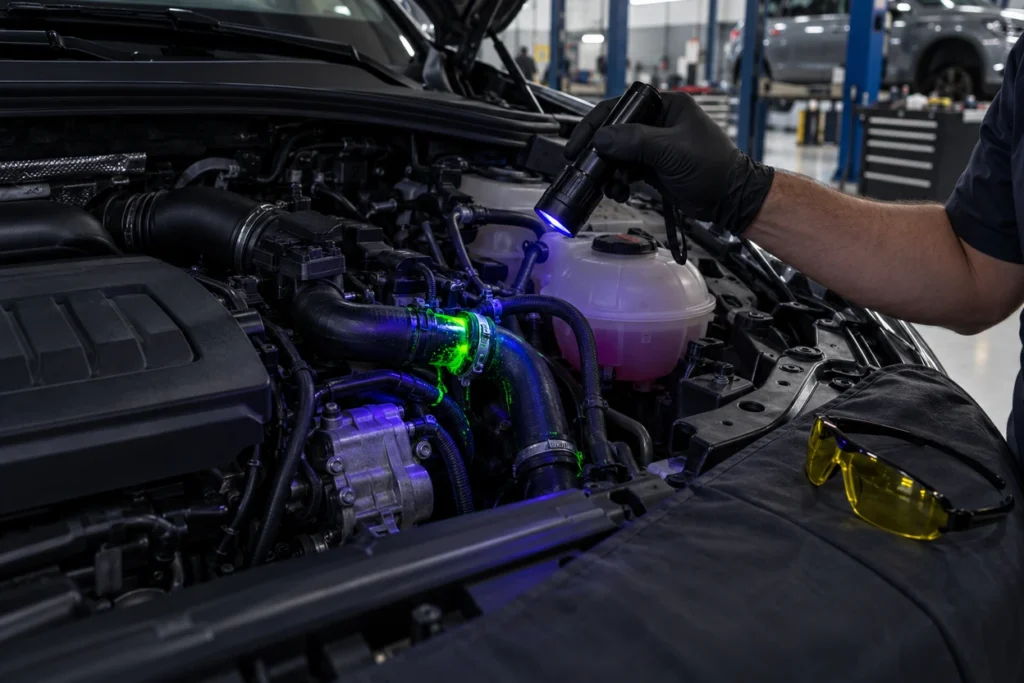
We pressure test the system and the cap, and add dye when a leak only appears hot.
-
We run the engine to temperature and confirm both fan speeds, the thermostat opening and pump circulation.
-
If coolant is being lost with no outside leak, we test for combustion gas before any engine work is discussed.
What to send before your visit
These details help us plan the right checks and tell you whether the car should be driven or recovered.
- Model, year and engine
- When it overheats, traffic, highway or both
- A photo of the warning or gauge
- How much coolant you have added
- Any steam, smoke or sweet smell
- Whether the fans seem to run
- Any recent cooling repair
- Your location if the car is stuck
Send them on WhatsApp to 056 464 6081 and a technician will reply with the safest next step.
Questions about VW engine overheating
What should I do if my VW overheats while driving?
Stop as soon as it is safe and switch the engine off. A red coolant warning, hot-range gauge or steam means do not continue driving. Keep clear of steam, leave the hot cap closed and follow the handbook and professional advice before restarting.
Why does my VW overheat in traffic but not on the highway?
On the highway, air is forced through the radiator by the movement of the car. In traffic, the radiator fan has to do this alone. A weak or failed fan, sand blocking the radiator fins, or low coolant shows up first in slow traffic, especially in summer with the AC working hard.
Is it safe to drive with the coolant warning on?
A red coolant warning means stop safely and switch off, even if the gauge looks normal. It may indicate low coolant, high temperature or a system fault. Follow the exact dashboard instruction and handbook; arrange assistance if safe restart conditions are uncertain.
Which coolant should I use in my Volkswagen?
Use the VW approval specified for the actual engine and follow the vehicle guidance on dilution and mixing. G12evo is identified by TL 774 L, but the colour or a similar product name is not enough to establish suitability. Check the handbook and approved product specification.
Can I add water to my VW coolant in an emergency?
Never open or fill a hot cooling system. Stop safely, let the engine cool and follow the emergency guidance in the handbook for your model. Adding water does not repair a leak or make continued driving safe; obtain advice or recovery if the fault remains.
How do I know if my head gasket has failed?
Common signs are coolant loss with no outside leak, white exhaust smoke, bubbles in the coolant tank, overheating that returns quickly and a milky look under the oil cap. These signs can also have other causes, so a combustion gas test or compression test confirms it before any engine work is quoted.
Why is my VW losing coolant but not overheating?
A slow leak can lower the level for weeks before the engine runs hot. Common places are hose joints, the water pump, the thermostat housing and the radiator. A pressure test with the engine cold, and dye for leaks that only appear hot, finds the source before it causes overheating.
How often should VW coolant be changed?
Follow the service schedule for your model, which depends on the coolant type and the car age. In Dubai heat it is worth checking the level and condition at every service and before summer. Coolant that looks brown, cloudy or oily needs investigating, not just replacing.
How much does it cost to fix an overheating VW?
It depends on the cause. Our guides are AED 300 to 800 for a hose or seal leak, AED 700 to 1,500 plus for thermostat work, AED 1,200 to 2,800 for water pump and thermostat jobs and AED 1,200 to 3,500 for a radiator. Damage from driving while hot is quoted after testing.
Get your cooling system checked in Al Quoz 4
Volkswagen Repair Dubai is an independent VW workshop in Al Quoz 4, open Monday to Saturday, 9am to 7pm. Tell us your model and when the temperature rises, and we will tell you whether to drive in or arrange recovery.
See repair options and prices on our Volkswagen coolant leak repair page.
How this guide was written
This guide explains the symptoms, relevant diagnostic checks and repair choices using Volkswagen owner information and the technical references below.
Prices are the indicative guide ranges published on our own service pages. They are planning figures, not fixed quotes, and the final price always follows an inspection of your car. We update this guide when our service pages or the manufacturer guidance changes.
Technical references
- Volkswagen engine cooling-system warning guidance, including stopping safely and switching off the engine.
- Volkswagen warning and indicator lights guide, explaining the red coolant warning for low level, high temperature or a system fault.
- febi Bilstein technical tip on VW coolant, listing the G11 to G12evo specifications and which types can be mixed.