
Operating conditions
Heat may influence when a fault appears; reproduce the conditions safely and test the system rather than diagnosing from ambient temperature.
Tiguan stalling, slow to start or losing power? We test fuel delivery and electrical supply before replacing a pump. In-tank pump replacement is estimated at AED 1,200–2,200 fitted; TSI high-pressure pump replacement at AED 1,900–3,500. Call to arrange diagnosis, or ask about recovery if it stalls or will not start.
Tiguan fuel pump replacement from AED 1,200. Indicative Dubai guide for the in tank pump. The engine mounted high pressure pump is priced separately.

Long cranking, stalling, hesitation and low-pressure codes are clues, not proof of a failed pump. Volkswagen Repair Dubai in Al Quoz 4 checks supply pressure or delivery, rail-pressure data, electrical supply and other possible causes. Estimated prices are AED 1,200–2,200 for an in-tank pump and AED 1,900–3,500 for a TSI high-pressure pump, subject to VIN and test results.
Record whether the fault occurs cold, hot, under load or at low fuel level. These conditions help diagnosis; none identifies the failed component alone.
| What you notice | What it means | How urgent |
|---|---|---|
| Long cranking | The engine turns over for several seconds before it fires, especially after it has stood in the sun. | Book soon |
| Hesitation when you accelerate | The Tiguan stumbles or feels flat when you overtake or climb a ramp. | Book soon |
| Whine from under the rear seat | A louder hum or whine from the tank area when the ignition is switched on. | Book soon |
| Engine warning light | Fault codes for fuel rail pressure too low or fuel pressure regulation. | Book soon |
| Fuel use going up | Higher consumption has several possible causes; it is not a reliable pump diagnosis. | Book soon |
| Stalling while driving | The engine dies at junctions or on the highway, which is dangerous in Dubai traffic. | Stop and call |
| Limp mode with power loss | The car limits power and the EPC or engine light comes on. | Stop and call |
| Cranks but will not start | The engine turns over but does not start. Fuel, ignition, engine timing and security-related faults need distinguishing. | Stop and call |
A single-cylinder misfire also needs ignition, wiring and engine-condition checks. If there is raw fuel smell or a visible leak, stop the engine, avoid ignition sources and arrange recovery; do not restart to find the leak. See our Tiguan fuel injector guide for that problem.
On TSI petrol Tiguans, fuel reaches the engine through two pressure stages. A supply fault and a high-pressure fault can feel similar, so each stage needs checking.
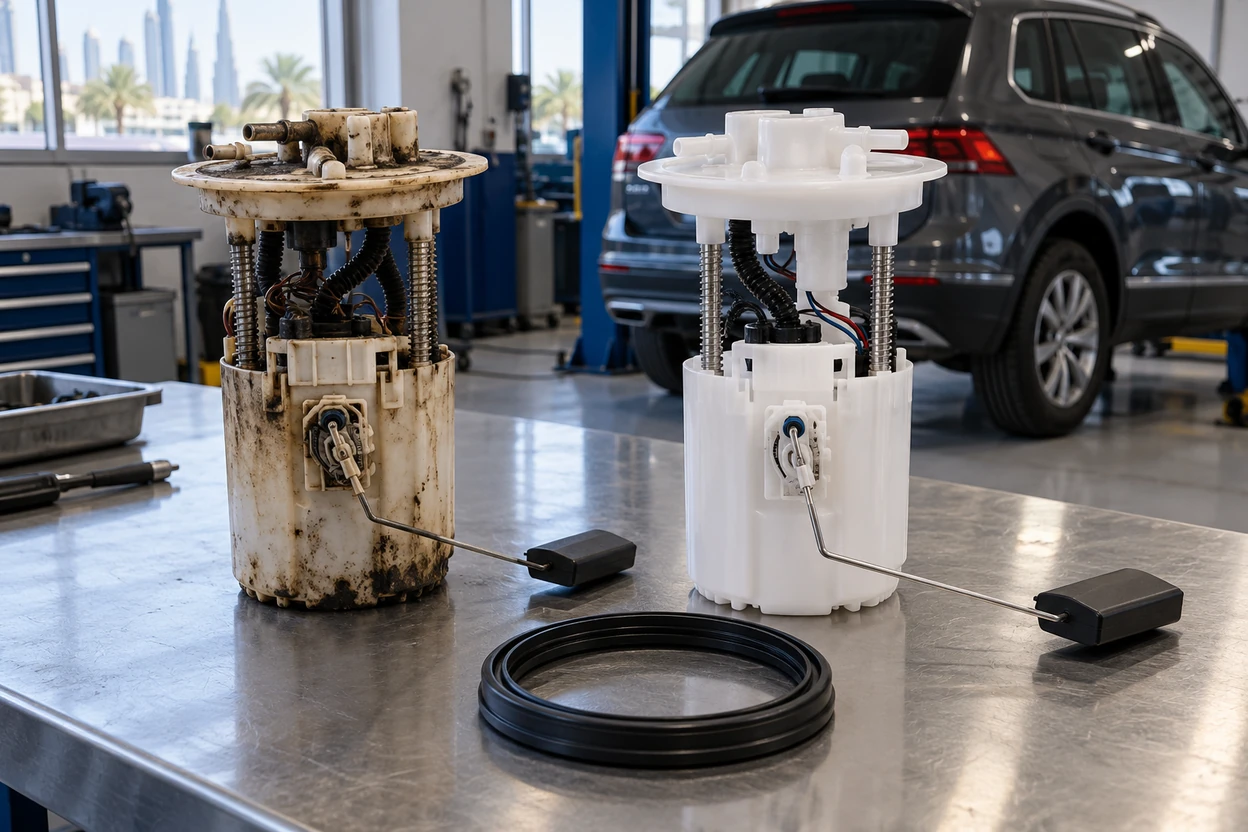
An electric in-tank pump sends fuel towards the engine. Its control module varies pump speed to match demand.
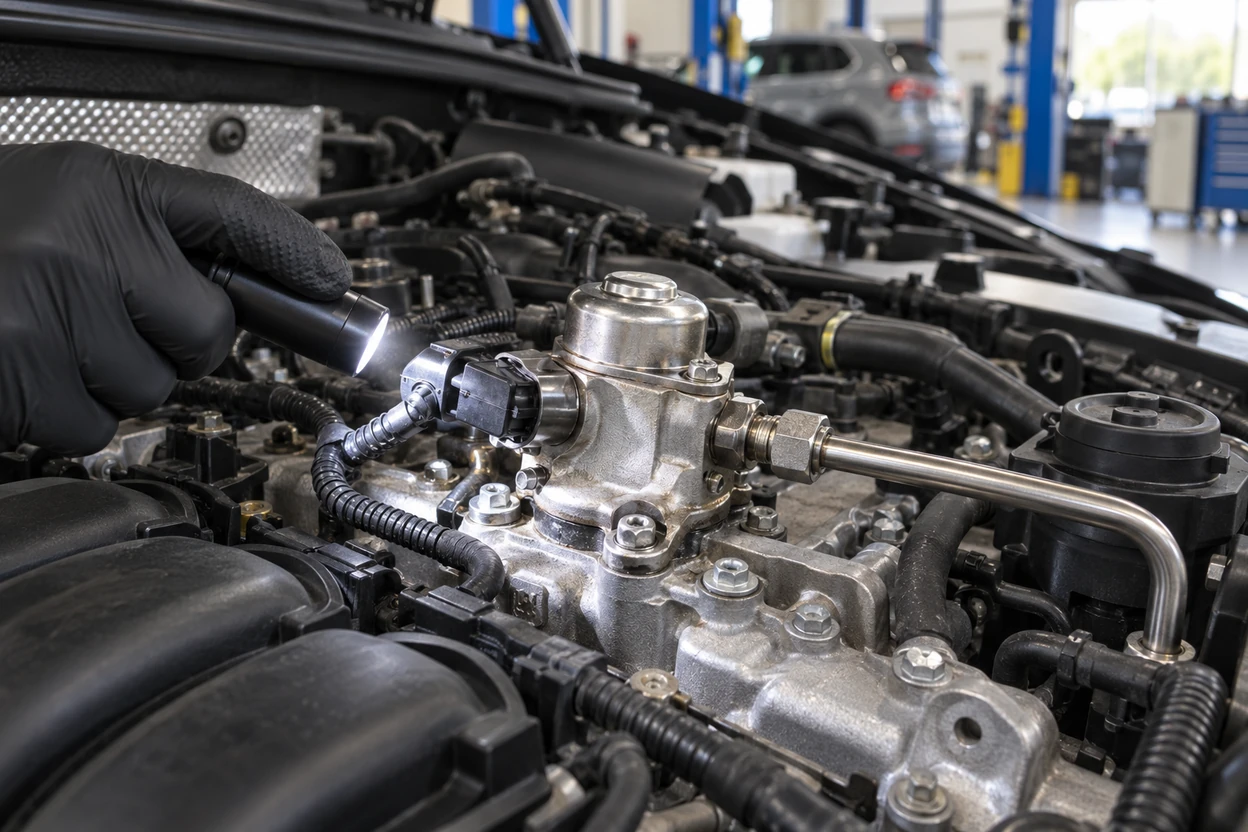
The engine-mounted mechanical pump raises the supply to the rail pressure required by the fitted engine.
The rail supplies the injectors, which spray fuel directly into the cylinders. Pressure data helps assess whether delivery matches demand.
Avoid running out of fuel. Keeping fuel in the tank helps maintain supply, but does not diagnose or repair an existing pump or transfer fault.
Heat and driving habits put extra load on both pumps.
Heat may influence when a fault appears; reproduce the conditions safely and test the system rather than diagnosing from ambient temperature.
Very low fuel can interrupt supply or expose a tank-transfer fault. Sediment is not drawn in only when the tank is low.
Dirt or water in the fuel wears the pump and blocks the strainer and filter.
Heat and corrosion at the connectors can starve a healthy pump of power.
On the engine side a worn roller follower reduces the stroke of the high pressure pump.
These examples cover TSI petrol engines. We check the fitted system before selecting parts for your car; diesel, hybrid and imported versions may need different work.
We use genuine or quality OEM supplier pumps and new seals, and we never reuse the tank flange seal.
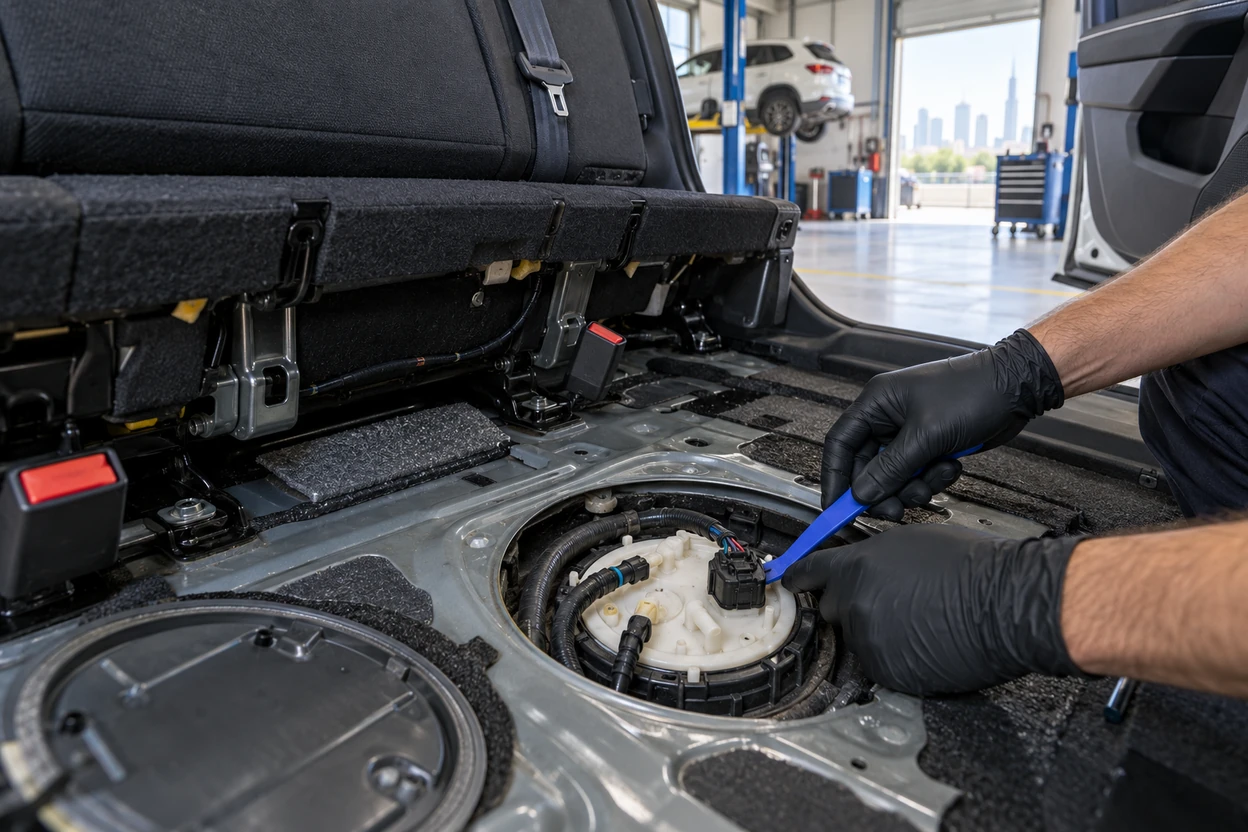
Allow roughly half a day for straightforward in-tank work or up to a day for some high-pressure jobs, subject to diagnosis, access and parts. Contamination, wiring repairs or additional damage can extend the job.
Volkswagen Repair Dubai, independent workshop in Al Quoz 4. Updated 20 October 2026. About our workshop.
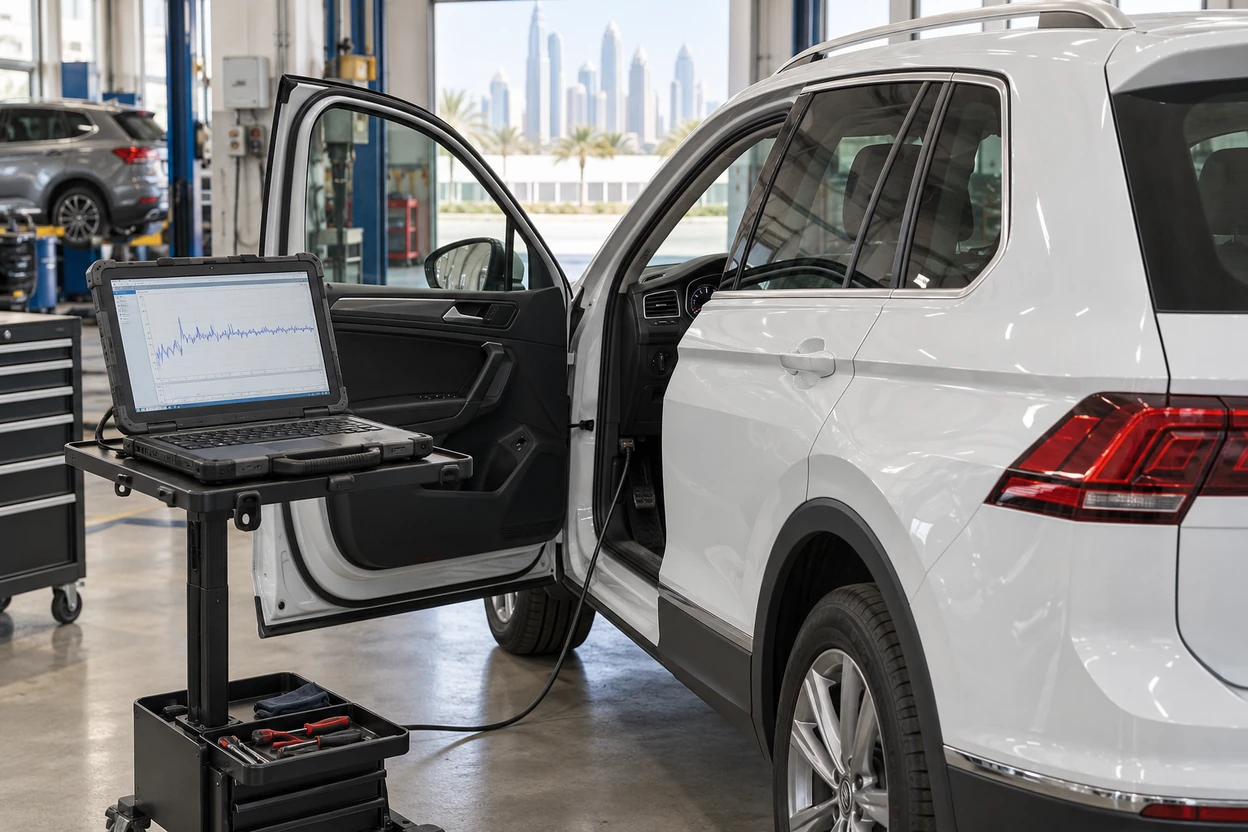
The pressure and electrical checks help distinguish a supply-pump fault from a high-pressure pump or control problem.
The biggest factor is which pump has failed.
Plan around AED 1,200 to 3,800 depending on which pump has failed.
Indicative guides for the listed TSI jobs, not fixed tariffs. Confirm whether any diagnostic charge is credited. TDI, hybrid or contamination-related repairs require a separate scope.
Confirm the diagnostic charge, VAT treatment and total payable in your written quote. Ask for the applicable parts and labour warranty terms, including exclusions, before authorising work. Additional repairs require approval.
Simple habits that reduce wear on both pumps.
Fuel cools the in tank pump, so avoid driving on the reserve light in summer.
Use the grade in your handbook from busy stations with good turnover.
Have pressure faults assessed before a breakdown. A code alone cannot tell whether a pump, module, filter or another component needs work.
Clean oil protects the cam follower that drives the high pressure pump.
If pump-drive damage is suspected, we inspect the related components before fitting the new pump. There is no universal mileage interval for replacing a roller follower.
Long cranking, stalling, hesitation and low-pressure codes justify diagnosis. Compare supply and rail-pressure behaviour, test electrical supply and pressure control, and rule out other causes. Live data alone does not prove which part failed.
Estimated prices are AED 1,200–2,200 for the in-tank pump and AED 1,900–3,500 for a TSI high-pressure pump. Diagnosis, additional damage, fuel contamination and variant differences need explicit quotation. Confirm VAT and the total payable.
The correct repair depends on the test results. Identify the fault with engine-specific tests rather than assuming the in-tank or high-pressure pump is more likely.
Many Tiguans have an access cover below the rear seat. Confirm the exact module and procedure by VIN; access, tank condition or other repairs can change the scope.
Stalling, severe power loss, a no-start or a fuel leak calls for stopping safely and arranging recovery. Do not rely on gentle driving. If symptoms are milder, seek advice before driving and do not assume a weak pump is confirmed.
P0087 can indicate low rail pressure; P0191 concerns pressure-sensor range or performance. Interpret the full code, freeze-frame data and engine-specific test plan. Supply faults, wiring, sensors, regulation or leakage can cause similar codes.
Neither a single-cylinder misfire nor a pressure code settles it. Check ignition and engine condition alongside fuel supply, pressure retention and appropriate injector tests. A leaking injector may also reduce retained rail pressure.
Many 4Motion petrol variants use an electric supply module plus a transfer or suction-jet arrangement in a saddle tank, and a high-pressure pump on the engine. A transfer device is not necessarily a second electric pump. Verify the actual layout by VIN.
Hot-start difficulty can involve loss of retained pressure, a leaking injector, pump or control faults, or a non-fuel issue. Test under the conditions that reproduce the symptom rather than replacing a pump from the symptom alone.
A straightforward in-tank job may fit within half a day; some high-pressure jobs need up to a day. Diagnosis, parts availability, wiring or contamination can extend this. Confirm timing after inspection.
Replace a separately serviceable filter when the maintenance schedule or diagnosis calls for it. Some variants integrate filtration into a module. Filter arrangement and any contamination treatment must be confirmed before ordering parts.
Tell us what happens when you try to start or drive the car. We will explain the next check and guide price; the model year and any warning message are useful if available.