Volkswagen EPC & Engine Warning Diagnosis in Dubai
EPC light, check-engine warning or reduced power? Our independent Volkswagen workshop in Al Quoz 4 reads the fault evidence, tests the affected system and gives you a written repair quote before work is approved.
Initial diagnosis: plan AED 150–500. Indicative Dubai budget; we confirm the assessment scope and fee before starting.
Shaking, flashing engine light or unsafe power loss? Stop safely and call before travelling.
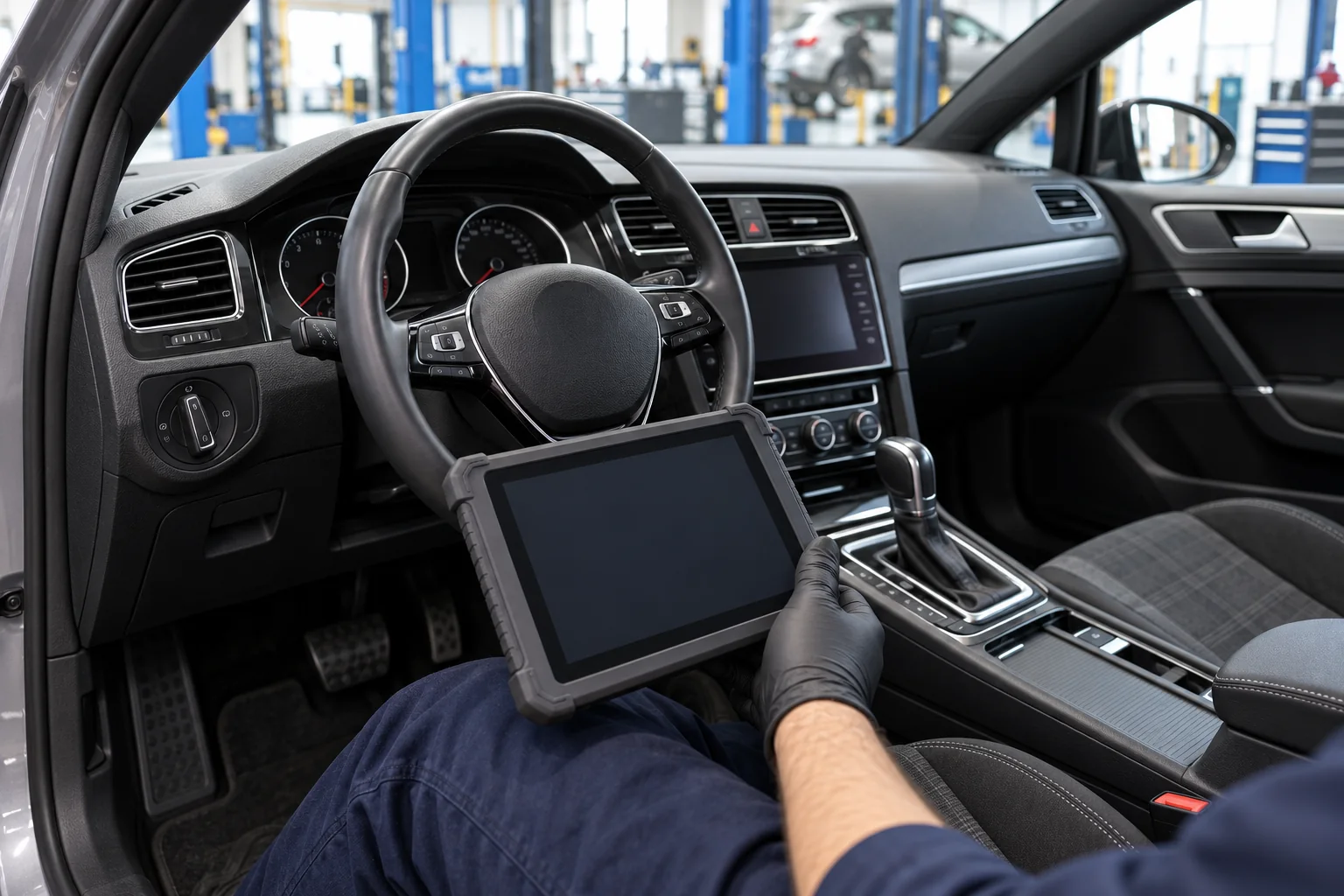
Diagnostic illustration; not a scan result from your vehicle.
Choose the safe next step
Use the symptoms and dashboard message together. EPC, the engine-shaped warning lamp and red oil-pressure or coolant warnings need different responses.
Stop safely · seek assistance
Shaking or unsafe power loss
Severe rough running, stalling, poor throttle response or an inability to keep up safely means you should stop in a safe place. A flashing engine lamp with vibration and reduced power needs assistance rather than a drive to the garage.
Also urgent: red oil-pressure/coolant warnings, overheating, smoke or a fuel smell. Switch off when the warning or symptoms require it; follow the handbook.
Arrange prompt assessment
Amber light, normal running
Read the exact message and the handbook for your model. Call with the details before setting off. A steady lamp and apparently normal performance do not guarantee that every journey is safe.
Unsure about the route or symptoms? Seek assistance. Avoid hard acceleration and do not repeatedly restart or test the car in traffic.
Volkswagen’s engine-management warning guidance advises assistance when the vehicle is vibrating and down on power. Assistance availability and recovery charges are agreed separately.
Budget before booking
What diagnosis and repair cost
There is no single “EPC repair” price. A scan identifies stored information; finding an intermittent signal or proving a mechanical fault can require further testing.
The ranges are planning guides, not fixed offers. Your written estimate identifies assessment, approved parts and quantity, fitting, required settings, any extra work, VAT treatment and applicable warranty terms.
We use Volkswagen-capable diagnostics alongside physical and electrical checks. The aim is to explain the fault, agree the correction and verify the result.
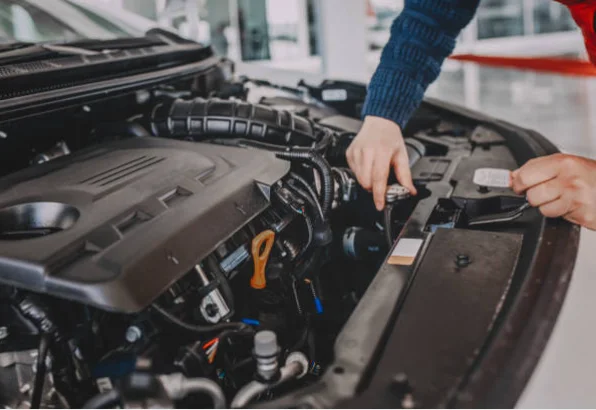
General engine-bay reference; not a documented EPC repair.
01
Keep the fault information
Record the complaint, warning messages, relevant module faults, status and available freeze-frame data before clearing anything. Note recent repairs, tuning or a battery event.
02
Test the relevant circuit or system
Compare live signals with vehicle-specific specifications. Check supply, earth paths, wiring and connectors where indicated. A pedal or throttle fault description does not by itself prove that the named assembly has failed.
03
Explain the findings and scope
Agree the confirmed repair and parts choice. If the fault cannot be reproduced, explain what was checked and what further monitoring or assessment is appropriate rather than declare a cure.
Repair the system that failed
EPC can involve the electronic throttle-control path or appear alongside a wider engine-running fault. The fitted system and test results determine the repair.
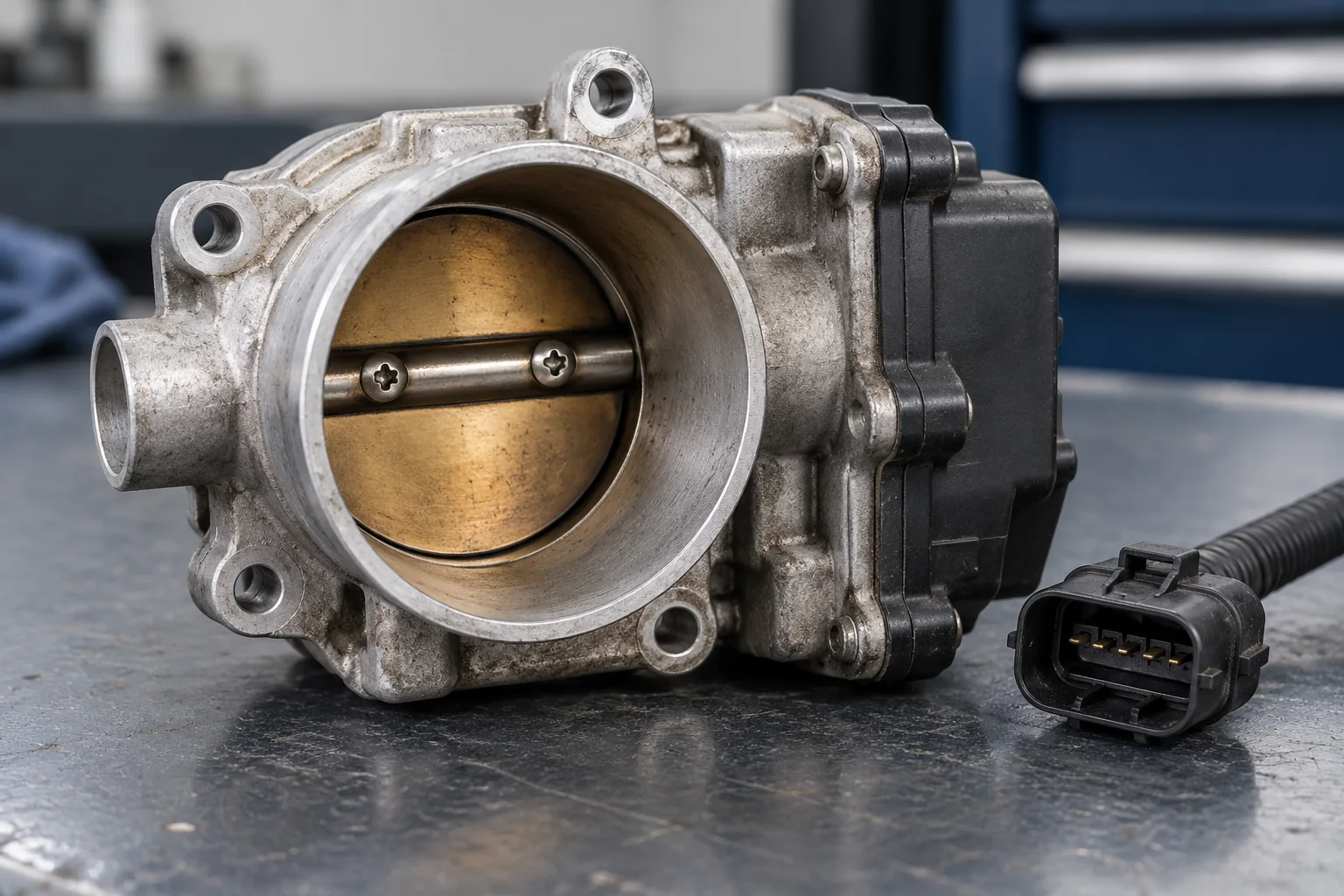
Component illustration; not an exact part for every VW.
Throttle and intake
Actuation and feedback
Compare the requested and actual throttle position and investigate the recorded fault. Cleaning, a required basic setting or replacement is considered only when appropriate. Do not force the throttle flap or use cleaning as a substitute for testing.
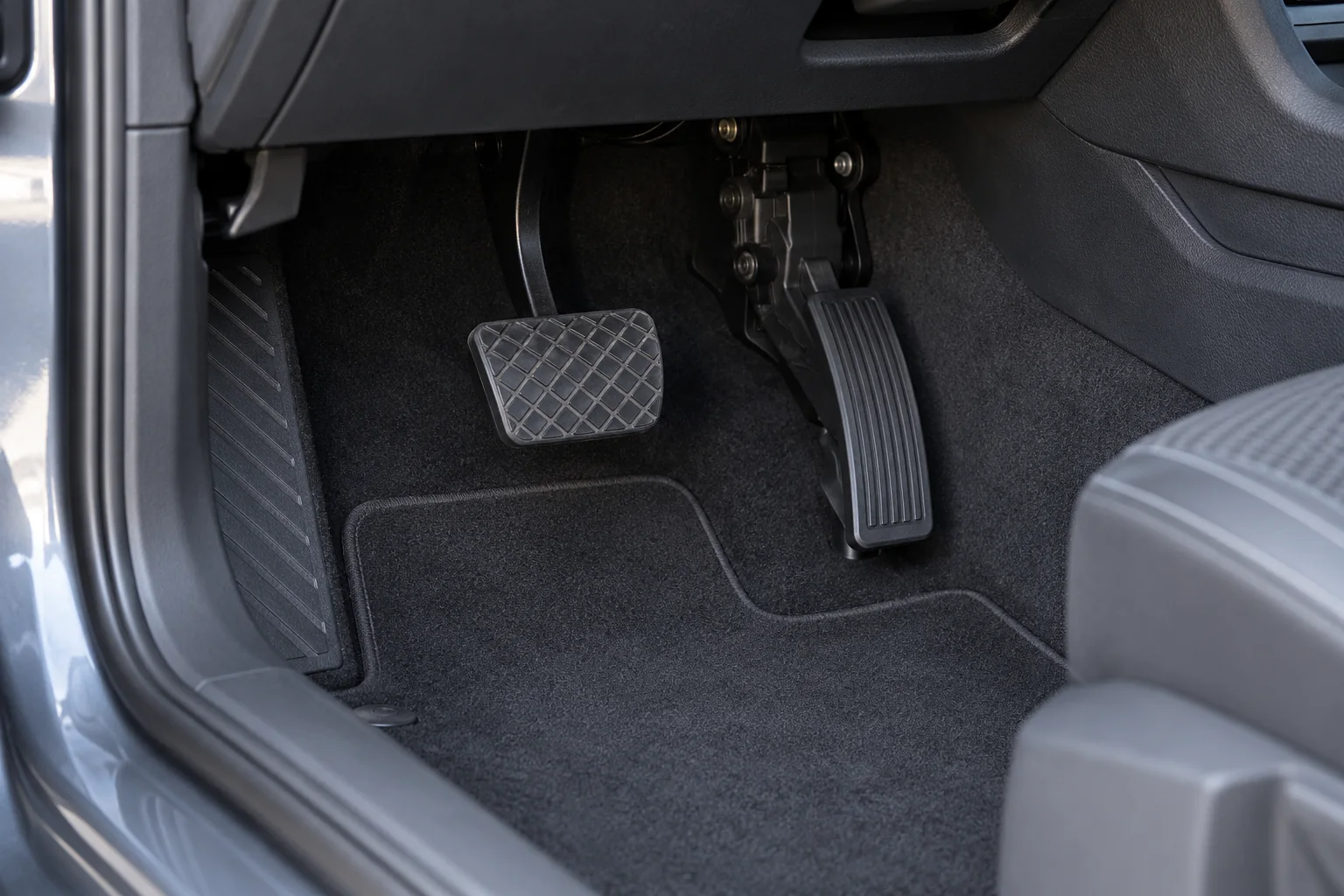
Pedal-layout illustration; equipment varies by vehicle.
Driver inputs and electrics
Signals the engine can trust
Check pedal signal plausibility and the applicable brake-switch input, then prove any wiring, supply or component fault. Working brake lamps alone do not establish that every brake signal is correct. Failed brake lamps or an abnormal brake pedal need attention before travel.
Misfire, fuel or boost findings
Confirmed ignition faults go to ignition diagnosis, with coil replacement or spark-plug replacement only where justified. Fuel-pressure and intake/boost checks depend on the evidence; an EPC lamp is not an automatic turbo order.
Mechanical or control-unit findings
Compression, timing or internal damage may require engine repair assessment. Suspected ECU faults need supply, wiring and supporting tests before ECU repair. Read starting diagnosis if the main problem is failure to start.
What we investigate
Checks behind the engine warning
The engine-shaped malfunction indicator lamp (MIL) covers several systems. We test the relevant one before quoting a repair.
01 · Mixture
Air and fuel
We measure
Mass-airflow (MAF) and manifold-pressure (MAP) readings; short- and long-term fuel trims.
We inspect
Intake/vacuum hoses and PCV crankcase ventilation. Smoke or leak testing where indicated.
Repair decision
Confirm fuel pressure and injector operation before injector replacement. A lean or rich reading needs a cause.
02 · Exhaust feedback
Oxygen sensors and catalyst
We identify
Upstream mixture-control and downstream catalyst-monitoring lambda sensors, by bank and position.
We test
Sensor response, heater circuits, wiring and exhaust leaks.
Repair decision
P0420 alone does not identify the failed part. Confirm the fault before oxygen-sensor replacement or catalyst work.
03 · Evaporative emissions
Petrol EVAP faults
We inspect
Fuel-cap seal, tank-ventilation hoses and canister, where fitted.
We test
N80 purge-valve operation when the EVAP flow fault points there.
Tell us
Hard starting after refuelling or a fuel smell. An EVAP fault does not automatically explain EPC or power loss.
04 · Power under load
Boost control
We compare
Requested and actual boost pressure.
We inspect
Charge-air hoses, control valves and the actuator/wastegate system.
Repair decision
Prove the fault before replacing a turbo. Engine generation determines the correct parts and procedure.
Engine-position signals
Crankshaft/camshaft faults can need wiring, supply and mechanical-timing checks. A sensor code alone does not prove the sensor has failed.
Strong fuel smell or visible leakage? Stop safely and seek assistance.
What your fault code tells us
An OBD-II/OBD2 code read is a starting point. A diagnostic trouble code (DTC) narrows the investigation; VW-specific descriptions and testing add context. Send the complete report, including the exact description, status and other codes. These examples show why a code read and a confirmed repair are different stages.
Code or pattern
What it points to
What we need to establish
P0300 / P0301–P0304
Random/multiple or cylinder-specific misfire on applicable engines.
Compare misfire counters, plugs, coils, injection and mechanical findings. A misfire code does not justify replacing every coil or injector.
P0171
A lean-mixture/fuel-trim condition on bank 1.
Check intake and vacuum leaks, air measurement and fuel delivery. A lean code is not proof of a failed oxygen sensor.
P0420
Catalyst-efficiency monitoring on bank 1.
Assess relevant leaks, oxygen-sensor operation and catalyst condition before selecting a replacement.
P0299
Boost pressure below the expected control range.
Check hoses, boost control and the turbo system. Replacing the complete turbo is not the default response.
P0441
Incorrect flow in the petrol EVAP purge system.
Check the applicable purge valve, ventilation lines and system operation before choosing a valve or canister.
P0571
An implausible brake-switch signal on applicable VW systems.
Compare brake-input data and the relevant circuit. Working brake lamps alone do not prove every switch signal is correct.
Status matters too. An active/static fault, an intermittent stored fault and a pending code provide different context. Freeze-frame information records conditions when a fault was logged. We preserve available evidence before clearing codes and use VW-specific fault descriptions where applicable.
A repair needs a recheck
After the approved work, complete the required settings, check for returning faults and repeat the original operating condition when safe. A cleared code on its own does not show the cause has gone.
We explain the result, any unresolved issue and the next step. Genuine Volkswagen or suitable named supplier parts are listed on the quote, and old parts can be returned on request.
Golf, GTI/R, Jetta, Passat, Polo, Tiguan, T-Roc and Touareg vary by generation, engine and control system. Send the VIN, model/year, engine and gearbox rather than order a part from the badge alone.
On applicable petrol models EPC means Electronic Power Control. Diesel glow-plug/engine-management lamps, hybrid messages and ID. drive-system warnings follow their own handbook instructions. Tell us the exact symbol or send a parked dashboard photo; we will confirm the appropriate assessment scope.
When the warning appears matters
A fault that returns only when cold or under load can be missed by checking a warm, stationary car. Describe the original conditions so the assessment addresses your complaint.
Prepare for the assessment
Send the history with the scan
Include the model/year, VIN, engine, gearbox, mileage and any existing report. Say whether the warning began after servicing, a battery event, jump-start, tuning or an intake/exhaust change.
Recent work helps direct the checks; it is not proof that a particular part or repair caused the warning. The engine control unit (ECU), also called the engine control module (ECM), needs the correct vehicle-specific checks. We match applicable software or technical guidance to the exact car.
Cold start or rough idle
Note how long the shaking lasts and whether it improves as the engine warms. Misfire counts, mixture information and physical checks help distinguish ignition, fuelling and mechanical test paths. Compression or leak-down testing may be needed when the evidence points to a cylinder-sealing problem.
Acceleration or motorway load
Describe hesitation, restricted power and any other message. Requested versus actual boost, throttle response and fuel delivery may matter. Do not reproduce unsafe acceleration to obtain a video.
Hot restart or after refuelling
Record the stopping time, temperature and fuel-stop connection. Supply, engine-position or purge-related checks are chosen from the evidence; the timing of the symptom does not diagnose a part.
Several warnings together
Report ABS (anti-lock brakes), ESC (stability control) or other messages alongside EPC. Relevant control units, supply voltage and network communication may need checks. An additional warning does not by itself identify the failed module.
After the lamp was cleared
Tell us the distance or conditions before it returned. Relevant faults and emissions-monitor readiness are checked after repair; an incomplete monitor or an erased lamp alone does not prove the fault is resolved.
Your questions
Costs, safe arrival, EPC causes and what a proper repair includes.
How much does VW EPC light diagnosis cost in Dubai?
Allow an indicative Dubai budgeting range of AED 150–500 for an initial diagnostic assessment. This is not our confirmed workshop tariff or a complete EPC repair price. We agree the checks and fee before starting; extended electrical tracing, parts, fitting, VAT and any recovery are identified separately on the estimate. The cause and your exact vehicle determine the repair cost.
Is EPC the same as the check-engine light?
No. EPC refers to Electronic Power Control and indicates an engine-control fault on applicable Volkswagens. The engine-shaped malfunction indicator lamp relates to engine/emissions monitoring. They can appear together, but neither identifies a failed component on its own. We record both lights, dashboard messages and symptoms before testing. The vehicle handbook gives model-specific instructions.
Can I drive my Volkswagen to the workshop with EPC on?
A warning lamp alone cannot establish that a journey is safe. Stop safely and seek assistance if the car shakes severely, stalls, will not respond normally or cannot maintain safe progress. A flashing engine lamp with rough running, red oil-pressure/coolant warnings, smoke or a fuel smell needs urgent attention. Call before travelling; if uncertain, arrange assistance rather than attempt a test drive.
Why does EPC disappear when I restart the engine?
An intermittent fault or a temporary operating restriction may no longer be active after a restart. That does not establish that the cause is repaired. Stored or pending faults and the conditions when they occurred may still help diagnosis. Tell us whether it returns when hot, under acceleration or after recent battery, engine or electrical work.
Does an EPC warning mean the throttle body needs replacing?
Not automatically. The throttle actuator and its feedback are one part of the investigation. Pedal signals, brake inputs where applicable, electrical supplies, connectors and the engine-running fault data may point elsewhere. Cleaning, adaptation, a wiring repair or replacement is proposed only when the vehicle-specific checks support it.
Do you diagnose EPC on Golf GTI, Golf R, Jetta and Tiguan?
Send the VIN, model year, engine and gearbox for Golf, GTI/R, Jetta, Passat, Polo, Tiguan, T-Roc or Touareg. Equipment and warning behaviour vary by generation and powertrain. TSI petrol, TDI diesel and hybrid warnings are assessed against the exact vehicle; a flashing diesel glow-plug lamp is not simply renamed EPC.
Will clearing the codes or disconnecting the battery fix it?
Erasing a warning is not proof of repair and can remove useful diagnostic evidence. We record the fault memory and relevant operating data first, address the confirmed cause, complete required settings and repeat the checks. Do not disconnect the battery just to hide the lamp. A generic scan report can be useful to share, but it is not a parts order.
How long will the diagnosis take and what warranty applies?
Timing depends on whether the fault is active, access, the test results and parts availability. We agree the assessment scope and update you if further testing is needed. The written repair estimate records the selected parts, fitting, applicable warranty terms, VAT treatment and collection expectation. Workshop hours are Monday–Saturday, 9am–7pm; assistance and recovery arrangements are confirmed separately.
Does an oxygen-sensor code mean I need a new sensor?
Not automatically. The exact code may concern the heater circuit, supply, wiring, signal behaviour or a mixture problem that the sensor is reporting. We identify the sensor bank and position, inspect the relevant circuit and compare the data with other findings. Replacement is quoted when a sensor defect is supported, rather than assuming every lean-mixture or catalyst code needs a new sensor.
Can a fuel-cap or EVAP fault cause the engine warning?
A petrol EVAP fault can bring on the engine-shaped warning. Where fitted, the cap/seal, hoses, canister and purge valve can need checks depending on the recorded fault. It is not a universal explanation for EPC, misfire or reduced power. Report a warning after refuelling, and seek assistance if there is a strong fuel smell or visible leakage.
What if the warning returns after a scan or repair?
A code-clearing scan is not a completed repair. Keep the original and new reports, note when the light returned and contact the workshop for a recheck. An intermittent fault, an unresolved cause or a separate issue can require different next steps. We compare the current evidence with the approved work; applicable warranty terms depend on the repair recorded on your quote or invoice.
Get a clear diagnosis
Call with the warning, symptoms and your location before travelling. Our Al Quoz 4, Dubai workshop opens Monday–Saturday, 9am–7pm. We agree the assessment and provide a written quote before approved repairs.