In this guide
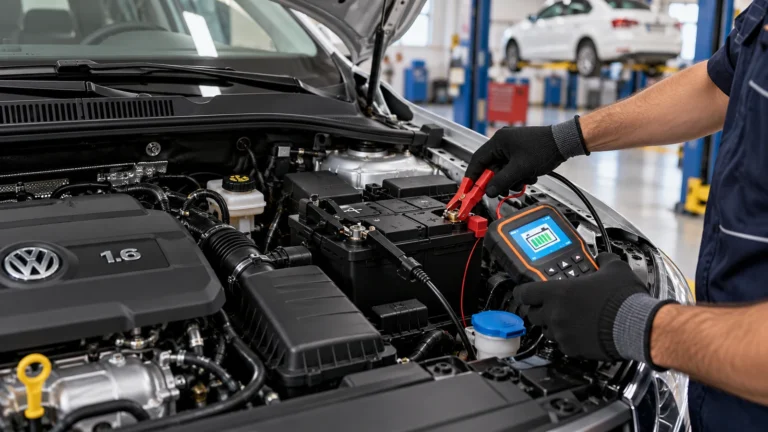
A VW battery tester measures resting voltage and, on most digital testers, the battery health under a simulated load. Voltage alone only shows state of charge, not condition. For a reliable answer, rest or recharge the battery first, enter the correct type and rating, run the load or conductance test, then check charging with the engine running.
Written by the Volkswagen Repair Dubai workshop team in Al Quoz 4. Reviewed by the technical team, updated October 2026.
Key takeaways
- A voltmeter shows how charged the battery is. It cannot prove the battery is healthy.
- Test after the car has rested for several hours, or the reading is falsely high from surface charge.
- Digital testers need the right battery type, AGM or EFB, and the cranking rating from the label.
- A flat battery should be recharged and retested before it is judged.
- A good battery that keeps going flat points to charging or a drain, not the battery.
- Many VWs use smart charging, so engine running voltage varies more than on older cars.
Which battery tester do you need for a VW?
There are three common kinds of tester. They answer different questions, so it helps to know what yours can and cannot tell you.
Multimeter
Measures voltage. Useful for state of charge and charging checks, but cannot judge battery health on its own.
Digital conductance tester
Estimates health and cranking ability without a heavy load. Needs the correct battery type and rating entered.
Carbon pile load tester
Applies a real load for a few seconds. Accurate but bulky, and mainly a workshop tool.
VW diagnostics
Reads the battery sensor and charging data the car itself records. Used alongside a tester, not instead of one.
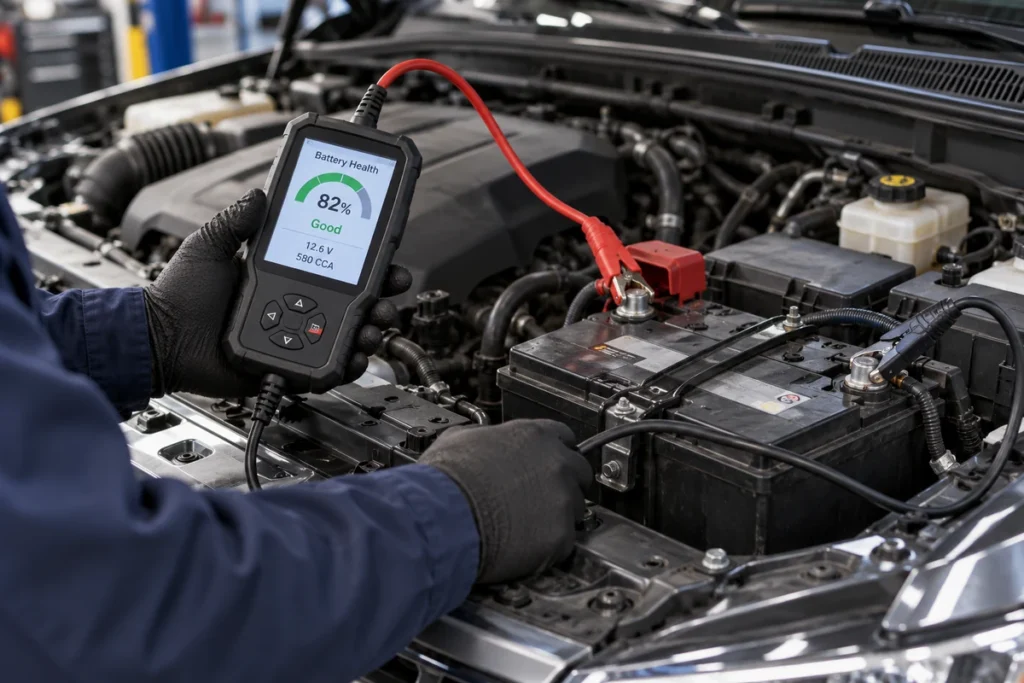
For most owners, a basic digital tester that supports AGM and EFB batteries is enough to spot a problem early. The workshop then confirms the result with a load test and the car data.
How do you prepare for an accurate test?
Most wrong readings come from testing at the wrong moment or with the wrong settings. A few minutes of preparation makes the result far more useful.
- Let it rest
- Test after the car has been parked for several hours, ideally overnight. A battery just after driving shows a falsely high surface charge.
- Everything off
- Lock the car or switch off lights, AC and accessories, and keep the key away so modules can sleep.
- Know the battery
- Read the label for type, AGM or EFB, capacity in Ah and cranking rating in CCA or EN. Enter these into a digital tester.
- Clean contact
- Clip onto clean metal on the terminals. Corrosion or a loose clamp gives a poor reading.
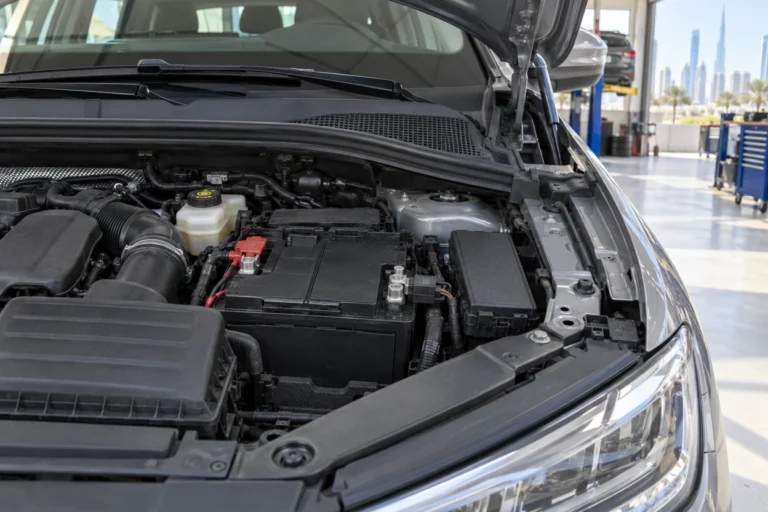
On some VWs the battery sits in the boot or under a seat. If you cannot reach it safely, use the jump start points shown in your owner manual for voltage checks, but a full health test needs the battery terminals.
Got a reading you are unsure about? Send us a photo of the tester screen and the battery label, and we will tell you what it means.
How do you test a VW battery step by step?
-
Resting voltage
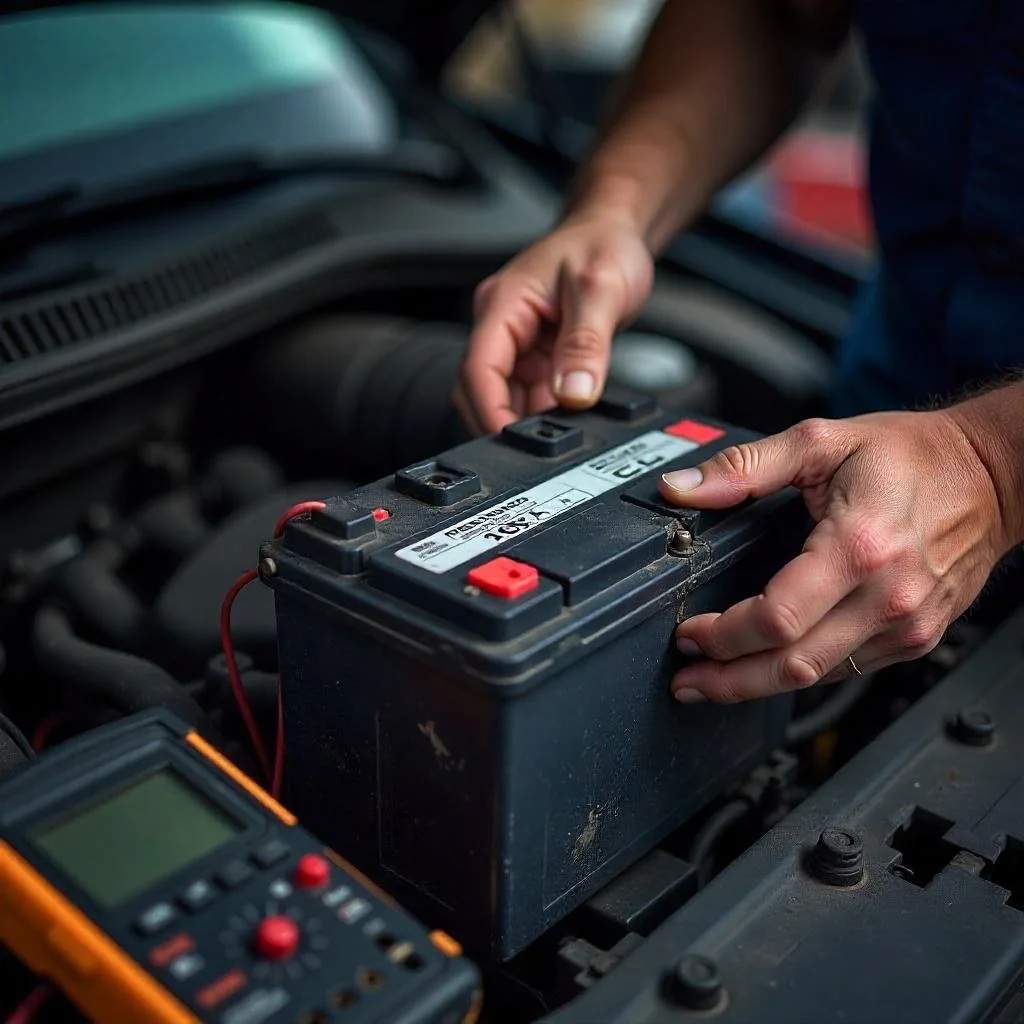
With the car rested and off, connect red to positive and black to negative. Note the voltage.
-
Health test
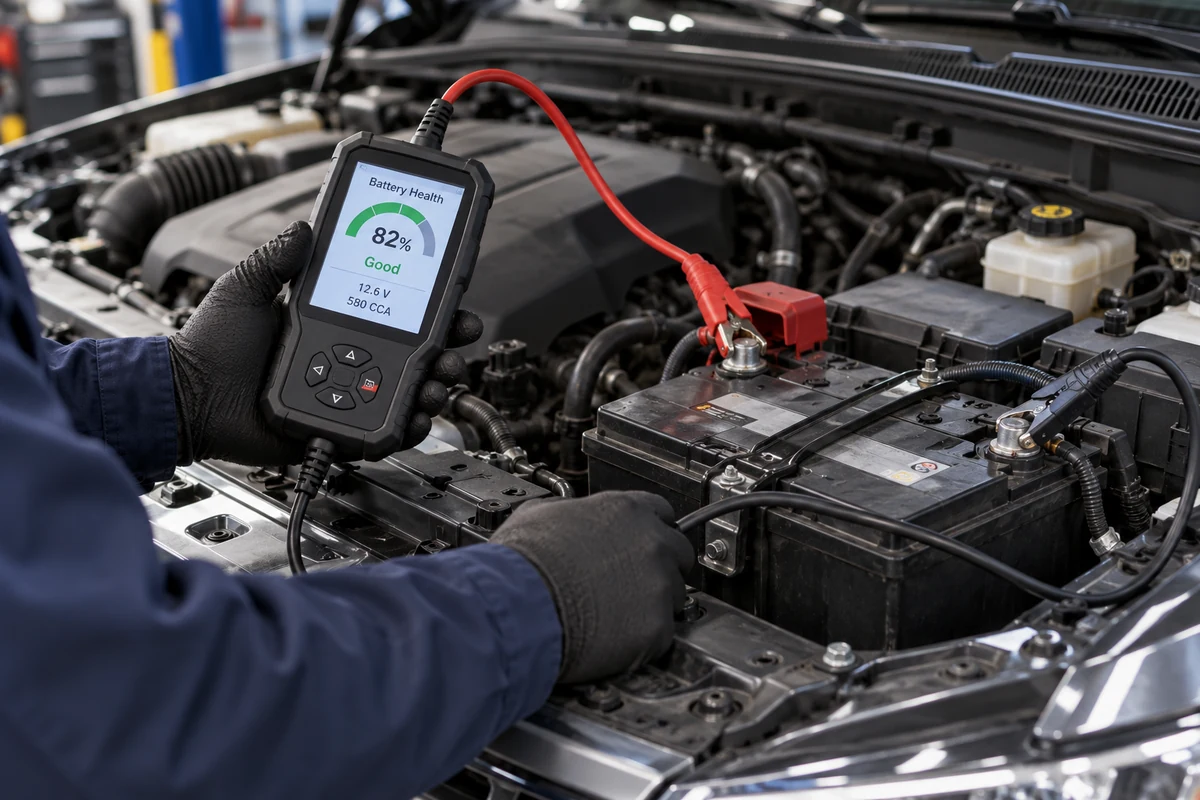
On a digital tester, choose the battery type and enter the rating from the label, then run the test.
-
Cranking check
If your tester offers it, start the engine while connected and note how far voltage drops.
-
Charging check
With the engine running, note the voltage at idle, then with lights, fans and AC on.
-
Record the result
Photograph the screen. Comparing readings over months shows a battery that is fading.

What do VW battery voltage readings mean?
These figures are approximate resting voltages for a healthy 12 volt lead acid battery after it has rested. AGM batteries often read a little higher when full. They show state of charge only.
| Resting voltage | Approximate state of charge | What to do |
|---|---|---|
| 12.6 volts or more | Fully charged | Run a health test to confirm condition |
| About 12.4 volts | Around three quarters | Charge with a longer drive or a charger, then retest |
| About 12.2 volts | Around half | Recharge and look for the cause |
| 12.0 volts or less | Discharged | Recharge fully before judging the battery |
Approximate values. Varta gives about 12.8 volts as ideal for a conventional battery and advises recharging below 12.4 volts. Temperature and battery design shift these slightly. A battery can show good voltage and still fail a load test.
A low reading does not mean the battery is finished. A healthy battery left with a dash cam running or parked for weeks can read low. If it recharges and passes a health test, look for why it went flat.
How do you read the health test result?
Digital testers usually give a simple verdict alongside the numbers. This is what each one usually means.
Good battery
Health and cranking figures are close to the rating. If the car still has starting trouble, check connections, charging and the starter.
Recharge
The battery may be fine but is too low to judge. Charge it fully, let it rest and test again.
Bad or replace
After a full charge, the battery cannot deliver its rated cranking power. Replace it with the correct type.
A wrong battery type or rating entered into the tester can turn a good battery into a fail, or the opposite. If the result surprises you, check the settings first.
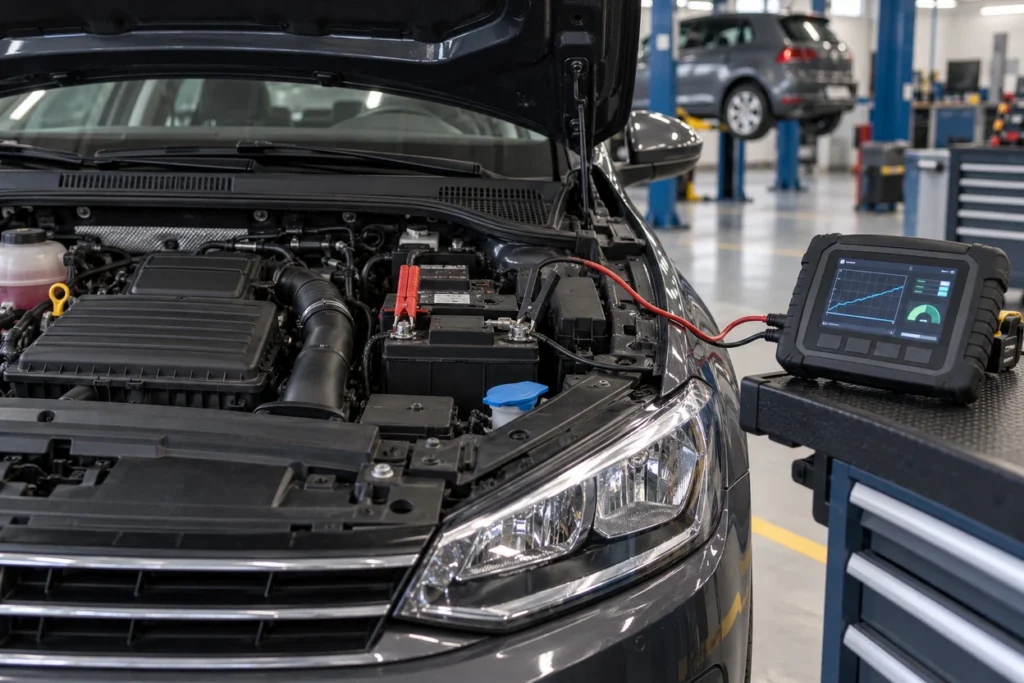
How do you check the charging system?
With the engine running, the alternator should raise the voltage above resting level. On older VWs this is usually around 13.5 to 14.5 volts. Many newer VWs use smart charging, which raises and lowers voltage depending on battery condition, temperature and driving.
- Voltage stays near resting level with the engine running suggests a charging fault.
- Voltage climbs very high can mean a regulator fault, which damages batteries.
- Low voltage with smart charging may be normal for a moment, so one reading is not enough.
- Red battery light with the engine running needs a full charging test.
Never disconnect the battery with the engine running to test the alternator. It can damage the electronics. Our alternator replacement page explains how charging is tested properly.
Why do battery readings matter more in Dubai?
Heat speeds up wear inside a battery, so capacity can fade faster here than in a cooler climate. A battery often loses strength quietly in summer, then fails on the first morning it is asked for full cranking power.
- 1Summer heat
Internal wear speeds up and capacity falls.
- 2Short trips, AC on
The battery is not fully recharged between starts.
- 3Long parking
Standby drain lowers the charge further.
- 4No start
A weak, partly charged battery cannot crank the engine.
Testing every few months, and before a long trip or summer, catches this before it leaves you stranded. Our guide to VW battery problems covers the warning signs to watch for between tests.
What should you do after the test?
The result points to the next step. Replacing a battery is only the answer when the battery itself has failed.
| Result | Guide range | Next step |
|---|---|---|
| Battery fails after a full charge | AED 400 to 1,200 | Battery replacement with the correct type and registration |
| Battery passes but no charging | AED 1,800 to 3,600 | Alternator test, then repair or replacement if confirmed |
| Battery passes but keeps going flat | Quoted after testing | Parasitic drain test with the car locked |
Indicative ranges from our service pages. Diagnosis and drain testing are quoted separately. Battery type and registration are explained in our AGM and EFB battery guide.
Get a full battery and charging test
Our Al Quoz 4 workshop load tests the battery, reads the VW battery sensor data and checks charging and drain, then explains the result with a written quote before any work.
Battery testing mistakes we see
Surface charge makes a weak battery look healthy.
An AGM tested as a standard battery can give a false result.
Recharge it first. A discharged battery always tests poorly.
Good voltage does not prove the battery can crank the engine.
Disconnecting with the engine running can damage modules.
If the battery passes but the car fails, the fault is elsewhere.
Quick answers about testing a VW battery
What is a good VW battery voltage? About 12.6 to 12.8 volts at rest when fully charged. Below 12.4 volts it needs recharging.
Does good voltage mean a good battery? No. Voltage shows charge only. A load or conductance test shows health.
When should I test the battery? After the car has rested for several hours, ideally overnight.
Which setting do I choose for AGM? The AGM setting on the tester, with the cranking rating from the label.
What if the battery passes but goes flat? Check charging and look for a parasitic drain with the car locked.
Key battery testing terms explained
Battery testers and labels use a few technical terms. These are the ones you need to read a result correctly.
- Open circuit voltage
- The voltage of a battery at rest with nothing connected and no charging. It shows state of charge.
- State of charge
- How full the battery is right now. A healthy battery can still show a low state of charge.
- State of health
- How much of its original ability the battery still has. This needs a load or conductance test.
- CCA and EN
- Cold cranking ratings printed on the label, measured to different standards. Enter the matching one into a tester.
- Surface charge
- A falsely high voltage just after driving or charging. It fades after the battery rests.
- Conductance test
- The method most digital testers use to estimate battery health without a heavy load.
What we see when owners test their own battery
Owners often bring us tester readings. These are the patterns that most often lead to a wrong conclusion.
Read the result right
The settings decide whether the verdict is useful.
-
The battery is tested straight after a drive, so surface charge makes a weak battery look healthy.
-
An AGM or EFB battery is tested on the standard battery setting, which gives a misleading verdict.
-
The cranking rating is entered in a different standard from the one on the label, such as CCA instead of EN.
-
A flat battery is tested before it is recharged, so it fails even though it may recover fully.
-
The tester shows a good battery, but the real fault is a drain or charging problem that was never checked.
What to send before your visit
A photo of your reading and these details let us tell you whether the battery or something else needs attention.
- Model, year and engine
- A photo of the battery label
- A photo of the tester result
- The setting you used on the tester
- When the car was last driven
- How the car behaves when starting
- Any dashboard warning
- The age of the battery if known
Send them on WhatsApp to 056 464 6081 and we will explain what the reading means.
Questions about testing a VW battery
What voltage should a VW battery have?
A healthy, fully charged 12 volt battery that has rested for several hours usually reads around 12.6 volts or more, and AGM batteries can read slightly higher. About 12.4 volts is roughly three quarters charged, and 12.0 volts or less is discharged. These figures show charge, not health, so a load or conductance test is still needed.
Can a battery show 12.6 volts and still be bad?
Yes. A battery can hold a good resting voltage but fail when asked to deliver starting current. That is why digital and load testers are used. They check how the battery performs under demand, which is what matters when you press start on a hot morning.
How often should I test my VW battery in Dubai?
Testing every few months is sensible, and before summer or a long trip. Older batteries, cars used for short trips and cars parked for long periods benefit from more frequent checks. Many workshops include a battery test with each service, which is an easy way to keep track.
Which setting do I choose for an AGM or EFB battery?
Choose the setting that matches the label on your battery. Most digital testers have separate options for AGM, EFB or start stop, and standard flooded batteries. Enter the cranking rating shown on the label in the same standard, usually CCA or EN. The wrong setting can give a false pass or fail.
What should the voltage be with the engine running?
On many older VWs it sits around 13.5 to 14.5 volts. Newer VWs with smart charging vary the voltage with battery condition and driving, so it can be lower for a while without a fault. A reading that stays near resting voltage, or climbs very high, needs a proper charging test.
My battery tests good but the car will not start. Why?
The fault is likely elsewhere. Loose or corroded terminals, a weak earth strap, a starter fault or a problem with key recognition can all stop a start with a good battery. If the engine cranks but does not fire, fuel, ignition or sensors are checked instead. Our no start diagnosis page covers these.
Does my VW need registration after a new battery?
Many modern VWs with battery management need the new battery registered, so the car charges it correctly for its type and capacity. Older or simpler models may not. A tester cannot do this step. It is done with VW diagnostic equipment after fitting.
Is a cheap battery tester worth buying?
A basic digital tester that supports AGM and EFB batteries is useful for spotting a fading battery early. It is not as precise as workshop equipment, and it cannot read the car battery sensor or charging data. Treat a fail as a reason to get a full test, not as a final verdict.
Get your battery tested properly
Volkswagen Repair Dubai is an independent VW workshop in Al Quoz 4, open Monday to Saturday, 9am to 7pm. Send your model, year and a photo of your tester reading, and we will tell you what to do next.
See prices and booking details on our Volkswagen battery replacement page.
How this guide was written
Written by the Volkswagen Repair Dubai workshop team in Al Quoz 4 and reviewed by our technical team in October 2026. It is based on the diagnosis steps we follow on Volkswagen cars in Dubai, together with Volkswagen owner information and the technical sources listed below.
Prices are the indicative guide ranges published on our own service pages. They are planning figures, not fixed quotes, and the final price always follows an inspection of your car. We update this guide when our service pages or the manufacturer guidance changes.
Technical references
- Varta step by step battery testing guide, which gives about 12.8 volts as the ideal resting voltage for a conventional battery and advises recharging below 12.4 volts.