In this guide
When a VW suddenly uses more fuel in Dubai, first confirm it with a fill to fill measurement, then rule out normal causes such as heavy AC use, idling in traffic, short trips, roof loads and low tyre pressure. If the rise is still there, a fault such as an oxygen or MAF sensor, a stuck open thermostat, misfires, leaking injectors or dragging brakes is likely and needs a diagnostic check.
Written by the Volkswagen Repair Dubai workshop team in Al Quoz 4. Reviewed by the technical team, updated October 2026.
Key takeaways
- Measure before you worry. A fill to fill check over a few tanks is more reliable than the trip computer alone.
- In a Dubai summer, AC use, long idling and stop start traffic can raise fuel use without any fault.
- Low tyre pressure, the wrong tyre size, roof boxes and heavy loads all add drag or rolling resistance.
- Common fault causes are oxygen or lambda sensors, the MAF sensor, a thermostat stuck open, misfires and leaking injectors.
- Dragging brakes and gearbox or DSG slip can waste fuel without a warning light.
- Use the fuel grade your VW asks for, as shown on the fuel filler flap or in the owner manual.
How do you measure VW fuel consumption properly?
A sudden jump on the trip computer is a useful warning, but it is not proof. The figure resets, depends on which memory you are looking at, and changes a lot with one long idle or one highway run. On many VW models the multifunction display can show consumption since start, since refuelling and long term, so check which one you are reading before you compare. The most reliable method is the fill to fill method, which uses the fuel pump and the odometer instead of the trip computer.
-
Fill the tank completely
Fill at the same station and pump if you can, and stop at the first automatic click of the nozzle. Do not top up after the click.
-
Reset a trip counter
Reset trip A or note the odometer reading straight after filling, before you drive away.
-
Drive normally
Use the car as you usually do, ideally until the tank is at least half empty, so a small error at the pump matters less.
-
Fill again to the first click
Refill at the same pump, stop at the first click again and note the litres added and the kilometres driven.
-
Repeat over two or three tanks
One tank can be distorted by a desert trip or a week of school runs. Two or three tanks give a fair average.
Divide the litres you added by the kilometres you drove, then multiply by 100. For example, 40 litres added after 500 km gives 8 litres per 100 km. Compare this with your own earlier tanks, driven in a similar way, rather than with a brochure figure, because brochure figures come from standard test cycles, not Dubai traffic in August.
If your own fill to fill figure has clearly risen compared with the same kind of driving a few months ago, the change is real and worth explaining. Keep the receipts or a note of each fill, because that record helps a technician separate a driving pattern change from a fault.
What normal things make a VW use more fuel in Dubai?
Before thinking about faults, look at how the car has been used. Many owners notice higher fuel use in summer, after a change of commute or after new tyres, and the car is working exactly as designed. These are the everyday causes we discuss with owners first.
- AC in the summer
- The AC compressor is driven by the engine, so on very hot days it takes a noticeable share of the fuel, especially at low speed and when idling.
- Idling in traffic
- An idling engine uses fuel while covering no distance, so slow traffic on Sheikh Zayed Road or Al Khail Road pushes the per 100 km figure up.
- Short trips
- A cold engine runs a richer mixture until it warms up. Many short trips mean more of each drive happens before the engine is fully warm.
- Roof load and weight
- Roof boxes, bike racks and roof bars add drag at highway speed, and a boot full of equipment adds weight on every start.
- Tyre pressure and tyre choice
- Low pressure and some replacement tyres raise rolling resistance, which the engine has to overcome all the time.
- Driving style
- Hard acceleration, late braking and high cruising speeds on open roads use far more fuel than smooth, steady driving.
If one of these has changed recently, adjust it and measure again over two tanks before booking anything. If nothing has changed and the figure still climbs, a fault becomes much more likely.
How much does AC use affect fuel in a Dubai summer?
AC is the largest normal reason for higher summer fuel use in the UAE. The United States fuel economy guide published by the Department of Energy states that AC use can reduce the fuel economy of a conventional vehicle by more than 25 percent in very hot conditions. In Dubai, where the AC runs almost all year and often at full power, that effect is part of normal ownership.
Some extra fuel in summer is normal
A modest rise from spring to August, with the same routes, is usually the AC and not a fault.
Park out of the sun
Shade or a sunshade keeps the cabin cooler, so the AC has less heat to remove at the start.
Vent hot air
Open the windows for a short time when you set off, then close them and use the AC.
Cool while driving
Most AC systems cool the car faster while driving than while standing still with the engine running.
The same source advises using the windows at low speed and the AC at highway speed, because open windows add drag as speed rises. If your AC struggles to cool and the fuel use is also high, the compressor may be working harder than it should. Our guide to VW dashboard warning lights covers other signs that appear with heat related problems.
Can tyre pressure or the wrong tyres raise fuel use?
Yes. Tyres affect fuel use every metre you drive. The same Department of Energy guide states that under inflated tyres can lower fuel economy by about 0.2 percent for every 1 psi drop in average pressure, and that correct pressure improves economy by 0.6 percent on average and up to 3 percent in some cases. Heat in Dubai raises tyre pressure during the day, so owners often check in the afternoon, see a normal figure, and miss that the cold pressure is low.
- Check cold. Check pressure in the morning before driving, using the figures on the label inside the fuel filler flap or the door pillar.
- Do not use the sidewall maximum. The number on the tyre is a limit, not the recommended pressure.
- Match the size. A wider or heavier tyre than the original size can raise rolling resistance and change the speed reading.
- Look at the tread type. Some off road or high grip patterns use more fuel than the tyre the car was designed around.
- Check for a slow leak. One tyre that keeps losing pressure also wears unevenly and can make the car pull.
Which faults cause high fuel consumption on a VW?
When normal causes are ruled out, these are the faults we find behind VW high fuel consumption, roughly from the most common. Several of them do not always turn on a warning light, which is why owners notice the fuel bill before anything else.
-
Oxygen or lambda sensor
A slow or faulty upstream sensor gives the engine control unit a wrong picture of the mixture, so it adds more fuel than needed.
Checked with sensor voltage and switching in live data, plus fuel trims.
-
MAF sensor
A dirty or failing air mass meter misreads incoming air, and the fuelling is calculated from that wrong number.
Checked by comparing measured air mass with the expected value at idle and under load.
-
Thermostat stuck open
The engine runs cooler than designed, so the control unit keeps a richer warm up mixture for longer.
Checked with coolant temperature in live data, because the VW gauge can stay at 90 while the real figure is lower.
-
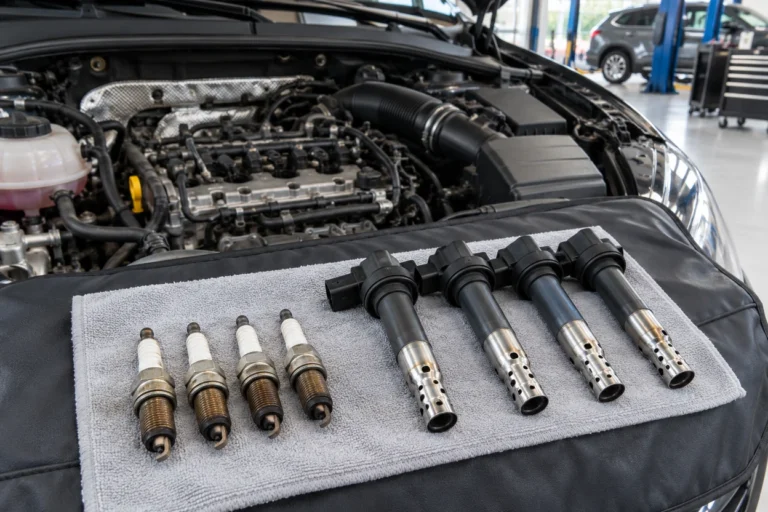
Misfires from coils or plugs
A weak spark leaves fuel unburnt, wastes power and can damage the catalytic converter if ignored.
Checked with misfire counters for each cylinder and a plug and coil inspection.
-
Leaking or dirty injectors
An injector that drips or sprays poorly delivers more fuel than commanded or burns it badly.
Checked with fuel trims, misfire data and pressure tests.
-
Dragging brakes
A sticking caliper or parking brake keeps braking lightly all the time, like driving with a hand on the brake.
Checked by wheel temperature after a drive and by turning each wheel by hand.
-
Gearbox or DSG slip
A slipping clutch or poor shifting raises engine speed without adding road speed.
Checked with gearbox live data, clutch slip values and a road test.
-
Wrong oil grade
A thicker oil than the engine is designed for adds internal friction.
Checked against the service record and the oil approval for the engine code.
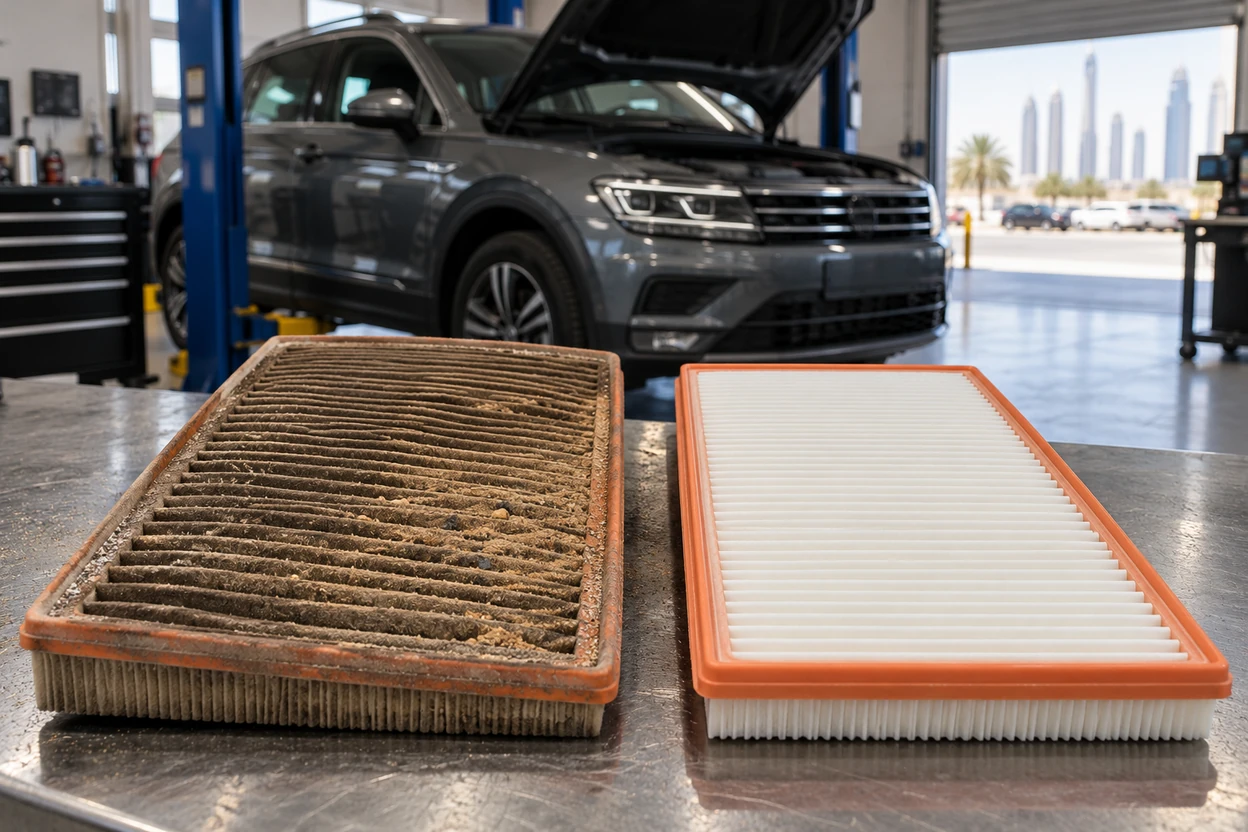
A clogged air filter is often blamed for high fuel use. The Department of Energy guide explains that on modern fuel injected, computer controlled engines, a new air filter does not improve fuel economy but can improve acceleration, while on old carburettor engines it can help both. We still check and replace dusty filters, because Dubai sand loads them quickly, but we do not sell a filter as a fuel cure. Our air filter replacement page lists the filter guide ranges.
Fuel use suddenly higher? Send us your model, year and your fill to fill figures, and a technician will tell you which checks make sense first.
How do oxygen and MAF sensor faults waste fuel?
The engine control unit decides how much fuel to inject from a set of sensor readings. When one of those readings is wrong, the engine still runs, often smoothly, but the mixture is not what it should be. These are the sensors that matter most for fuel use on TSI and older MPI petrol engines.
Upstream lambda sensor
Sits before the catalytic converter and reports how much oxygen is left in the exhaust. A slow sensor makes the control unit correct the mixture late or too far.
Downstream lambda sensor
Sits after the converter and mainly monitors converter efficiency. A fault here often shows as P0420 or a sensor code rather than a big change in fuel use.
MAF sensor
Measures the air entering the engine. Contamination or an air leak after the sensor makes the measured air differ from the real air.
Coolant temperature sender
Tells the engine how warm it is. A wrong reading can keep a cold start mixture active on a fully warm engine.
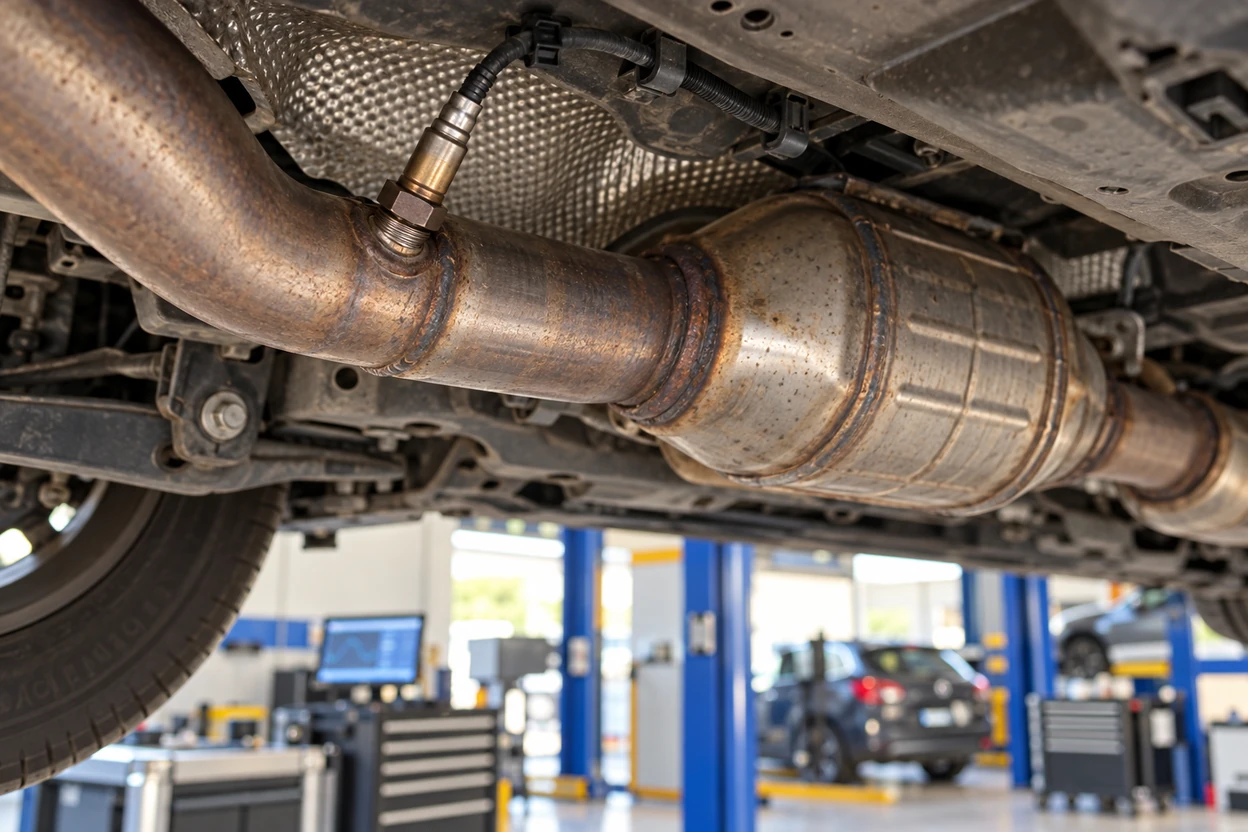
A failing sensor does not always store a fault code straight away. The fuel trims, which show how much the control unit is adding or removing from its base fuelling, often move first. That is why we read live data and do not rely on a code alone. If a sensor is confirmed faulty, our oxygen sensor replacement page explains the job and the guide range.
Can misfires, spark plugs or injectors raise fuel use?
Yes, and they are among the most common causes on turbocharged TSI engines in Dubai heat. A misfire means one cylinder does not burn its fuel properly. The driver feels less power, presses the pedal further, and fuel is wasted on both counts.
Coils and spark plugs
- Worn plugs need a higher voltage to spark, which strains the coils.
- A weak coil can misfire only under load or when hot, so the car feels fine at idle.
- Typical signs are a shake at idle, hesitation when overtaking or a flashing engine light.
- Codes such as P0300 random misfire or P0301 to P0304 for a single cylinder point here.
Injectors and fuel pressure
- A leaking injector can flood one cylinder, causing a rough start after the car has stood.
- A poor spray pattern burns fuel badly and can leave a smell of fuel at the exhaust.
- Fuel trims that are strongly negative on one bank can point to extra fuel getting in.
- Fuel pressure that is too high or too low changes how much each injection delivers.
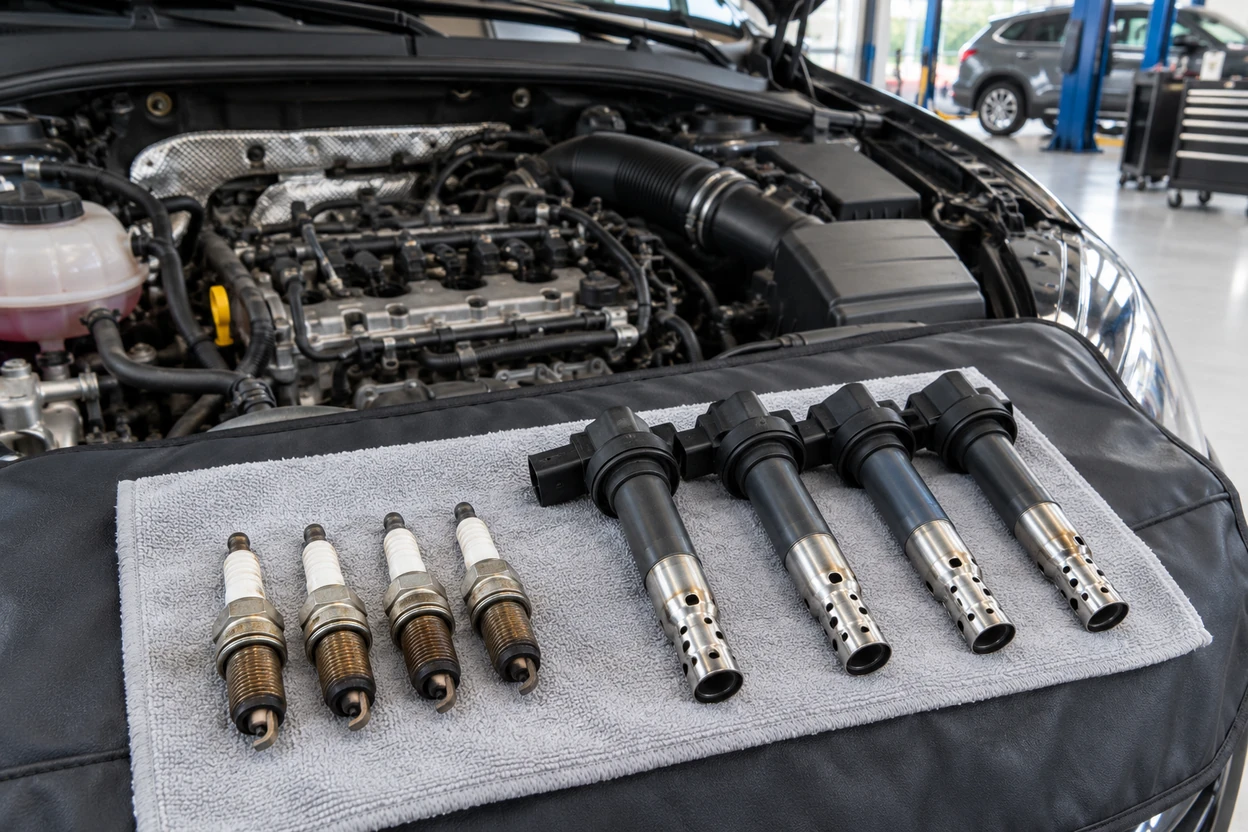
Spark plug condition also tells a story. Black, sooty plugs suggest a rich mixture, while oily plugs point to a different problem. Our spark plug replacement page explains plug sets and intervals, and coil or injector work is quoted after testing for your engine.
Can brakes, the gearbox or engine oil cause higher fuel use?
These causes sit outside the fuel system, so they are easy to miss. None of them always lights a warning, and each one makes the engine work harder for the same road speed.
Dragging caliper or parking brake
One wheel hotter than the others after a drive, a burning smell, a pull to one side or the car rolling less freely in neutral all suggest drag. On cars with an electronic parking brake, a sticking rear caliper is a known cause.
DSG or automatic slip
Engine speed rising without the car speeding up, a flare between gears or jerky low speed driving can mean clutch slip in a DSG or a lock up problem in a torque converter automatic. Our DSG repair page covers gearbox diagnosis.
Wrong grade or low level
The Department of Energy guide states that using the manufacturer recommended oil grade improves fuel economy by 1 to 2 percent, and a thicker grade lowers it. A low oil level is not usually a direct fuel cause, but it is checked at the same visit.
For oil, the grade and the VW approval matter together. Every engine code has an approved specification, so the right oil is chosen from the engine, not from the brand on the shelf. Our VW oil change page explains approvals and the oil change guide range.
Which fuel should a VW use in the UAE?
UAE stations sell three petrol grades plus diesel. Hertz UAE, in its guide to UAE fuel types, lists E Plus 91 as 91 octane, Special 95 as 95 octane and Super 98 as 98 octane, and explains that many cars mark the required grade on the fuel cap or the inside of the fuel flap, while the owner manual gives the recommended octane.
Listed for older cars, low compression engines and some commercial fleets. Use it in a VW only if the flap or manual allows it.
Listed for standard modern cars. Many VW petrol engines sold in the region are set up around 95, but your own label decides.
Listed for high compression and high performance engines. Use it where your VW asks for it, for example on some performance models.
The same source notes that repeatedly using a lower octane than the car is designed for may cause knocking, reduced efficiency and long term wear, while using 98 in a car rated for 95 usually does no harm but costs more without a noticeable gain in medium compression engines. Modern VW engines have knock sensors that retard the ignition when the fuel is too low in octane. That protects the engine, but it reduces efficiency, so a driver who switched from 95 to 91 to save money may see higher fuel use and no saving at all. Diesel models must only receive diesel, and a wrong fuel fill in any VW means do not start the engine and call for help.
Which warning lights should you watch with high fuel use?
Higher fuel use with no warning light is common. When a light does appear, it helps narrow the cause and tells you how urgent the visit is. Read the bars from the lightest concern at the top to the most urgent at the bottom.
Measure fill to fill over two or three tanks and book a check if the rise stays.
A stored emissions fault such as a lean, rich, sensor or thermostat code. Book a diagnostic check soon.
Power or gearbox function may be limited. Drive gently and have it read without delay.
A flashing light means active misfire that can damage the catalytic converter. Reduce load, stop safely and arrange a check.
A rising temperature reading, a strong smell of fuel or smoke from a wheel are also reasons to stop. Our engine warning diagnosis page explains the EPC and engine lights in more detail.
How do we check high fuel use with VW diagnostic software?
A basic code reader shows only stored engine codes. VW specific diagnostic software reads every control unit and shows live data, which is where most fuel faults are found. This is the order we follow in our Al Quoz 4 workshop.
- 1Full scan
Read engine, gearbox, brake and other units and save the fault history.
- 2Fuel trims
Check short and long term trims at idle and under load for a lean or rich pattern.
- 3Sensor data
Compare lambda, air mass and coolant temperature with expected values.
- 4Misfire counters
Watch misfires per cylinder during a road test, including hot running.
- 5Mechanical checks
Check brakes for drag, tyres, oil and gearbox slip, then confirm the cause.
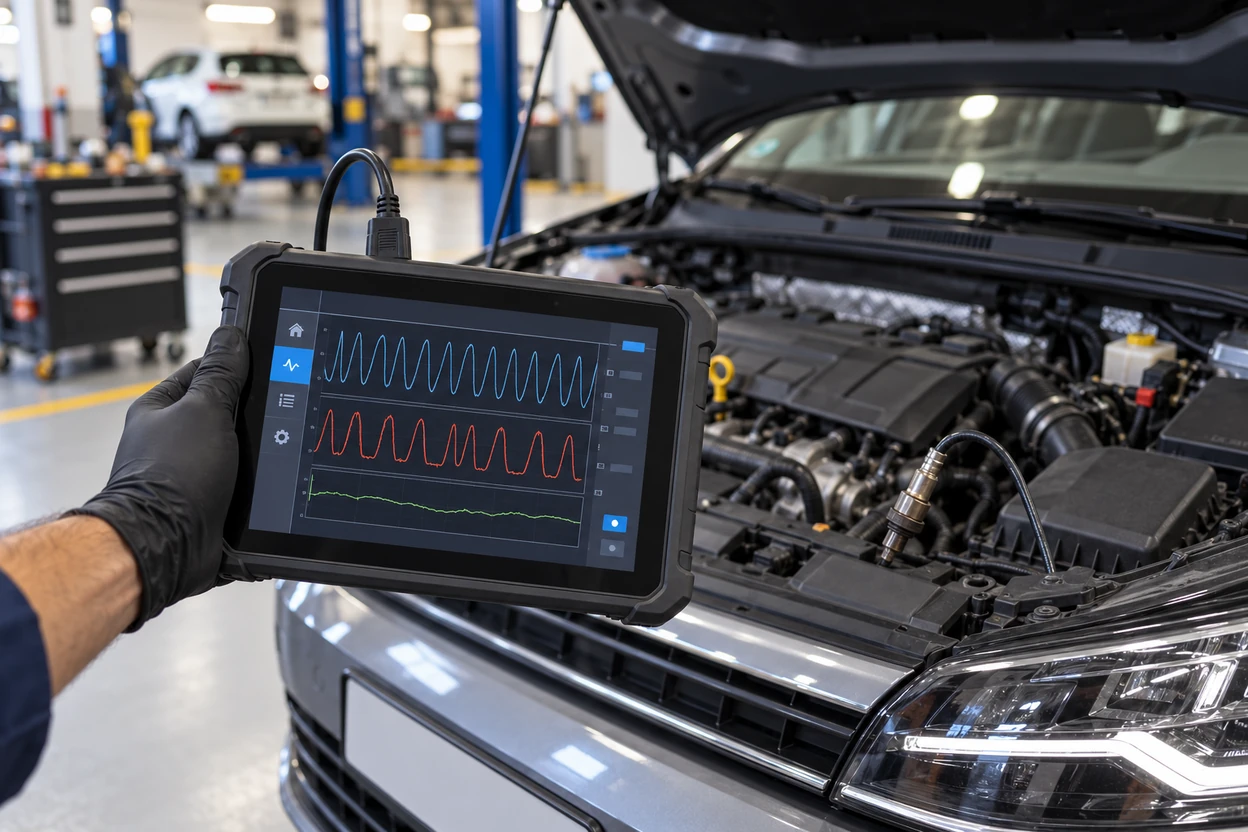
Fault codes are generic OBD meanings. A code tells us where to look, not which part to replace, so every code is followed by a test of the circuit and the part before we quote. You can read more about what a scan shows in our VW inspection service page.
How much does it cost to fix high fuel consumption?
The cost depends entirely on the cause. Many cases end with advice and no repair at all, for example tyre pressure or a change in driving pattern. These guide ranges are published on our own service pages and are alternatives, not one bill.
| Work | Guide range | Where it is published |
|---|---|---|
| Initial diagnostic assessment | AED 150 to 500 | Engine warning diagnosis page |
| Multi point condition inspection | AED 200 to 1,500 | Inspection service page |
| Engine air filter replacement | AED 100 to 350 | Air filter replacement page |
| Spark plug set, four to eight plugs | AED 400 to 1,500 | Spark plug replacement page |
| One oxygen sensor | AED 650 to 1,300 | Oxygen sensor replacement page |
| Oil and filter change | AED 250 to 750 | Oil change page |
Indicative guides. MAF sensor, thermostat, coil, injector, brake and gearbox work is quoted after testing for your engine. You approve the written quote before work starts, and extra work is only done after your approval.
Find out why your VW uses more fuel
Our Al Quoz 4 workshop scans every control unit with VW diagnostic software, reads fuel trims and sensor data, checks brakes, tyres and gearbox, and gives you a written quote before any work.
When should you book an inspection for high fuel use?
Use this scale to decide how soon to book. Read it from left to right, from signs you can monitor to signs that need a check straight away.
Likely AC and traffic. Keep measuring fill to fill.
No change in use explains it. Book a diagnostic check.
A stored fault is likely. Book within days.
A leak, misfire or dragging brake needs prompt attention.
Stop safely and arrange a check or recovery.
Fuel economy mistakes we see
These are the habits that most often lead owners to the wrong conclusion about fuel use. Each one comes with what to do instead, so you get a reading you can trust before paying for any part.
Trusting one trip computer reading
A single reading after a traffic jam says little about the car.
Measure fill to fill over two or three tanks with your normal driving.
Switching to 91 to save money
Lower octane than the label asks for can cost efficiency.
Use the grade shown on the fuel flap or in the manual.
Checking tyres in the afternoon
Hot tyres hide a low cold pressure.
Check pressures in the morning before driving, against the door pillar label.
Fitting a new air filter as a cure
On modern fuel injected engines it rarely changes fuel use.
Replace it on schedule, and look for the real cause in the data.
Clearing the engine light
The fault returns and the fuel use stays high.
Have the stored code and freeze frame read before anything is cleared.
Replacing sensors without live data
A code points to a circuit, not always to the part.
Confirm the fault with live data and fuel trims before a part is ordered.
Quick answers about VW high fuel consumption
Is higher fuel use in summer normal? A moderate rise is normal because of AC and idling.
What is the most reliable way to measure it? The fill to fill method over two or three tanks.
Can a sensor cause it without a warning light? Yes, fuel trims often move before a code is stored.
Does premium fuel save money? Only use 98 if your VW asks for it.
Can brakes cause it? Yes, a dragging caliper wastes fuel all the time.
Key fuel consumption terms explained
These terms appear on scan reports and in our explanations.
- Fill to fill
- Measuring consumption from the litres needed to refill a full tank and the distance driven.
- Fuel trim
- The correction the engine control unit applies to its base fuelling, shown as short and long term values.
- Lambda sensor
- The oxygen sensor in the exhaust that reports whether the mixture is rich or lean.
- MAF sensor
- The air mass meter that measures how much air the engine draws in.
- Octane rating
- A measure of how well petrol resists knocking. UAE grades are 91, 95 and 98.
- Rolling resistance
- The energy lost as a tyre flexes on the road, raised by low pressure and some tyre types.
What we check first when a VW uses more fuel
Every high fuel use complaint at our Al Quoz 4 workshop starts with the same conversation and checks, so the simple causes are ruled out before any part is quoted.
Use, tyres, data, then parts
Parts are the last step, not the first.
-
We ask how the car is used, what changed recently and how the fuel use was measured, and we look at your fill to fill notes.
-
We check tyre size and cold pressure, roof loads, the fuel grade you use and the oil grade in the service record.
-
We scan all control units with VW diagnostic software and save the fault history.
-
We read fuel trims, lambda, air mass, coolant temperature and misfire data, then road test the car.
-
We check the wheels for brake drag and the gearbox for slip, then explain the cause and give a written quote.
What to send before your visit
A few details help us judge where to start and how urgent the visit is.
- Model, year and engine
- Mileage
- Your fill to fill figures
- When the rise started
- The fuel grade you use
- Any warning lights
- Recent tyre or brake work
- Your usual routes
Send them on WhatsApp to 056 464 6081 and a technician will reply.
Questions about VW high fuel consumption
Why is my VW suddenly using more fuel?
First confirm it with a fill to fill measurement over two or three tanks. If it is real, look at normal causes such as heavy AC use, idling in traffic, short trips, roof loads and low tyre pressure. If none of those changed, common faults are oxygen or MAF sensors, a stuck open thermostat, misfires, leaking injectors and dragging brakes.
How do I measure my VW fuel consumption accurately?
Fill the tank to the first click, reset a trip counter, drive normally, then refill to the first click at the same pump. Divide the litres added by the kilometres driven and multiply by 100 to get litres per 100 km. Repeat over two or three tanks and compare with your own earlier figures for similar driving.
Does AC use really increase fuel consumption in Dubai?
Yes. The United States Department of Energy fuel economy guide states that AC use can reduce the fuel economy of a conventional car by more than 25 percent in very hot conditions. In Dubai the AC runs most of the year, so some rise in summer is normal and is not a fault on its own.
Can a bad oxygen sensor cause high fuel consumption?
Yes. A slow or faulty upstream lambda sensor gives the engine control unit a wrong reading of the mixture, so it may add more fuel than needed. It does not always store a fault code at first, but the fuel trims often move. We test the sensor in live data before recommending a replacement.
Can a thermostat stuck open increase fuel use?
Yes. If the thermostat stays open, the engine runs cooler than designed and the control unit keeps a richer mixture for longer. On many VWs the temperature gauge stays at 90 across a range, so the problem may not show on the dashboard. Coolant temperature in live data, and often code P0128, confirm it.
Which fuel should I use in my VW in the UAE?
Use the grade shown on the fuel filler flap or in the owner manual. UAE stations sell E Plus 91, Special 95 and Super 98. Using a lower octane than your VW asks for can reduce efficiency, while using 98 in a car designed for 95 usually costs more without a noticeable gain.
Will a new air filter reduce my fuel consumption?
On modern fuel injected VW engines, usually not. The Department of Energy guide explains that a new air filter on these engines does not improve fuel economy but can improve acceleration. Dubai sand still clogs filters quickly, so we check and replace them at service, but we do not sell a filter as a fuel cure.
Can dragging brakes or the DSG gearbox increase fuel use?
Yes. A sticking caliper or parking brake keeps braking lightly all the time, often with a hot wheel or a burning smell. A slipping DSG clutch or poor shifting raises engine speed without adding road speed. Neither always shows a warning light, which is why we check brakes and gearbox data during diagnosis.
How much does it cost to diagnose high fuel consumption in Dubai?
Our engine warning diagnosis page lists an initial diagnostic assessment at AED 150 to 500. Repairs depend on the cause. Published guides include AED 650 to 1,300 for one oxygen sensor and AED 400 to 1,500 for a spark plug set. Other work is quoted after testing, with a written quote before any work.
Get your VW fuel use checked in Al Quoz 4
Volkswagen Repair Dubai is an independent VW workshop in Al Quoz 4, open Monday to Saturday, 9am to 7pm. Send your model and your fill to fill figures, and we will advise the next step.
See what a full check covers on our VW inspection service page and our VW oil change page.
How this guide was written
Written by the Volkswagen Repair Dubai workshop team in Al Quoz 4 and reviewed by our technical team in October 2026. It is based on the fuel consumption diagnosis we carry out on Volkswagens in Dubai, on United States Department of Energy fuel economy guidance and on published information about UAE fuel grades, all listed below.
Fuel grades, tyre pressures and oil approvals differ between models and engines, so always follow the fuel filler flap label and the owner manual for your car. Prices are the indicative guide ranges published on our own service pages, not fixed quotes.
Technical references
- FuelEconomy.gov, keeping your vehicle in shape, on tyre pressure, oil grade and air filters and their effect on fuel economy.
- FuelEconomy.gov, fuel economy in hot weather, on how AC use reduces fuel economy and how to limit it.
- Hertz UAE, which fuel type to use in the UAE, on the octane of E Plus 91, Special 95 and Super 98 and where the required grade is shown.