In this guide
An amber ABS light on a VW means the anti lock braking system has a fault, so normal braking usually still works but the wheels can lock under hard braking. Drive carefully, leave more distance and book a diagnostic check. If a red brake warning comes on with it, the pedal feels soft or sinks, or you see a fluid leak, stop safely and arrange recovery, because the main braking system may be affected.
Written by the Volkswagen Repair Dubai workshop team in Al Quoz 4. Reviewed by the technical team, updated October 2026.
Key takeaways
- An amber ABS light means the anti lock function has a fault. Normal braking usually remains.
- A red brake warning is different and more serious. With a red warning, stop safely.
- ABS, traction and stability control share signals, so one fault can light several warnings.
- The most common causes are wheel speed sensors, their wiring and the encoder ring, not the ABS module itself.
- A pulsing pedal during hard braking on a slippery road is normal ABS working.
- Clearing the light without finding the cause does not fix it, and the light returns.
Is it an amber ABS light or a red brake warning?
The colour tells you how urgent it is. Volkswagen owner information describes the amber ABS lamp as a failed or malfunctioning anti lock system, while red brake warnings mean pull over when it is safe.
Anti lock fault
Normal braking usually works, but anti lock and often stability control may not. Drive carefully and book a check.
Braking system warning
Low brake fluid or a fault in the main braking system. If it stays on with the parking brake released, stop safely.
Treat as red
An ABS light with a red brake warning can mean the brake force distribution is affected. Stop and get help.

Our guide to VW dashboard warning lights covers the other red and amber warnings.
What does ABS actually do on a VW?
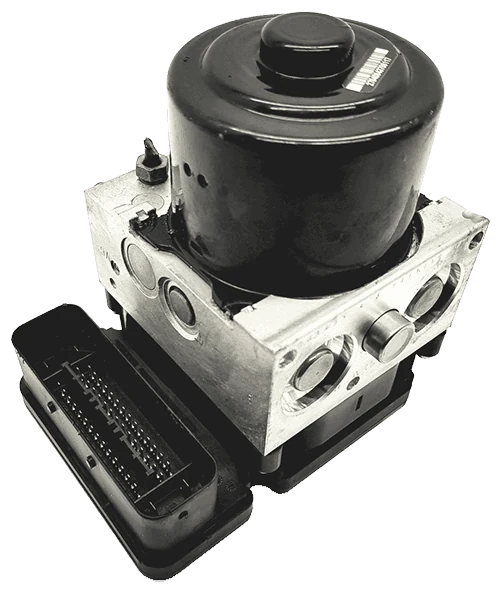
ABS watches the speed of each wheel through a sensor at every hub. If one wheel starts to slow much faster than the others under braking, the ABS unit briefly reduces the brake pressure on that wheel so it keeps turning and you keep steering.
- Wheel speed sensors send a signal from each wheel to the ABS control unit.
- The control unit compares the four signals many times a second.
- The hydraulic unit and pump adjust brake pressure at each wheel.
- Stability control uses the same signals with steering and motion sensors.
- Traction control uses them to limit wheel spin when pulling away.
What causes the ABS light to come on?
The ABS unit switches the light on when it sees a signal or function it cannot trust. These are the causes we find most often, roughly from the most common.
| Cause | Typical clue | How it is checked |
|---|---|---|
| Wheel speed sensor | Light on after a few metres, one wheel fault code | Compare all four wheel signals in live data |
| Sensor wiring or plug | Light comes and goes, worse over bumps or in rain | Wiring, connector and corrosion checks |
| Encoder ring or bearing | Fault returns after a new sensor, recent bearing work | Inspect the encoder and the wheel bearing |
| Low battery voltage | Several warnings at once after a flat battery | Battery and charging tests |
| Steering angle or setup | Warning after alignment or steering work | Basic settings and plausibility checks |
| ABS control unit or pump | No communication or internal fault codes | Supply, earth and unit tests before replacement |
An ABS warning alone does not prove the module has failed. Our ABS module repair page explains how the module, pump and hydraulic unit are told apart.
Is it safe to drive with the ABS light on?
With only the amber ABS light and a normal pedal, most cars can be driven carefully to a workshop. The car behaves differently in an emergency stop, so change how you drive until it is fixed.
-
Check the colour
Make sure no red brake warning is on with the parking brake released.
-
Test the pedal gently
At low speed, check the pedal feels normal and the car stops in a straight line.
-
Leave more distance
Without ABS, the wheels can lock in a hard stop, so increase the gap ahead.
-
Brake early and smoothly
Avoid sudden hard braking, especially on wet, sandy or painted surfaces.
-
Book a check
Arrange a diagnostic check soon rather than living with the light.
Stop safely and arrange recovery if a red brake warning appears, the pedal feels soft or sinks towards the floor, you see brake fluid near a wheel, or braking feels weaker than normal. These point to the main braking system, not just ABS.
ABS light just came on? Send us a photo of the dashboard and tell us how the brakes feel, and we will tell you whether it is safe to drive in.
Why do the ABS, traction and stability lights come on together?
These systems share the same wheel speed signals. When one signal is missing or implausible, the car switches off every function that depends on it and lights all the related warnings.
- One sensor, several lights
- A single faulty wheel speed sensor can light ABS, traction control and stability control together.
- Low voltage
- A weak battery or charging fault can make several control units report faults at the same time.
- Steering angle
- After steering or alignment work, an unset steering angle sensor can disable stability control.
- Tyre sizes
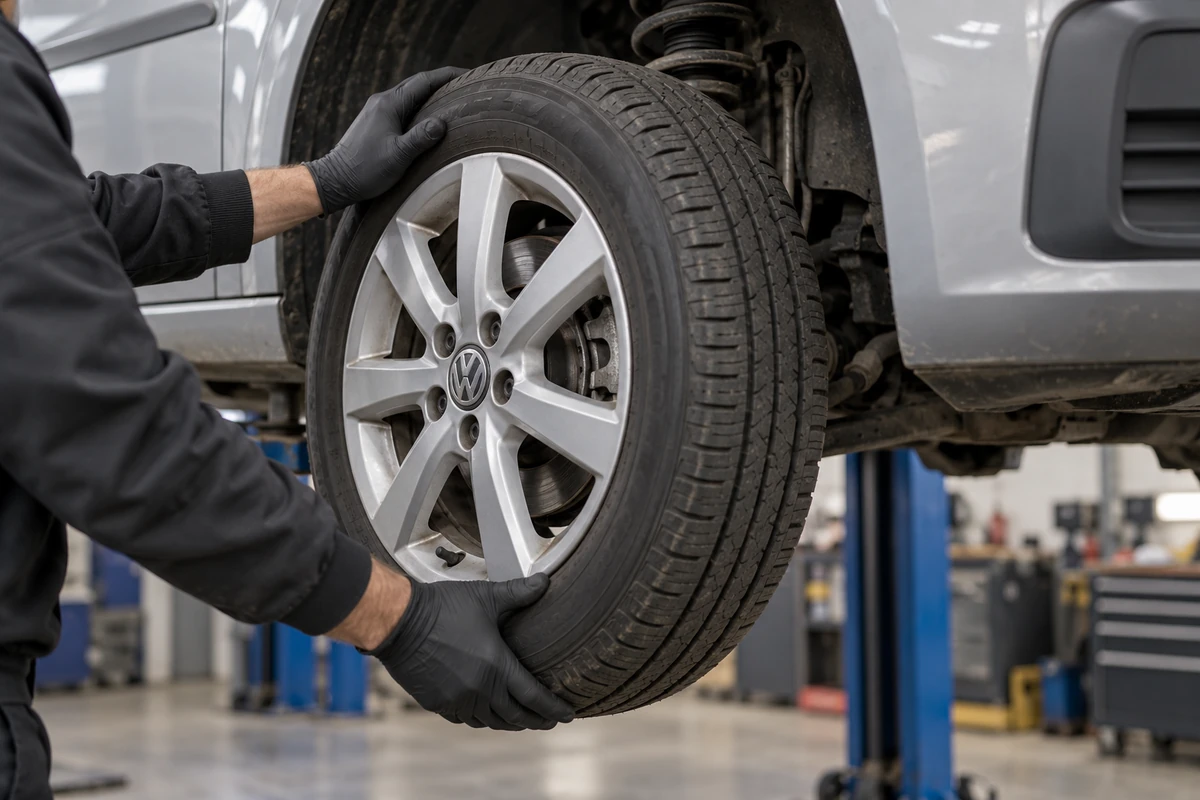
- Mismatched tyre sizes or very uneven wear can confuse the wheel speed comparison.
Several lights do not mean several failed parts. The shared cause is found first, then the codes are cleared and the car is retested.
When is ABS activity normal?
Not every ABS sensation is a fault. These are normal signs of the system working.
Pulsing pedal
A rapid pulsing under the foot during hard braking on a slippery surface is ABS working.
Buzzing sound
A short buzz or grinding sound from the front of the car during ABS action is the pump.
Self test at start
A brief whirr just after starting or moving off can be the system checking itself.
Light at start up
The ABS light should come on briefly with the ignition, then go out.
If the pedal pulses during gentle braking at low speed on a dry road, the ABS may be reacting to a faulty wheel signal. That needs checking.
What causes ABS faults more often in Dubai?
Wheel speed sensors and their wiring live close to the road. These local conditions are behind many of the faults we see.
Check the wheel area first
Most ABS faults start at the wheel, so sensors, wiring and bearings are checked before the module.
Dirty sensors
Fine sand and metal dust can build up on sensors and encoder rings.
Corroded plugs
Car washes and flooded roads can let water into connectors over time.
Bearings and brakes
A sensor or plug disturbed during bearing or brake work can trigger the light.
How is an ABS fault diagnosed?
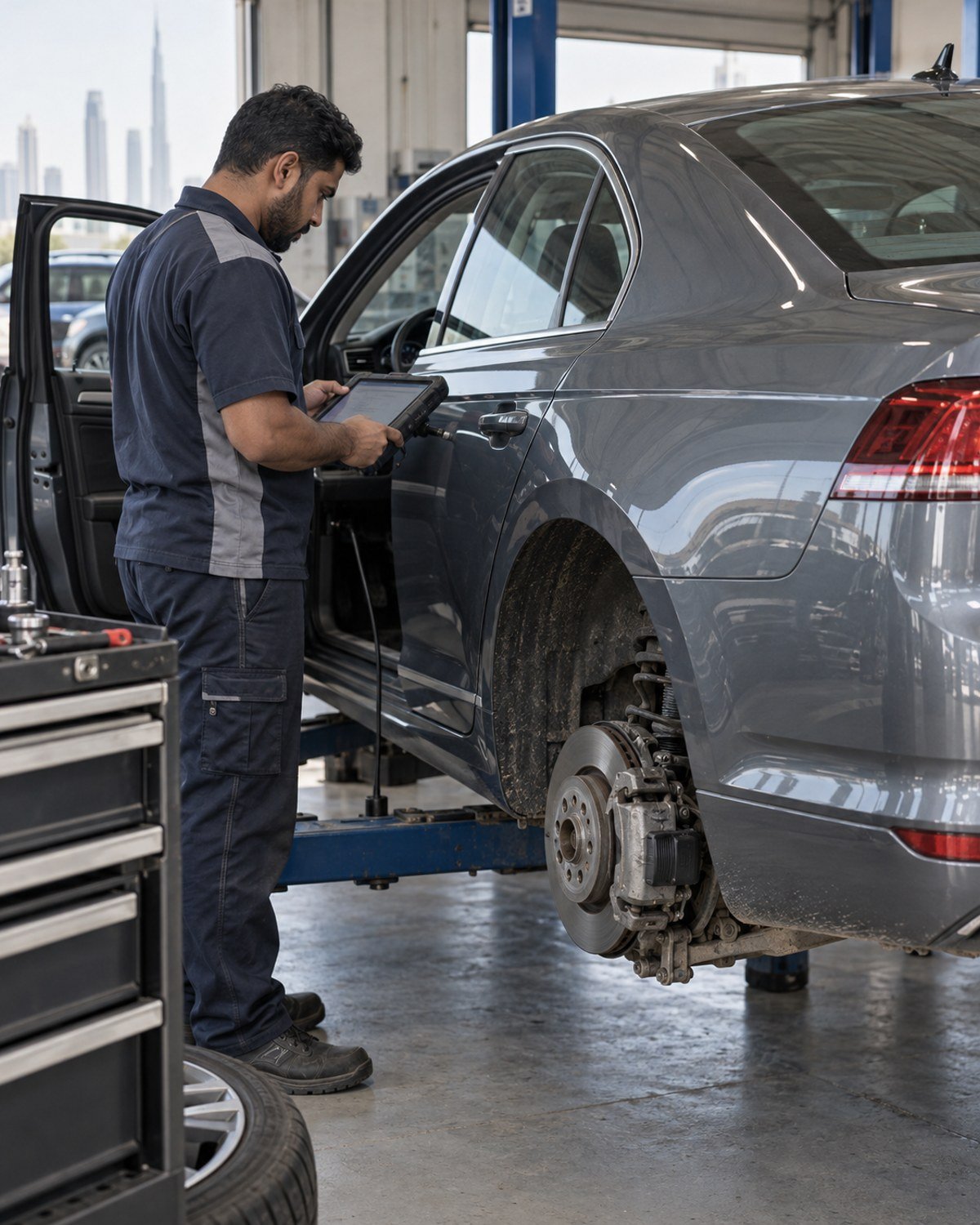
An ABS warning needs a VW specific scan, because a basic engine code reader often cannot see the brake control unit.
- 1Scan the units
Read the ABS, stability and related fault entries.
- 2Compare wheel signals
Watch all four wheel speeds in live data while driving.
- 3Test the circuit
Check the sensor, wiring, plug, encoder and supply.
- 4Repair and verify
Fix the cause, clear codes and road test the car.
How much does an ABS repair cost in Dubai?
The cost depends on what the diagnosis finds. Many ABS faults are fixed with a sensor or wiring repair. These guide ranges come from our own service pages and are alternatives, not one bill.
| Work | Guide range | When it applies |
|---|---|---|
| Initial diagnostic assessment | AED 150 to 500 | Reading faults and first checks |
| Wheel speed sensor, each | AED 400 to 800 | A confirmed faulty sensor |
| ABS module repair | AED 1,200 to 2,500 | A repairable internal electronic fault |
| ABS assembly replacement | AED 2,500 to 6,000 plus | An unrepairable unit, with setup |
| Brake fluid change | AED 200 to 400 | Routine fluid service |
Indicative guides. Wiring, bearing and encoder repairs are quoted after diagnosis. You approve the written quote before work starts.
Find the real ABS fault
Our Al Quoz 4 workshop reads the brake control unit with VW diagnostics, compares the wheel signals and tests the circuit before any module is quoted, with a written quote before work.
How urgent is each ABS and brake sign?
Read the scale from left to right, from signs you can book in for to signs that mean stop now.
Note when it happened and mention it at your next visit.
Drive carefully and book a diagnostic check soon.
Drive gently, avoid wet roads and book within days.
Get it checked straight away, as braking can be affected.
Stop safely and arrange recovery.
ABS light mistakes we see
Most faults are sensors, wiring or encoders.
A red brake warning needs you to stop.
The light returns if the cause is still there.
It often cannot see the brake control unit.
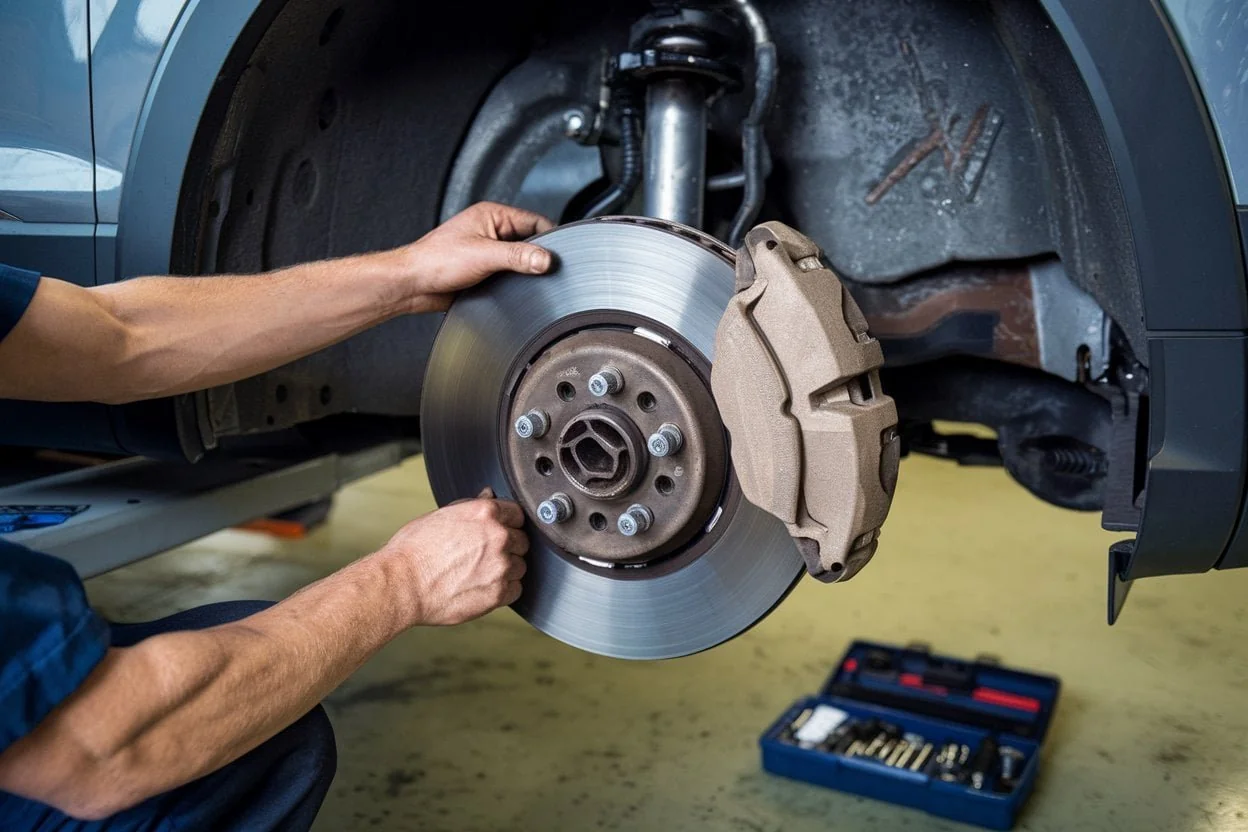
A damaged encoder brings the fault back.
Uneven tyres can confuse wheel speed signals.
Quick answers about the VW ABS light
What does the ABS light mean? The anti lock system has a fault and may not work.
Can I drive with the ABS light on? Carefully, if the pedal is normal and there is no red warning.
What is the most common cause? A wheel speed sensor or its wiring.
Will the light go off by itself? Sometimes, but the fault is usually still stored.
Is a pulsing pedal a fault? Not during hard braking on a slippery road.
Key ABS terms explained
These terms appear on scan reports and brake quotes.
- ABS
- Anti lock braking system, which stops the wheels locking under hard braking.
- Wheel speed sensor
- The sensor at each wheel that reports how fast it is turning.
- Encoder ring
- The toothed or magnetic ring the wheel speed sensor reads.
- ESC
- Electronic Stability Control, which uses ABS signals to keep the car stable.
- Hydraulic unit
- The valve block and pump that adjust brake pressure at each wheel.
- Brake force distribution
- The function that balances braking between the front and rear axles.
What we check first on an ABS warning
Every ABS warning in our Al Quoz 4 workshop starts with the same checks, so the cheapest real fix is found first.
Wheel, wiring, then module
The module is checked last, not first.
-
We ask how the brakes feel and check for a red warning, low fluid or leaks before anything else.
-
We test battery voltage, because low voltage can store ABS and stability faults.
-
We read the brake control unit with VW diagnostics and save the fault entries.
-
We compare all four wheel speed signals and test the sensor, wiring, plug and encoder on the affected wheel.
-
Only then do we assess the ABS unit itself, and we explain the repair and any coding or bleeding needed.
What to send before your visit
A few details help us judge how urgent the warning is.
- Model, year and mileage
- A photo of the warning lights
- How the brake pedal feels
- When the light comes on
- Recent bearing or brake work
- Any red brake warning
- Recent battery problems
- Any scan report you have
Send them on WhatsApp to 056 464 6081 and a technician will reply.
Questions about the VW ABS warning light
What does the ABS light mean on a Volkswagen?
An amber ABS light means the anti lock braking system has detected a fault and may not work. Normal braking usually still works, but the wheels can lock under hard braking. Stability and traction control can also be affected. Book a diagnostic check, and stop safely if a red brake warning appears with it.
Can I drive my VW with the ABS light on?
If only the amber ABS light is on and the pedal feels normal, you can usually drive carefully to a workshop. Leave more distance, brake early and avoid hard stops on wet or sandy roads. If a red brake warning appears, the pedal is soft or you see a fluid leak, stop and arrange recovery.
What is the most common cause of a VW ABS light?
A faulty wheel speed sensor, its wiring or connector, or a damaged encoder ring are the most common causes we find. Low battery voltage and missing basic settings after steering work are also common. A failed ABS module is possible, but it is checked after the sensors and wiring, not before.
What is the difference between the ABS light and the brake light?
The amber ABS light points to the anti lock system. The red brake warning points to the main braking system, such as low brake fluid, or the parking brake being applied. A red warning that stays on with the parking brake released is more serious and means stop safely and get help.
Why are the ABS and traction control lights on together?
ABS, traction control and stability control share the same wheel speed signals. When one signal is missing or implausible, all the functions that depend on it switch off and their warnings light together. Several lights usually point to one shared cause, such as a single wheel sensor or low voltage.
Can a wheel bearing cause an ABS fault?
Yes. On many VWs the encoder ring that the wheel speed sensor reads is part of the wheel bearing. A worn bearing or a damaged encoder can upset the signal and light the ABS warning. This is why the bearing and encoder are checked when a new sensor does not clear the fault.
Will the ABS light reset itself?
Sometimes the light goes out on the next drive if the fault was brief, but the fault is usually still stored in the control unit. Clearing the light without finding the cause does not fix it. A scan reads the stored history and helps find an intermittent fault before it becomes permanent.
Is a pulsing brake pedal a sign of a fault?
Not during hard braking on a slippery surface, as that pulsing is the ABS working. If the pedal pulses during gentle braking at low speed on a dry road, the ABS may be reacting to a faulty wheel signal. Juddering that follows the disc rotation can also point to the brake discs.
How much does it cost to fix the ABS light in Dubai?
Our guides are AED 150 to 500 for an initial diagnostic assessment and AED 400 to 800 for each confirmed wheel speed sensor. An ABS module repair is AED 1,200 to 2,500, and a replacement assembly is AED 2,500 to 6,000 plus. Wiring and bearing repairs are quoted after diagnosis.
Get your ABS light checked in Al Quoz 4
Volkswagen Repair Dubai is an independent VW workshop in Al Quoz 4, open Monday to Saturday, 9am to 7pm. Send a photo of the warning and tell us how the brakes feel, and we will advise the next step.
See repair options on our ABS module repair page and our brake repair page.
How this guide was written
Written by the Volkswagen Repair Dubai workshop team in Al Quoz 4 and reviewed by our technical team in October 2026. It is based on the ABS and brake diagnosis we carry out on Volkswagens in Dubai and on the Volkswagen owner information listed below.
Warning lamps, brake systems and safe driving advice differ between models, so always follow the owner manual for your car. Prices are the indicative guide ranges published on our own service pages, not fixed quotes. For brake wear, see our VW brake pad guide.
Technical references
- Volkswagen Canada, warning and indicator lights, describing the amber ABS lamp as a failed or malfunctioning anti lock system and red lamps as a reason to pull over when safe.