In this guide
Replace VW suspension parts when an inspection shows they are worn, leaking or loose, not at a fixed mileage. Bouncing and nose dive point to shock absorbers or struts. Knocks over bumps and vague steering point to control arm bushes, ball joints or drop links. The right repair replaces only the parts that have failed, in matched pairs where needed.
Written by the Volkswagen Repair Dubai workshop team in Al Quoz 4. Reviewed by the technical team, updated October 2026.
Key takeaways
- Condition decides replacement, not mileage. Some VWs need parts early, others run well beyond average.
- Shock absorbers control bounce. Struts also carry the spring and locate the wheel, so they affect steering.
- A knock over bumps is often a bush, drop link or ball joint, not a shock absorber.
- Shocks and struts are replaced in pairs on the same axle so both sides behave the same.
- Fix worn suspension before new tyres or alignment, or the alignment will not hold.
- DCC adaptive and air suspension need their own parts, checks and setup.
Which VW suspension part does what?
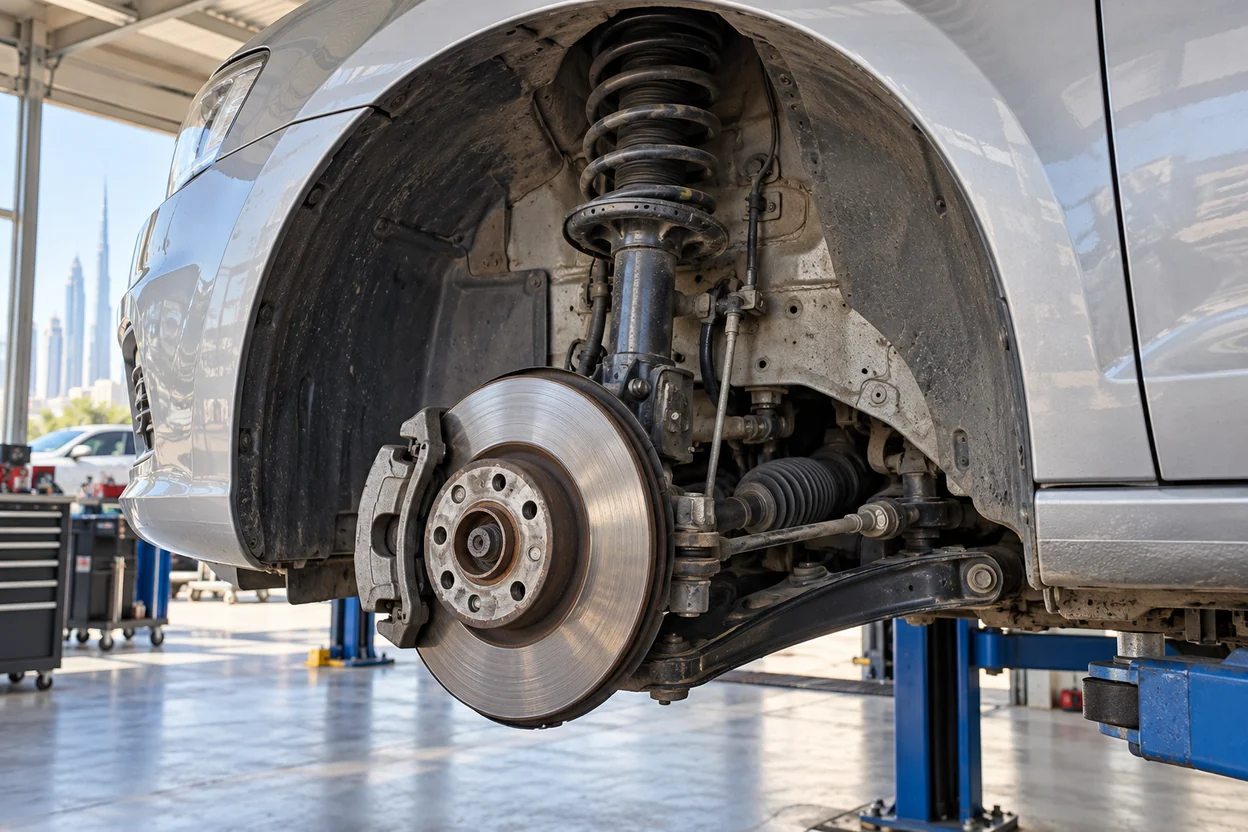
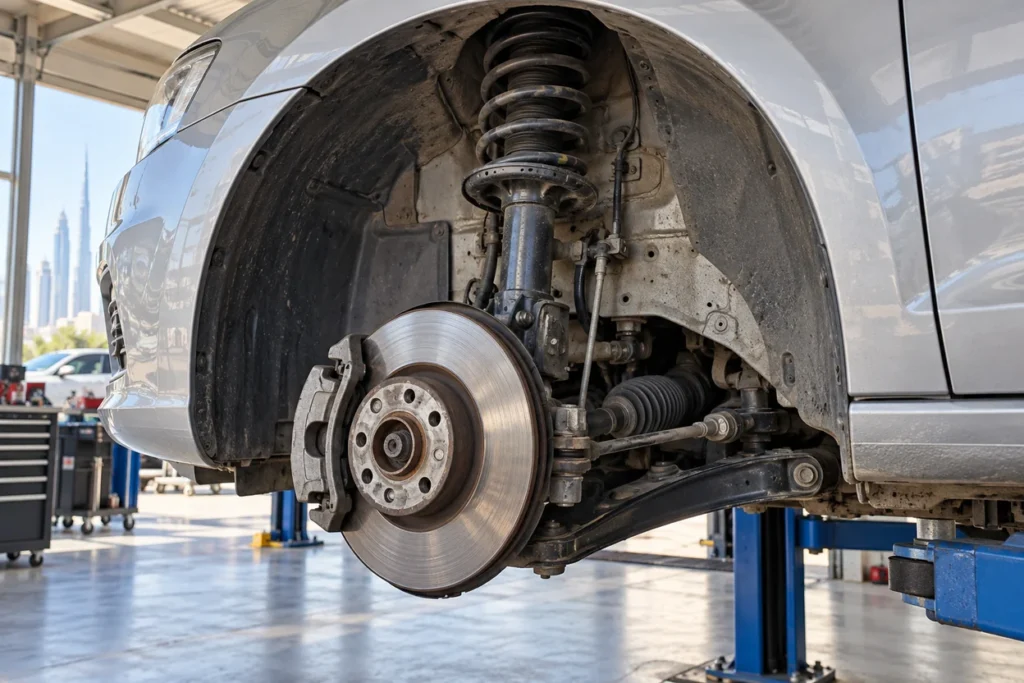
Suspension is a set of parts that work together. Knowing what each one does makes it easier to match a symptom to the part that has worn.
Shock absorber
Controls how fast the spring moves. A worn shock lets the car bounce, wallow and float.
Strut
A shock built into a structural assembly with the spring and top mount. It also locates the wheel.
Control arm
Links the wheel hub to the body through rubber bushes and a ball joint.
Links and joints
Anti roll bar drop links, ball joints and track rod ends keep the wheel stable and the steering precise.
Most front wheel drive VWs, such as the Polo, Golf, Jetta, Passat and Tiguan, use struts at the front and separate shocks and springs at the rear. Touareg and some higher trims may use adaptive or air suspension.
How do you know which part is worn?
Match what you feel or hear with the parts most often behind it. This table is a starting point for the inspection, not a diagnosis.
| What you notice | When it happens | Likely worn part |
|---|---|---|
| Bouncing after bumps | Speed humps, uneven roads | Shock absorbers or struts |
| Nose dives when braking | Firm braking | Front struts or shocks |
| Knock or clunk | Over bumps or potholes | Drop links, bushes, ball joints, top mounts |
| Vague or wandering steering | Straight roads, lane changes | Control arm bushes, ball joints, track rod ends |
| Creak when turning | Low speed turns, parking | Strut top mount bearing or dry bushes |
| One corner sitting low | Parked on level ground | Broken spring or air suspension leak |
Similar noises can come from wheel bearings and drive shafts. Our guide to VW drive shaft noises explains how to tell them apart.
Shocks, struts or control arms, what is the difference?
Owners often ask for new shocks when the real fault is elsewhere. Each part fails in its own way, and the repair is different for each.
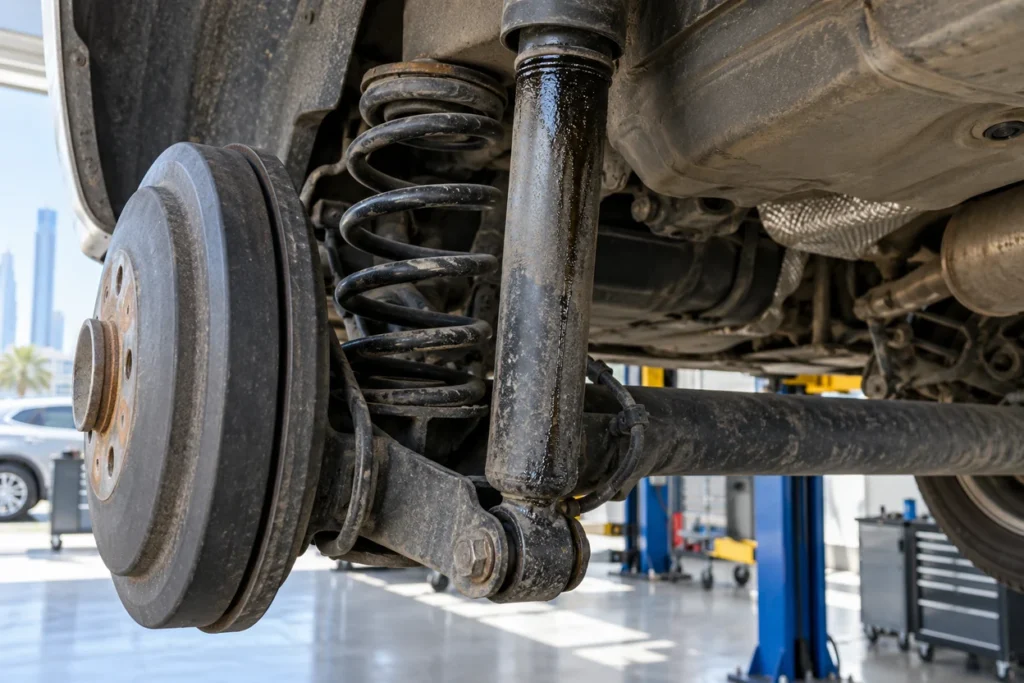
- Shock absorbers wear gradually. The car feels softer and floatier, and oil may show on the body.
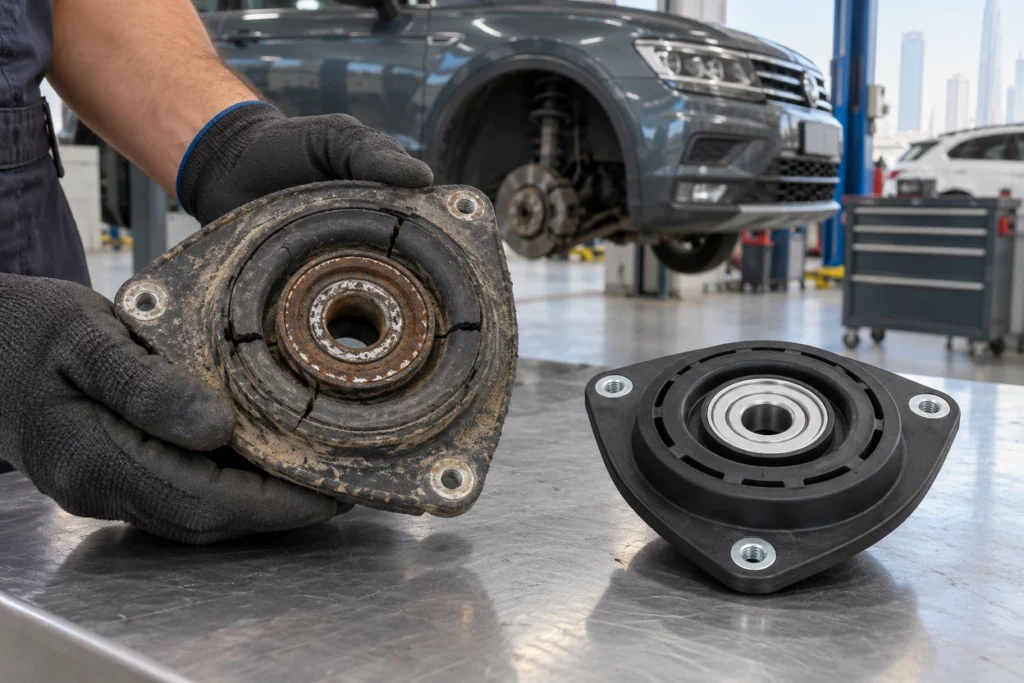
- Struts wear the same way, but a worn strut top mount can also creak and affect steering.
- Control arm bushes crack and soften, giving knocks, vague steering and uneven tyre wear.
- Ball joints develop play, which shows as a clunk and can become a safety risk.
Replacing shocks will not cure a worn bush, and new arms will not stop a car from bouncing. Inspection first saves money.
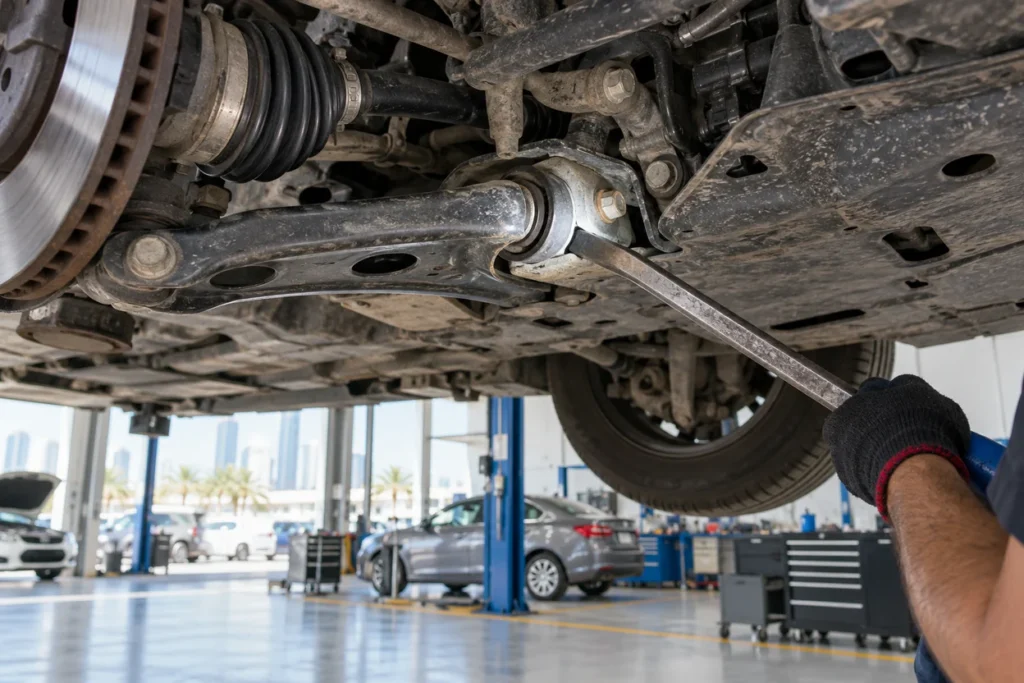
Details for each repair are on our shock absorber page and our control arm replacement page.
Knock, bounce or vague steering? Tell us your model and when it happens, and we will tell you what to check first.
Inspect, repair or replace?
Not every finding means replacement today. This is how we explain the options after an inspection.
Light wear, no play
Slight weeping on a shock or early bush cracking with no play. Recheck at the next service.
Clear wear or leak
A leaking shock, soft bushes or a noisy drop link. Book the repair before uneven tyre wear sets in.
Play or breakage
A loose ball joint, broken spring or damaged arm affects safety. Replace before driving far.
Is there a mileage for VW suspension replacement?
There is no single mileage that applies to every VW. Two cars of the same model can wear very differently depending on how and where they are driven.
- Road and parking use
- Speed humps, kerbs, construction zones and steep car park ramps load the bushes and joints.
- Heat
- Dubai heat dries and hardens rubber bushes and mounts, so cracks can appear sooner.
- Load
- Regular full loads, roof boxes and towing work shocks and springs harder.
- Wheels and tyres
- Larger wheels with low profile tyres pass more impact into the suspension.
That is why condition at inspection matters more than the odometer. A suspension check at each service catches wear early.
Do suspension parts need replacing in pairs?
Some parts must be replaced across the axle, others can be replaced one at a time. The rule depends on the part.
Match each axle
Both sides of an axle should behave the same, so damping parts are matched left and right.
Shocks and struts
Replaced in pairs on the same axle, with mounts and protection kits as required.
Springs
Replaced in pairs so ride height stays even from side to side.
Arms, joints and links
Can be replaced on one side only when the other side checks good.
What about DCC and air suspension?
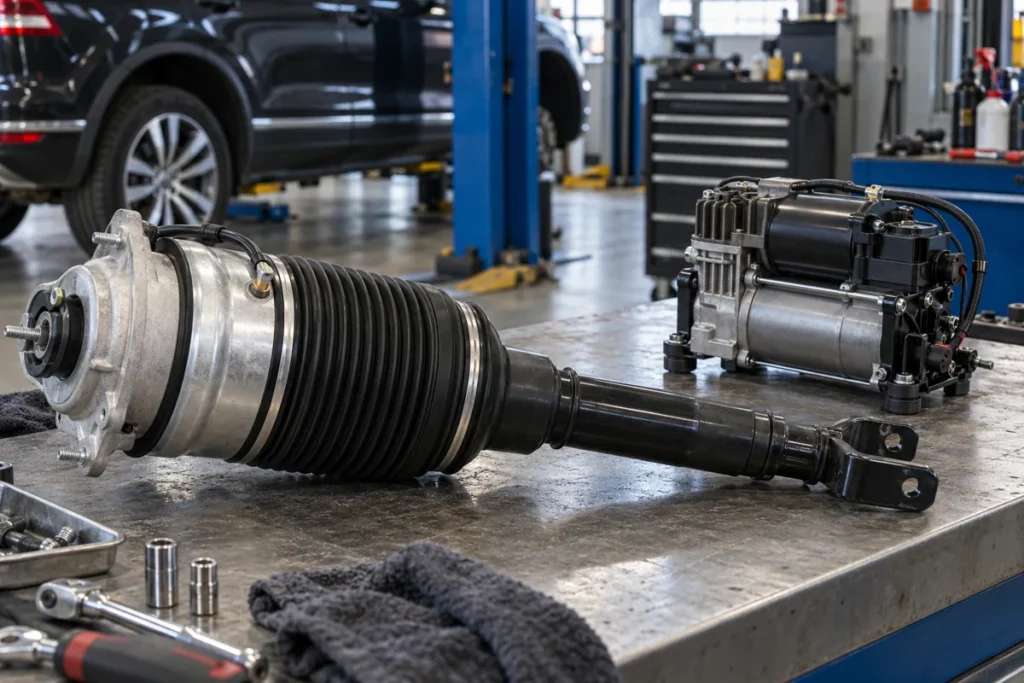
Some VWs, including many Touareg models and higher trims of Golf, Passat, Arteon and Tiguan, use DCC adaptive dampers. The Touareg can also have air suspension. These systems need different parts and checks.
- 1Identify the system
Passive, DCC or air suspension, confirmed from the VIN and equipment.
- 2Read the faults
Adaptive and air systems store faults for sensors, dampers and the compressor.
- 3Find the cause
An air leak, a failed compressor or a damper circuit fault each need a different repair.
- 4Set up
Ride height and system setup are completed with VW diagnostics after repair.
How is VW suspension inspected?
A proper suspension check looks at every part, not just the one that seems noisy.
-
Road test
Confirm the noise or feel, over bumps, in turns and under braking.
-
Bounce test
Check each corner settles quickly rather than bouncing on.
-
Lift inspection
Check shocks for leaks, springs for breaks and boots for damage.
-
Play check
Use a pry bar to check bushes, ball joints, links and track rod ends for movement.
-
Tyres and geometry
Read tyre wear and check whether alignment is needed after repair.
Heavy knocking, a sudden change in steering feel or a wheel that looks out of line can mean a failing ball joint or broken part. Drive slowly to safety and arrange an inspection before further driving.
How much does VW suspension repair cost in Dubai?
The cost depends on which parts are worn and the system fitted. These guide ranges come from our suspension service pages. They are alternatives, not one bill added together.
| Repair | Guide range | Notes |
|---|---|---|
| Control arm, one side | AED 900 to 1,800 | Bush and joint content depend on the arm |
| Shock absorbers, pair | AED 1,500 to 3,500 | Passive dampers on one axle |
| Air suspension strut, one | AED 2,500 to 4,500 | Where air suspension is fitted |
| Air compressor | AED 1,800 to 3,200 | After testing, leaks are separate |
| Wheel alignment after repair | AED 150 to 450 | Front or four wheel, when required |
Indicative ranges. DCC dampers are quoted by VIN. Model, parts choice and extra findings change the quote. Details are on our Volkswagen suspension repair page.
Replace only what has worn
Our Al Quoz 4 workshop road tests the car, checks every joint, bush, shock and spring, then explains which parts need replacing, with a written quote before work.
Suspension mistakes we see in Dubai
Most knocks are links, bushes or joints, not dampers.
A single new shock makes the axle uneven. Replace in pairs.
The settings will not hold if bushes or joints are loose.
A dry top mount bearing can damage the spring seat over time.
Fitting passive dampers to a DCC car causes faults and warnings.
Uneven tyre wear often reveals the worn part.
Tyre wear patterns are explained in our guide to uneven VW tyre wear, and alignment on our wheel alignment page.
Quick answers about VW suspension
How often should VW shocks be replaced? When an inspection shows leaking or weak damping, not at a fixed mileage.
What causes a knock over bumps? Usually drop links, control arm bushes, ball joints or top mounts.
Should shocks be replaced in pairs? Yes, on the same axle, so both sides behave the same.
Do I need alignment after suspension work? Often yes, especially after arm, strut or track rod work.
What does a pair of shocks cost? Our guide is AED 1,500 to 3,500 for passive dampers on one axle.
Key suspension terms explained
These are the parts and terms a technician will mention when explaining a suspension fault.
- Damping
- How well a shock controls spring movement. Weak damping lets the car bounce.
- Top mount
- The rubber and bearing at the top of a strut that lets it turn with the steering.
- Bush
- A rubber or rubber and metal mounting that lets an arm pivot while absorbing vibration.
- Ball joint
- A pivot joint linking the control arm to the wheel hub.
- Drop link
- A short link joining the anti roll bar to the suspension. A common source of knocks.
- DCC
- Dynamic Chassis Control, VW adaptive dampers that change stiffness electronically.
What we check before recommending suspension parts
Before any suspension part is quoted in our Al Quoz 4 workshop, we follow the same steps, so the repair matches the fault.
Every part, every corner
The noisy corner is not always the worn one.
-
We road test the car with you or from your description, noting the corner, speed and road surface.
-
We identify the suspension type, passive, DCC or air, from the VIN and equipment.
-
We inspect all four corners on the lift for leaks, breaks, cracked rubber and damaged boots.
-
We check every bush, joint and link for play, and the top mounts for noise and wear.
-
We explain what needs replacing now, what can wait and whether alignment is needed afterwards.
What to send before your visit
These details help us plan the inspection and give you an idea of the likely repair before the visit.
- Model, year and trim
- Which corner the noise seems to come from
- When it happens, bumps, turns or braking
- Whether the car bounces after bumps
- Any warning light on the dashboard
- Any recent kerb strike or pothole
- Whether tyres show uneven wear
- Whether DCC or air suspension is fitted
Send them on WhatsApp to 056 464 6081 and a technician will reply.
Questions about VW suspension replacement
When should I replace my VW suspension?
Replace suspension parts when an inspection shows they are worn, leaking, cracked or loose. Common signs are bouncing after bumps, nose dive when braking, knocks over bumps, vague steering and uneven tyre wear. There is no fixed mileage for every VW, because road use, heat and load all change how fast parts wear.
How do I know if my VW shocks are worn?
The car bounces more than once after a bump, dives under braking, leans more in corners or feels floaty at speed. Oil on the shock body is a clear sign. Uneven, scalloped tyre wear can also point to weak damping. A bounce test and lift inspection confirm it.
What is the difference between a shock absorber and a strut?
A shock absorber only controls spring movement. A strut combines the damper with the spring and top mount in one structural assembly that also locates the wheel. Most VWs use struts at the front, so a worn front strut can affect steering as well as ride comfort.
Why does my VW knock over speed bumps?
The most common causes are worn anti roll bar drop links, control arm bushes, ball joints or strut top mounts. A shock absorber can knock when badly worn, but it is less often the cause. A pry bar check on the lift shows which part has play.
Do I need to replace all four shocks at once?
Not always. Shocks should be replaced in pairs on the same axle, so the front or rear pair can be done separately. If the other axle checks good, it can stay. Replacing a single shock on its own leaves the car uneven from side to side.
Is it safe to drive with worn suspension?
Mild wear is not an emergency, but worn shocks lengthen braking distance and reduce grip, especially on uneven roads. A loose ball joint, broken spring or damaged arm is a safety risk and should be repaired before driving far. Get any heavy knock or sudden change in steering checked quickly.
Do I need a wheel alignment after suspension work?
Often yes. Replacing struts, control arms or track rod ends can change the wheel angles, and alignment checks them afterwards. Shock replacement on some rear setups may not need it. The workshop tells you whether alignment is required for the work done.
Can DCC dampers be replaced with standard shocks?
It is not recommended. DCC cars expect adaptive dampers and fitting passive units can trigger warnings and change how the car drives. The correct replacement is a compatible DCC damper, matched to the VIN and set up with VW diagnostics after fitting.
How much does VW suspension repair cost in Dubai?
Our guides are AED 900 to 1,800 for one control arm, AED 1,500 to 3,500 for a pair of passive shocks, AED 2,500 to 4,500 for one air strut and AED 1,800 to 3,200 for an air compressor. Alignment and DCC dampers are quoted separately after inspection.
Get your suspension checked in Al Quoz 4
Volkswagen Repair Dubai is an independent VW workshop in Al Quoz 4, open Monday to Saturday, 9am to 7pm. Tell us your model and what you feel or hear, and we will tell you what to check first.
See repair options and prices on our Volkswagen suspension repair page.
How this guide was written
Written by the Volkswagen Repair Dubai workshop team in Al Quoz 4 and reviewed by our technical team in October 2026. It is based on the suspension inspections we carry out on Volkswagen cars in Dubai and on Volkswagen owner information for passive, DCC and air suspension systems.
Prices are the indicative guide ranges published on our own service pages. They are planning figures, not fixed quotes, and the final price always follows an inspection of your car. We update this guide when our service pages or the manufacturer guidance changes.